thermodynamics
No description yet. This curated deck is ready for daily study.
Card preview (17)
define lattice enthalpy of dissociation/formation
lattice enthalpy of dissociation = when 1 mole of a solid ionic lattice is separated into its constituent gaseous ions lattice enthalpy of dissociation = when 1 mole of a solid ionic lattice is formed from its gaseous ions lattice enthalpy measures strength of ionic bonding
factors affecting size of lattice enthalpy
• ion size • ion charge • charge density = ion charge/ion size • the smallest ions with the biggest size have the highest charge density • the higher the charge density, the stronger the electrostatic attractions between oppositely charged ions
explain how ion size relates to charge in positive/negative ions
for negative ions: • size increases as charge increases because more e- than protons = • weaker electrostatic attraction between outer e- and positive nucleus • also increased e- repulsion between inner e- and added e- = bigger ionic radius for positive ions: • size decreases as charge increases because less outer e- than protons • stronger electrostatic attraction between positive nucleus and outer e- = decreased ionic radius
compare and explain lattice enthalpies of formation for MgO (-3512 kJmol-1) and MgCl2 (-2493 kJmol-1)
O2- ions smaller and has bigger charge than Cl- ion oxide ions have higher charge density than chloride ions stronger electrostatic attraction between Mg2+ and O2- tha between Mg2+ and Cl- more energy released when Mg2+ and O2- form ionic lattice than when Mg2+ and Cl- form ionic lattice MgO therefore has more exothermic lattice enthalpy of formation
enthalpy of atomisation
enthalpy change for the formation of 1 mole of gaseous atoms from its element in its standard state e.g 1/2 Br2 (l) → Br (g)
bond dissociation enthalpy
enthalpy change when 1 mole of covalent bonds is broken under standard conditions in the gaseous state e.g F2(g) →2F (g) bond dissociation enthalpy for diatomic molecules is twice the enthalpy of atomisation
first electron affinity
enthalpy change when 1 mole of gaseous atoms form 1 mole of 1- ions e.g. F(g) + 1e- →F- (g)
why is the second electron affinity positive
it is endothermic due to the repulsion between 1- ion and the negative e- being added
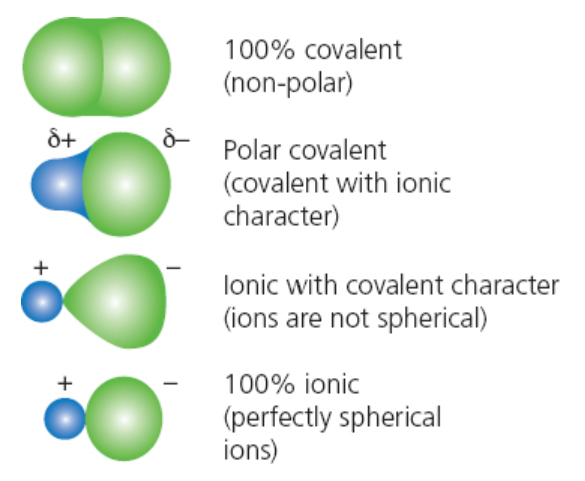
perfect ionic model
100% ionic bonding with 0% covalent character both ions are perfect spheres with no distortion
fajan’s rules
positve ions that are small and/or highly charged are good at polarising negative ions negative ions that are large and/or highly charged are easier to be polarised polarisation of negative ion results in ionic bonding having covalent character the larger the % diff between theoretical lattice enthalpy (which assumes 100% ionic bonding) and experimental lattice, the the more covalent character the ionic solid has due to more distorted,polarised negatice ions.
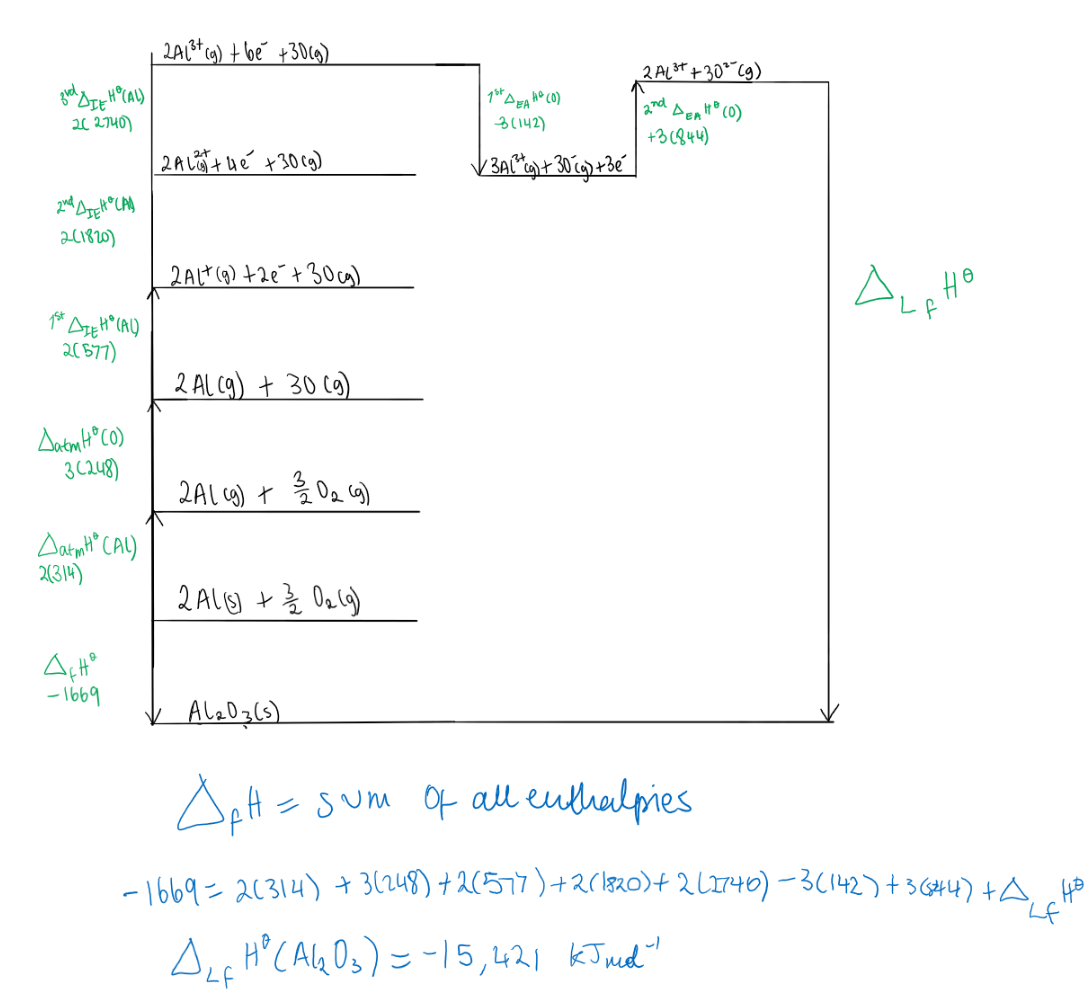
Born-Haber cycles calculate the lattice enthalpy of formation of aluminium oxide given that: ΔfHθ (Al2O3) = -1669 kJ.mol-1 Δ<span>atm</span>Hθ (Al) = 314 kJmol-1 Δ<span>atm</span>Hθ (O) = 248 kJmol-1 first ΔIEHθ (Al) = 577 kJmol-1 second ΔIEHθ (Al) = 1820 kJmol-1 third ΔIEHθ (Al) = 2740 kJmol-1 first ΔEAHθ (O) = -142 kJmol-1 second ΔEAHθ (O) = 844 kJmol-1
begin with elements in their standard states (these have energy zero) ↑ = positive enthalpy (Endothermic) ↓ = negative enthalpy (Exothermic) remember all enthalpies must be multiplied by the number of moles in the orginal chemical equation lattice enthalpy of formation of aluminium oxide given by the equation 2Al3+ (g) + 3O2-(g) → Al2O3 (s)
enthalpy of solution definition and equation
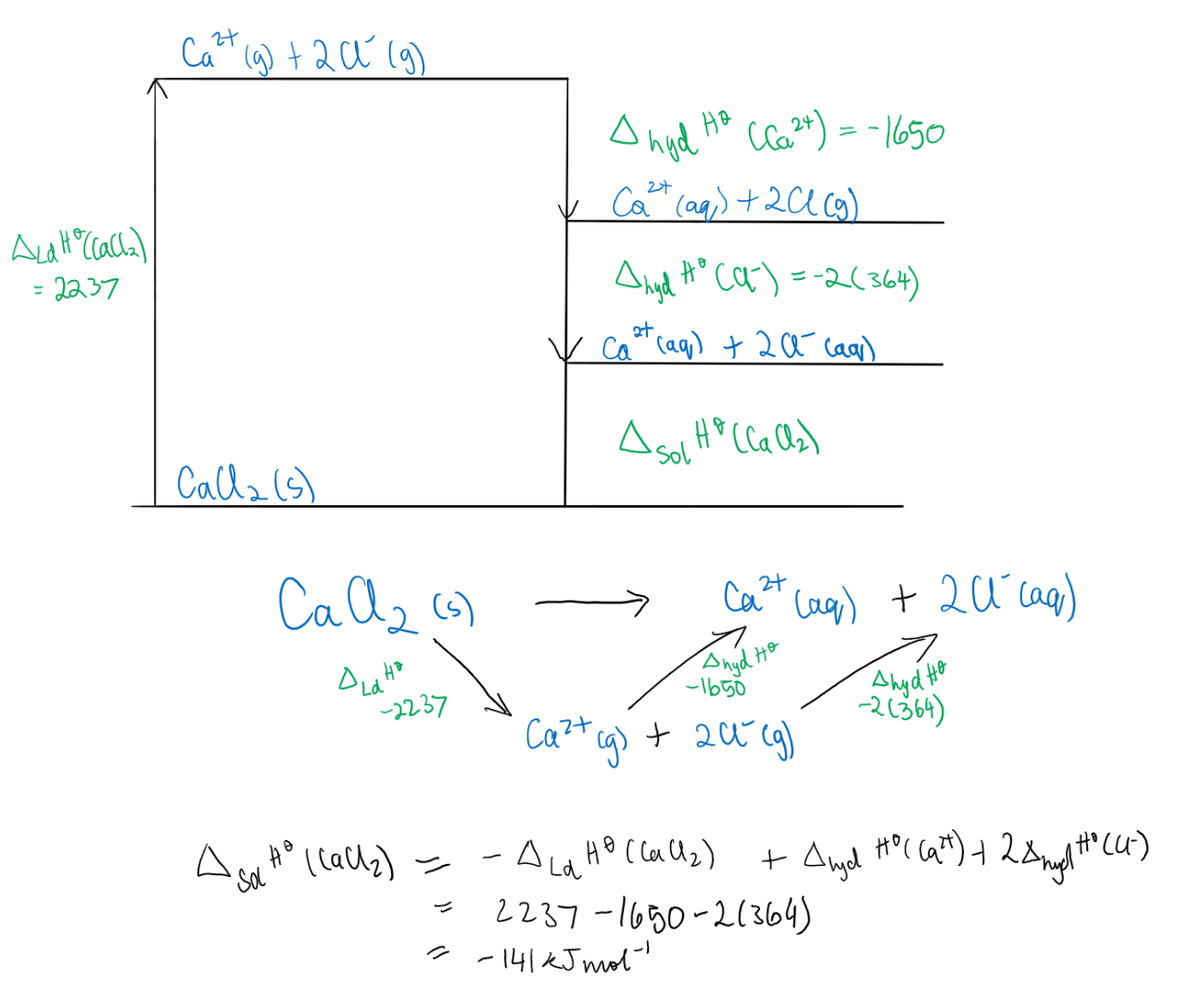
when 1 mole of a solid ionic lattice dissolves completely in large volume of water so that the dissolved aqueous ions are far enough apart to not interact e.g NaCl (s) → Na+(aq) + Cl-(aq) ΔsolHθ = ΔLdHθ +Σ ΔhydHθ(ions)
factors affecting hydration enthalpy
ion size and ion charge (charge density) the bigger the charge and the smaller the size = the higher the charge density = ion attracts 𝛿+ H/ 𝛿- O of water molecule more strongly = more exothermic hydration enthalpy
calculate enthalpy of solution for CaCl2 given that: lattice enthalpy of formation (CaCl2) = -2237 kJ mol-1 enthalpy of hydration Ca2+ = -1650 kJmol-1 enthalpy of hydration Cl- = -364 kJmol-1 use a born-haber cycle use Hess’ Law
first ionisation energy
enthalpy change when 1 mole of e- is removed from 1 mole of gaseous atoms to form 1 mole of gaseous 1+ ions
the lattice enthalpy of dissociation of CaO2 is 3513 kJmol-1 CaO2 is insoluble in water explain why
the enthalpy of dissociation is bery endothermic = strong electrostatic attraction between Ca2+ and O2- ions = large amount of energy required to form Ca2+ (aq) and O2-(aq)
how does covalent character affect the lattice enthalpy and MP of ionic compounds?
covalent chracter reduces the MP due to weaker IMF covalent bonds are stronger than ionic bonds so lattice enthalpy of formation will be more exothermic (more negative). lattice enthalpy of dissociation will be more endothermic (bigger)