NMR
No description yet. This curated deck is ready for daily study.
Card preview (24)
What does NMR Stand For?
Nuclear Magnetic Resonance
Explain The Principles of How NMR Works (5)
Nuclei with Spin produce weak magnetic fields NMR fires out EM (radio) waves at a specific frequencies The Nuclei with spin that are parallel with the larger magnetic Field absorb the energy and flip to the higher energy level and are now anti-parallel with the larger magnetic field This Energy Change can be monitored and recorded
An Nucleus has spin when ……
The atomic nucleus has a odd number of nucleons -NMR only works with nucleons with uneven nucleons
How would you carry out NMR spectroscopy? (7)
Dissolve liquid sample in a suitable solvent place dissolved sample along with a small amount of TMS inside a tube put the tube into the NMR machine zero the spectrometer against the value read for TMS The sample is spun to even out ant imperfections in the magnetic field Radiation with different radio frequencies but a constant magnetic field is applied to the sample any absorbtions due to resonance are detected and plotted
Name a use of NMR
MRI scans
What kind of Nuclei does NMR work with? Provide Examples
(protium) H-1 & C-13 Those Nuclei with an uneven number of nucleons
What defines the resonant frequency of a C-13 atom (What affects the chemical shift of an NMR)
• The chemical environment it is in -The amount of electron shielding it has
What type of graph is produced by NMR
Energy absorbed against Chemical shift
What is Chemical Shift? What are its units?
The Resonant frequency of the nuclei compared to that of a H-1 atom in TMS Parts per million (ppm)
What is the range of Chemical shift for C-13 NMR?
0-200 ppm
What does it mean when C-13 atoms show a different chemical shift value?
Having different chemical environments
What kind of environment leads to a greater chemical shift? (C-13)
When a carbon atom is adjacent to a more electronegative atom/portion (such as C=C, or -Br)
Why is it easier to get a spectrum of H-1 NMR then C-13 NMR
Most atoms that are Hydrogen are protium (H-1) so most have Nuclear spin that can be recognised by NMR Much more abundant then C-13 relative to C-12
What is the Range of Chemical Shift for H-1 NMR
0-10 ppm
What leads to a smaller chemical shift value for H-1 NMR
H-1 with a greater amount of electrons surrounding them • Further away from electronegative groups/atoms Hydrogens resonate more like a hydrogen atom in TMS
On a low resolution spectrum What peaks you would expect to see for H-1 NMR
One peak for each set of inequivalent H-1 Atoms (each chemical shift environment shows 1 peak)
What does the area below a peak representation in H-1 NMR
The area below the peak is proportional to the number of H-1 atoms causing the peak Integration Trace
What is the Integration Trace
A Line located above a graph of H-1 NMR That is equal to the area below the graph at every value of Chemical shift Easier to measure the relative abundance of H-1 atoms within each environment
What is TMS Name? Structure?
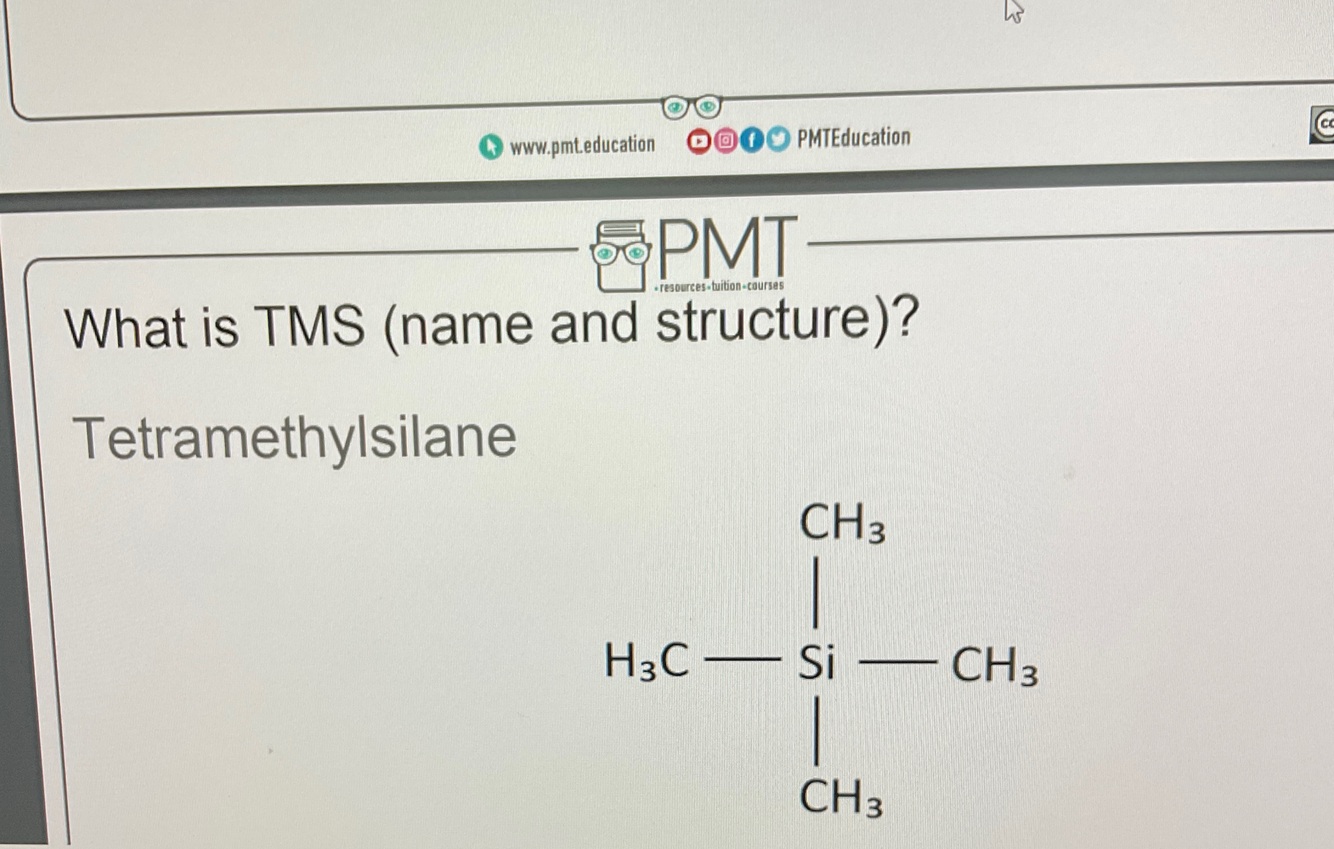
What state is TMS at room Temperature
Liquid
Why is TMS Used?
Inert, non toxic and easy to remove form sample Provides a peak at 0 ppm Used as a reference point so that every chemical shift caused by an environment is measured comparatively to it
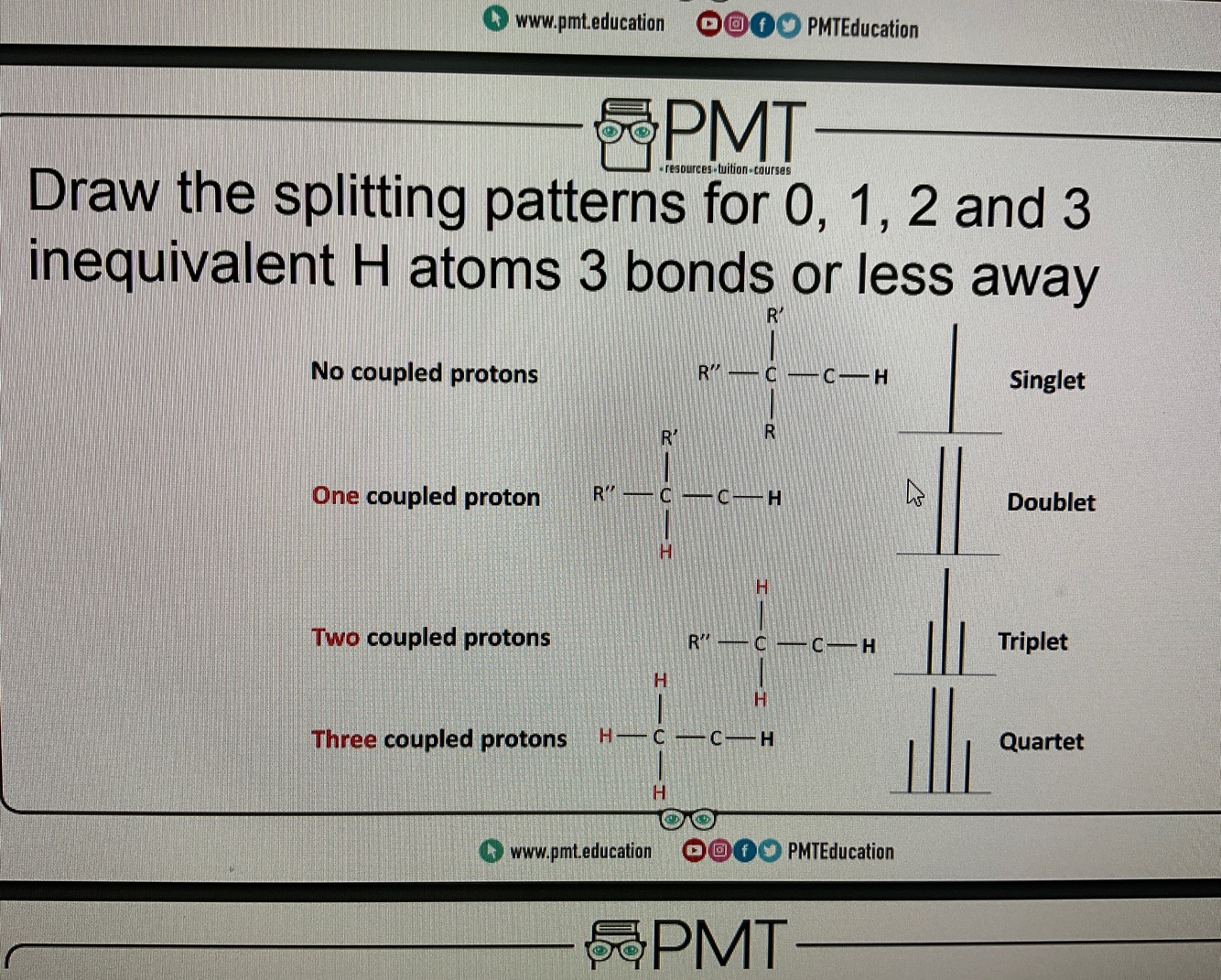
When does Splitting coupling occur?
Neighbouring hydrogen atoms (3 or fewer bonds away/ on an adjacent carbon atom) affect the magnetic field of H-1 atoms. Causing their Peaks to split
What is the N+1 rule?
If there are n inequivalent H-1 Atoms on the adjacent carbon then the peaks will be split into n+1 peaks of varying sizes