Electronic States
No description yet. This curated deck is ready for daily study.
Card preview (24)
The interaction that mixes a ground state into a particular excited state must transform as the_______.
Direct product of the symmetry of the two states. Γgs ⊗ Γex (First step in determining if spin-orbit coupling mixes an excited state into an ground state.)
Relaxation of an excited state to a ground state that emits a photon without a change in spin multiplicity.
Fluorescence
This process occurs when an excited molecule or atom relaxes to a lower energy state (possibly the ground state) through emission of a photon.
Luminescence
Relaxation of an excited state to a ground state that emits a photon with a change in spin multiplicity.
Phosphorescence
A process where there is a conversion between electronic states of different multiplicity.
Intersystem Crossing
In order that the spin-coupling operator mix a ground state into a particular excited state, what is required?
• The energy difference between the two states must be small • The direct product of the two states must contain the irreducible representation of the spin-coupling operator.
A phenomenon that arises in paramagnetic systems with multiple unpaired electrons (i.e., S > 1/2) as a result of both spin–spin coupling (SSC) and spin–orbit coupling (SOC) interactions
Zero-field splitting
The spin-orbit coupling operator directly splits the degeneracy of a group state without resorting to a distortion.
In-state orbital angular momentum
When the spin-orbit coupling operator cannot split degeneracy of a state and requires coupling to a low lying excited state and a molecular distortion.
Out-of state orbital angular momentum
The interaction between electronic and nuclear vibrational motion that leads to d-d transition becoming more Laporte allowed
Vibronic Coupling
A type of electronic transition that involves a transition from metal dominated MOs in the ground state to ligand dominated MOs in the excited state.
Metal-Ligand Charge Transfer
A type of electronic transition between two metal sites differing only in oxidation state
Intervalence charge transfer
A type of electronic transition that involves a transition from ligand dominated MOs in the ground state to metal dominated MOs in the excited state
Ligand-Metal Charge Transfer
What non-radiative exchange mechanism is shown below?
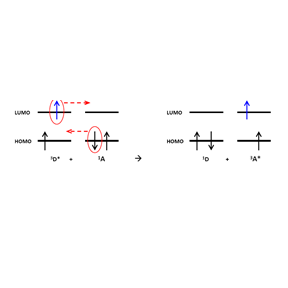
Triplet-Triplet Dexter Energy Transfer
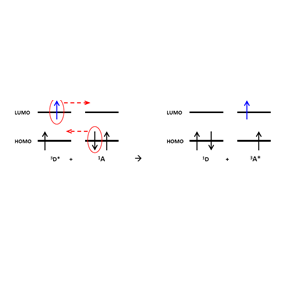
What non-radiative exchange mechanism is shown below?
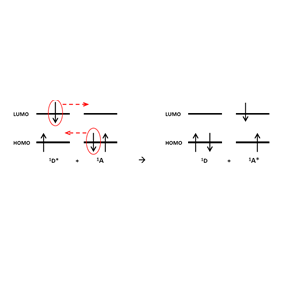
Singlet-Singlet Dexter Energy Transfer
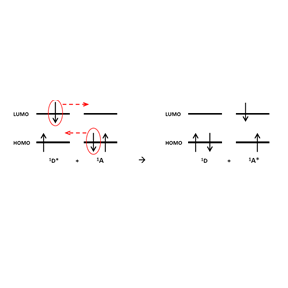
What non-radiative exchange mechanism is shown below?
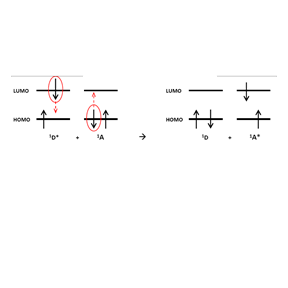
Singlet-Singlet Foster Energy Transfer
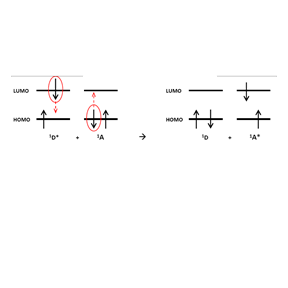
The characteristic of f-f transitions in Lanthanide:
• Characteristic wavelengths • Narrow line widths • Millisecond lifetimes (Long lifetimes) • Laporte forbidden
Which electronic transition will have the higher value of epsilon in the d2 metal complex? 4A2g —-> 2Eg 4A2g —-> 4T2g
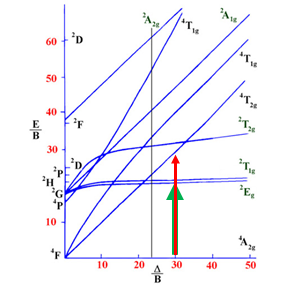
4A2g —-> 4T2g 4A2g —-> 2Eg is spin forbidden
Electronic transitions between states with different spin multiplicities.
Spin Forbidden
How does the spin-orbit coupling operator transform in a particular point group?
Rx Ry Rz (infinitesimal rotations)
How many microstate does the 3F term symbol contain?
21 —————————————————————– F —> L=3 —> 2*(3)+1=7 7*3=21
The degeneracy of the |Ms> sublevels of the ground state is lifted in the absent of a magnetic field.
Spin-Orbit Coupling
Ground state will have the _____spin multiplicity.
Largest If thesame spin multiplicity, then the GS will have the highest value of L.
In Oh and D4h , all d orbitals are gerade and so too are the states arising from their d configurations. Thus, their electronic transitions between them are________.
Laporte Forbidden