ChemPath: Sodium and Fluid Balance
No description yet. This curated deck is ready for daily study.
Card preview (24)
Which hormone controls water balance?
ADH (vasopressin)
Describe how ADH controls water balance.
ADH is released from the posterior pituitary gland. It acts on V2 receptors on collecting ducts causing insertion of aquaporin-2 water channels. This causes increased water reabsorption.
What receptors may ADH (Vasopressin) work on?
V1 receptors: • On vascular smooth muscle • Causes vasoconstriction • This occurs at higher concentrations V2 receptors: • On kidneys • Insertion of aquaporin-2 channels on collecting ducts
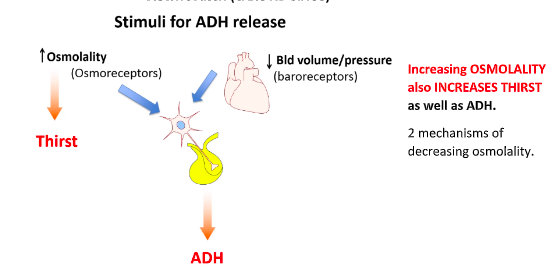
What are the two main stimuli for ADH secretion?
• Serum osmolality - mediated by hypothalamic osmoreceptors • Blood volume/pressure - mediate by baroreceptors in carotids, atria and aorta
What is the first step in the clinical assessment of a patient with hyponatraemia?
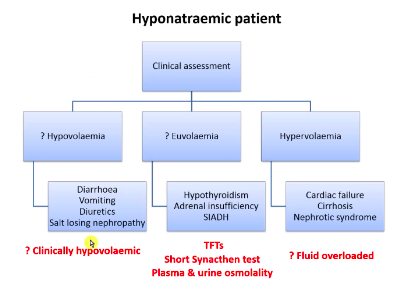
• True hyponatraemia? Serum osmolality *Clinical assessment of volume status • Look at hands • Head and neck • Peripheries
What are clinical signs of hypervolaemia?
• Raised JVP • Peripheral oedema • Bibasal crackles (on chest examination)
What makes urine sodium uninterpretable?
Diuretics - these alter the kidney’s ability to retain salt. Must stop it and check 48 hours after.
What are causes of hypovolaemia?
• Diarrhoea • Vomiting • Diuretics • Salt losing nephropathy
What are causes of hypervolaemic hyponatraemia?
• Heart failure • Cirrhosis • Nephrotic syndrome
What are causes of hyponatraemia in a hypovolaemic patient?
• Renal: diuretics • Extra-renal: diarrhoea, vomiting
What the causes of hyponatraemia in a hypervolaemic patient?
• Cardiac failure • Cirrhosis • Renal failure
What are causes of hyponatraemia in a euvolaemic patient?
• Hypothyroidism - due to reduction in CO detected by baroreceptors leading to ADH secretion • Adrenal insufficiency - cortisol needed for water excretion, aldosterone needed for sodium and water retention. • SIADH
What are the causes of SIADH?
• CNS pathology • Lung pathology • DRUGS (SSRI, TCA, opiates, PPIs, carbamazepine) • Tumours • Surgery
What investigations would you order in a patient wih euvolaemic hyponatraemia?
• Hypothyroidism: Thryoid function tests • Adrenal insufficiency: Short synacthen test • SIADH: Plasma and urine osmolality (low plasma & high urine osmolality)
Will osmolality of plasma and urine be high or low in SIADH?
Plasma osmolality - LOW Urine osmolality - HIGH (>100)
What does a diagnosis of SIADH require?
• No hypovolaemia • No hypothyroidism • No adrenal insufficiency • Reduced plasma osmolality • Increased urine osmolality (>100)
How would you manage a hypovolaemic patient with hyponatraemia?
Volume replacement with 0.9% saline - this removes the stimulus for ADH secretion
How would you manage a hypervolaemic patient with hyponatraemia?
Fluid restriction and treat the underlying cause. Do NOT give saline as the patient will just hold onto the water and exacerbate the hyponatraemia → giving saline won’t address the issue causing ADH secretion if it’s a tumour etc.
How would you manage a euvolaemic patient with hyponatraemia?
Fluid restriction and treat the underlying cause (same as hypervolaemic patient with hyponatraemia)
What are clinical symptoms of severe hyponatraemia?
• Reduced GCS • Seizures Seek expert help (treat with hypertonic 3% saline)
How is severe hyponatraemia managed?
Can give boluses of hypertonic 3% saline but only if patient has low GCS or fitting. DO NOT GIVE 3% saline if alert and orientated.
What is an important point to remember while correcting hyponatraemia?
To avoid central pontine myelinolysis, sodium should not be corrected faster than 0.5 mmol/L/hr unless patient is seriously symptomatic (or more than 8-12mmol/L in 24 hours) • Risk of osmotic demyelination (central pontine myelinolysis) • Presents a few days later with quadriplegia, dysarthria, dysphagia, seizures, coma, death
What drugs are used to treat SIADH?
If water restriction is insufficient: • Demeclocycline • Tolvaptan
How does Demeclocycline work?
• Reduces responsiveness of collecting tubule cells to ADH • Need to monitor U&Es (risk of nephrotoxicity)