Kinetic molecular theory and changes of state (pre-IB)
No description yet. This curated deck is ready for daily study.
Card preview (24)
What is the Kinetic Molecular Theory of matter?
A model that explains the physical properties of solids, liquids, and gases, and changes of state, based on: energy, arrangement and motion of particles - All matter is made of particles in constant motion. - Particle energy depends on absolute temperature (Kelvin). - Changes of state occur when particle energy changes. - The average space between particles increases from solid → liquid → gas. - Attractive forces between particles strengthen as they get closer.
What are the three types of molecular motion?
• Translational – particle moves from one location to another (gas & liquid; absent in solids). • Rotational – particle spins about its center of mass. • Vibrational – atoms within a molecule oscillate around their equilibrium positions (present in all states).
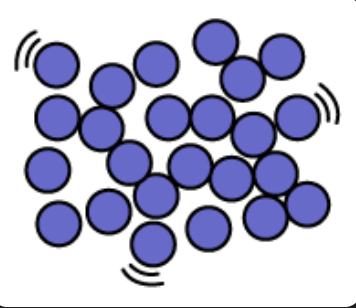
Describe the particle arrangement, shape, motion, and properties of gases.
• No fixed shape or volume; expands to fill container. • Particles widely spaced, randomly arranged. • Negligible intermolecular forces; particle volume negligible compared to container volume. • Can be compressed easily due to the large space between particles • Rapid, random translational motion → diffusion occurs. • Low density, highest particle energy of all three states • Particle motion causes collisions, which generate pressure
Describe the particle arrangement, motion, and properties of solids.
• Fixed shape & volume. • Particles closely packed in a regular, ordered lattice. • Held in fixed positions by strong intermolecular forces. • Only vibrational motion (no translational velocity), they do not move around • High density, lowest particle energy of all three states.

Describe the particle arrangement, motion, and properties of liquids.
• Fixed volume, takes shape of container. • Particles close together but randomly arranged. • Held by intermolecular forces but can slide past each other (translational velocity present → diffusion possible). • particles have more energy than solids but less than gases • Medium density, intermediate particle energy.
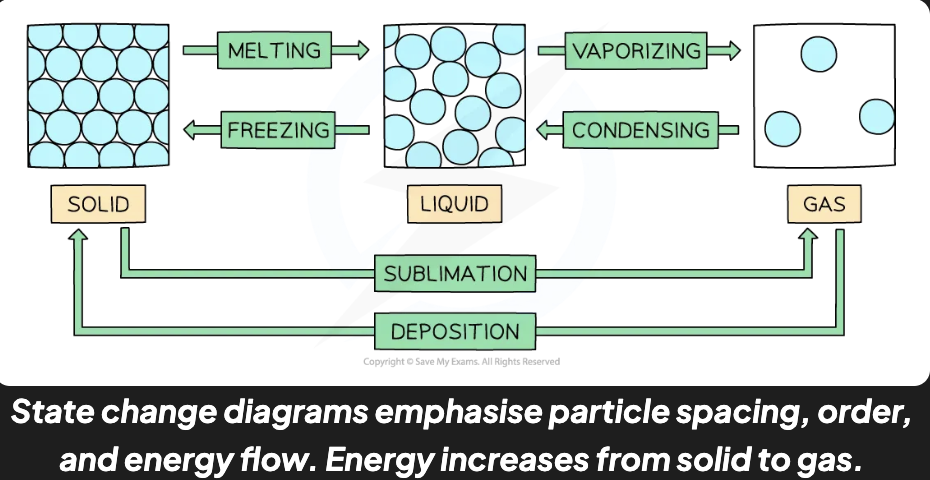
Name and define the six changes of state.
State changes are physical changes and are reversible They involve energy transfer but do not alter the chemical identity of the substance - Melting: solid → liquid (endothermic). - Freezing: liquid → solid (exothermic). - Vaporisation: liquid → gas (endothermic), includes: - Boiling – throughout liquid at boiling point. - Evaporation – surface process below boiling point. - Condensation: gas → liquid (exothermic). - Sublimation: solid → gas (endothermic). - Deposition: gas → solid (exothermic).
Define “phase” vs. “state” of matter.
• State – broad classification: solid, liquid, gas (and plasma). • Phase – region with uniform composition and properties; a system can have multiple phases in the same state (e.g., oil and water are two liquid phases).
What happens at the particle level during melting?
• Temperature increases until particles vibrate enough to overcome lattice forces. • At melting point, temperature stays constant while energy (enthalpy of fusion) breaks intermolecular bonds. • vibrations are sufficiently energetic for • After all solid melts, temperature rises as kinetic energy increases.
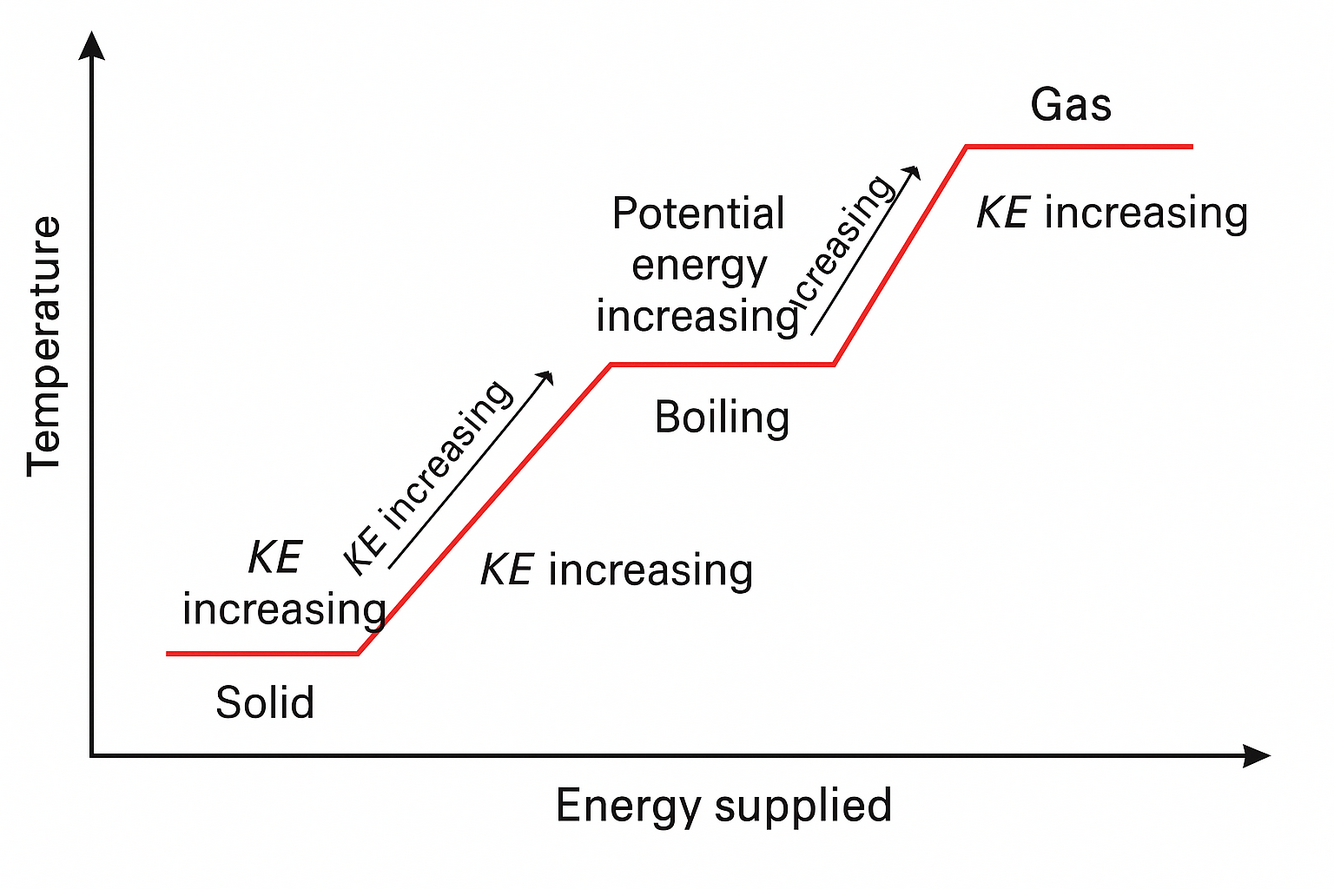
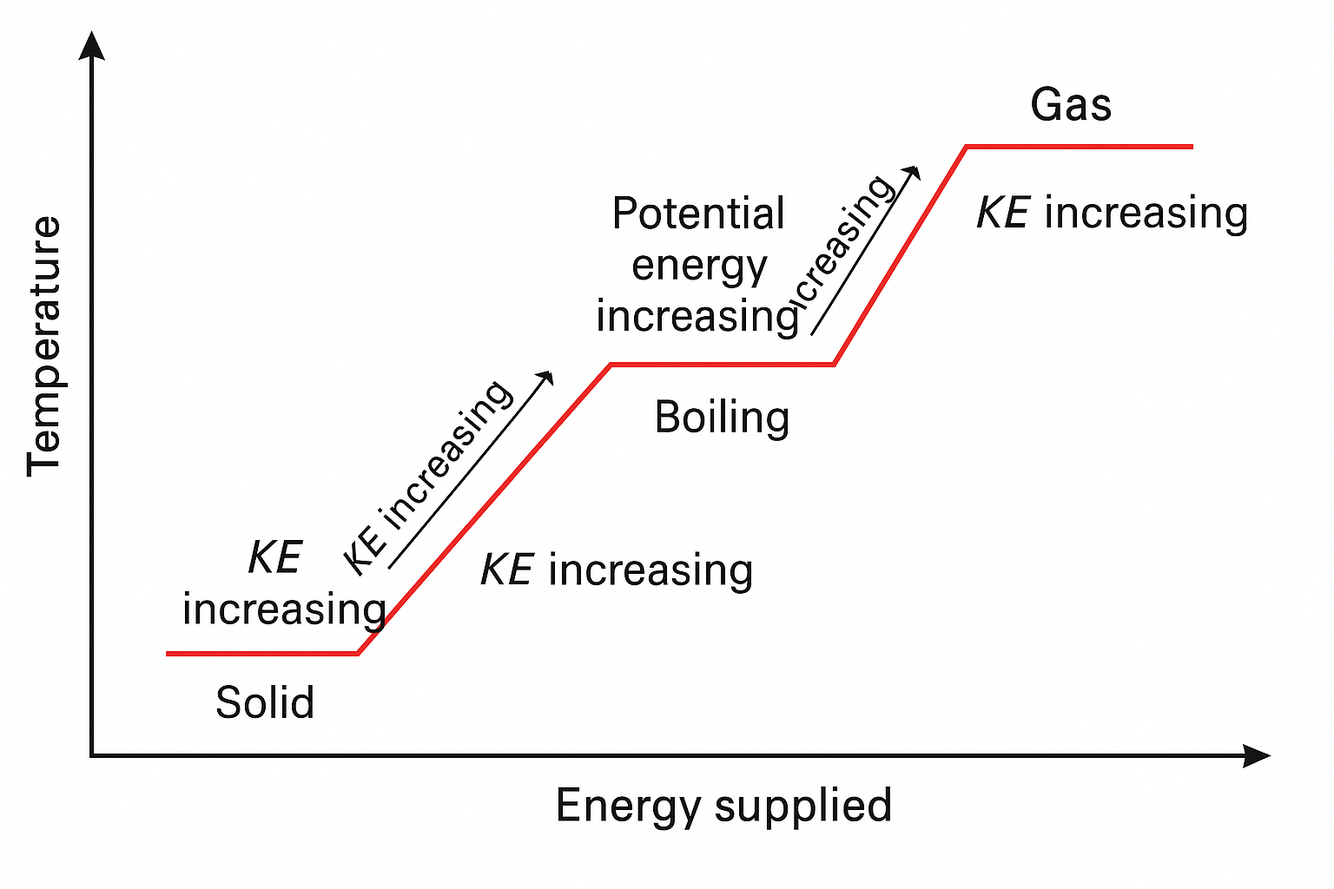
Why is temperature constant during melting and boiling?
Energy supplied is used to overcome intermolecular forces (potential energy change) rather than increase kinetic energy.
What are endothermic and exothermic changes of state?
Endothermic (energy absorbed): melting, vaporisation, sublimation — energy used to overcome intermolecular forces. Exothermic (energy released): freezing, condensation, deposition — energy released as particles come closer.
What happens at the particle level during boiling?
• Temperature rises until vapour pressure = external pressure. • At boiling point, temperature remains constant while energy (enthalpy of vaporization) overcomes intermolecular forces. • After all liquid becomes gas, temperature rises as kinetic energy increases.
Define vapour pressure and boiling point.
Vapour pressure: Pressure exerted by a vapour in equilibrium with its liquid at a given temperature. Boiling point: Temperature at which vapour pressure equals external pressure.
How do pressure and intermolecular forces affect boiling point?
• Lower external pressure → lower boiling point (e.g., high altitude). • Higher external pressure → higher boiling point. • Stronger intermolecular forces → higher boiling point.
State the Kelvin–Celsius conversion formulas.
• T(K)=T(°C)+273.15 • T(°C)=T(K)−273.15 • Kelvin is proportional to average kinetic energy; absolute zero (0 K) = no particle motion. At the same temperature, all gases have the same average kinetic energy, but: • Lighter gases move faster • Heavier gases move slower
What is evaporation, and why does it cause cooling?
• Surface particles with highest kinetic energy escape into vapour phase below boiling point. • Removes higher-energy particles → lowers average kinetic energy → temperature of liquid decreases.
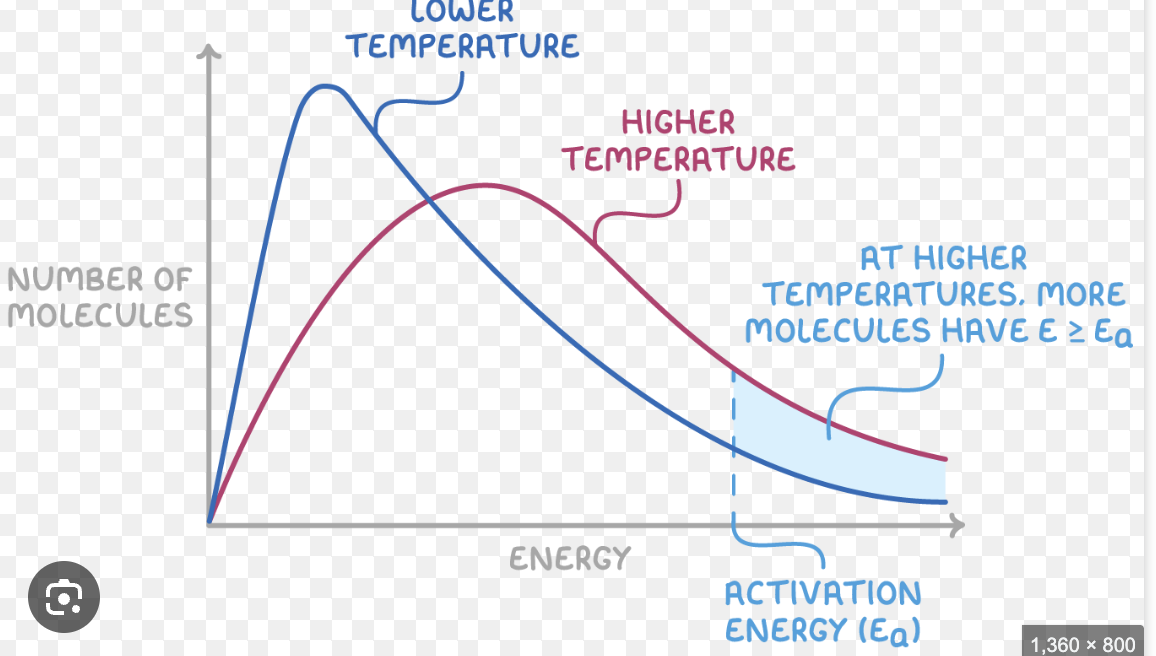
What is the Maxwell–Boltzmann distribution, and how does it change with temperature?
• Shows spread of particle speeds in a sample. • Not all particles have the same velocity; curve area = total particles (constant). • Higher temperature → curve flattens & shifts right → more high-energy particles. • At higher T, more particles exceed activation energy, increasing rate of evaporation/boiling.
State the kinetic energy formula for a particle.
KE= 1/2 mv^2 where m = particle mass, v = translational velocity.
According to kinetic theory, how is temperature related to average kinetic energy?
AverageKE∝T(K). - At the same temperature, all gases have the same average KE. - Lighter gases have higher average velocities; heavier gases have lower velocities.
Compare evaporation and boiling.
Evaporation: surface process, any temperature below boiling point, slower, only high-energy particles escape. Boiling: occurs throughout liquid, at boiling point, rapid, all particles have enough energy to overcome intermolecular forces.
Why does water boil at 71 °C on Mount Everest?
Atmospheric pressure is lower (~3.4 × 10⁴ Pa), so vapour pressure of water equals external pressure at a lower temperature.
On a heating curve, what happens to particle motion and spacing in: (a) solid heating, (b) melting, (c) liquid heating/evaporation, (d) boiling, (e) gas heating?
(a) Vibrations increase, spacing constant. (b) Forces overcome, spacing increases, motion changes from vibration to translation. (c) Translational motion increases, spacing slightly increases. (d) Forces between particles broken, large increase in spacing. (e) Rapid translational motion increases further, spacing very large.
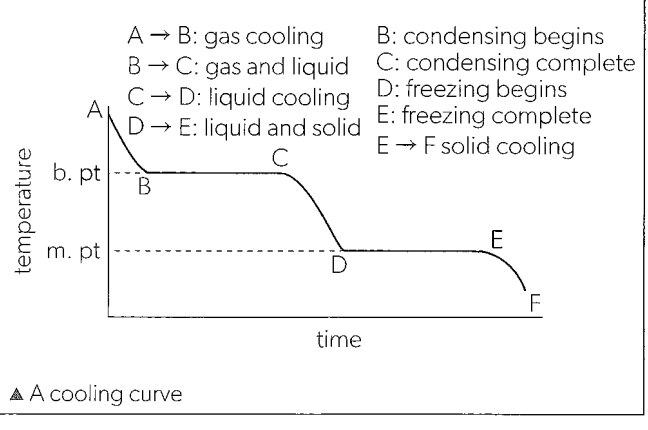
Cooling Curve: Why is temperature constant during condensation and freezing?
Heat is released as particles come closer together and form intermolecular bonds, decreasing potential energy without changing average kinetic energy.
Heating Curve: Why is temperature constant during melting and boiling?
During these phase changes, heat energy is used to overcome intermolecular forces (increase potential energy), not to increase kinetic energy. Average particle speed stays the same until the change is complete.
Maxwell–Boltzmann: How does increasing temperature change the curve?
Curve flattens and shifts right → more particles have high kinetic energy above the activation energy threshold, increasing evaporation and reaction rates.