25.1 Introducing Benzene
No description yet. This curated deck is ready for daily study.
Card preview (6)
What is the formula of benzene?
C6H6
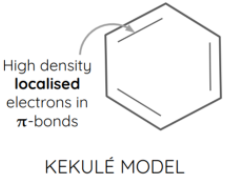
Draw & label the Kekulé model of benzene:
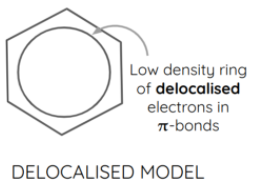
Draw the delocalised model for benzene:
What is the difference between the Kekulé & delocalised model of benzene?
• In delocalised model, electrons are delocalised in a ring. • In Kekulé model, electrons are localised in pi-bonds
Describe & explain the evidence which disproves the accuracy of the Kekulé model:
• LACK OF REACTIVITY • Since benzene contains double bonds, it should undergo electrophilic addition with bromine & decolourise bromine water. • However, benzene does not decolourise bromine water. • BOND LENGTH • Every carbon-carbon bond in benzene are longer than C=C but shorter than C―C • but in Kekulé model, alternating single & double bonds suggests that bond length alternates. • HYDROGENATION ENTHALPIES • Since benzene is depicted to have 3 double bonds, it should have the hydrogenation enthalpy of 3x that of cyclohexene. • However, actual hydrogenation enthalpy is less exothermic than expected. • therefore actual structure of benzene is more stable than Kekulé model.
Describe the bonding within the delocalised model of benzene:
• Each carbon has 1e- in p-orbital at right angle to plane • Adacent p-orbitals overlap above + below the plane • Creates system of pi bonds spread over 6 carbons • forms ring of delocalised electrons • consists of 6e-