Lecture 14 - Electrophilic carbonyls 1
No description yet. This curated deck is ready for daily study.
Card preview (19)
Name these reactions: 1. carbonyl + H2O 2. carbonyl + R-OH 3. Carbonyl + amine
• hydration • ketal/acetal • condensation
Draw the general mechanism for a hydration reaction of carbonyls- use a ketone.
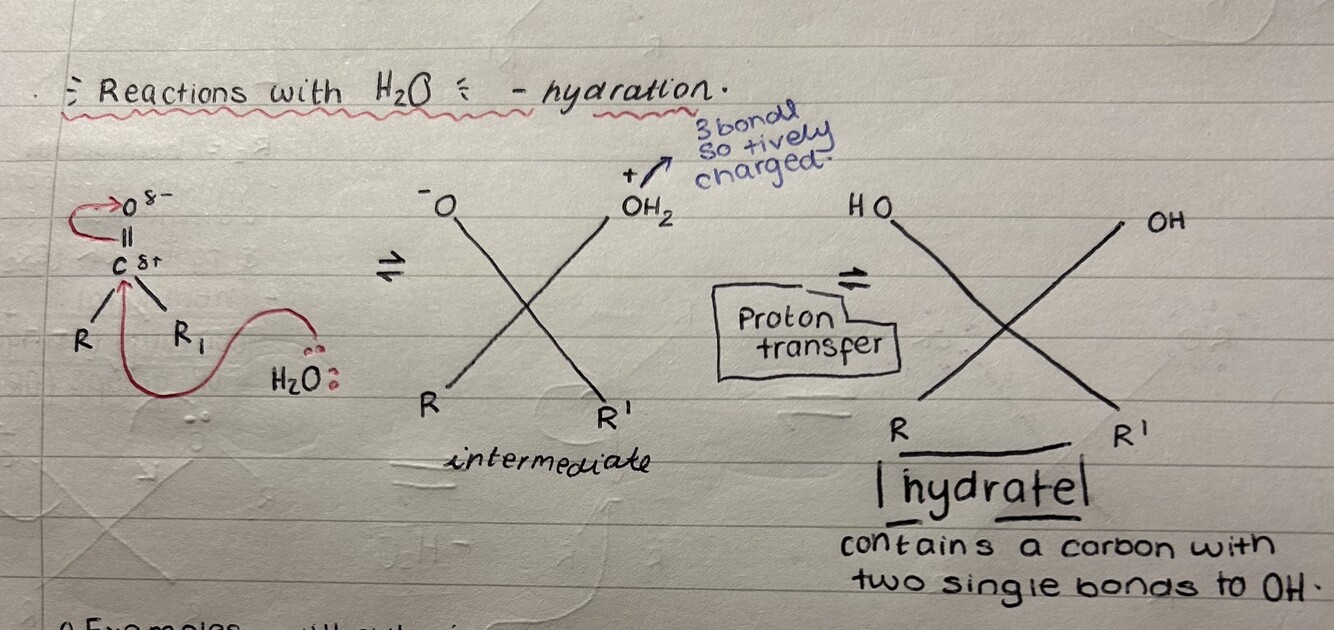
What do we call the product of a carbonyl compound reaction with water? All of these products contain…
hydrate All hydrates contain a carbon with two single bonds to OH.
Write the general equations for the reaction of…. 1. ketone 2. aldehyde (formaldehyde) … with water (hydration reaction) Give the minor and major species in both reactions.
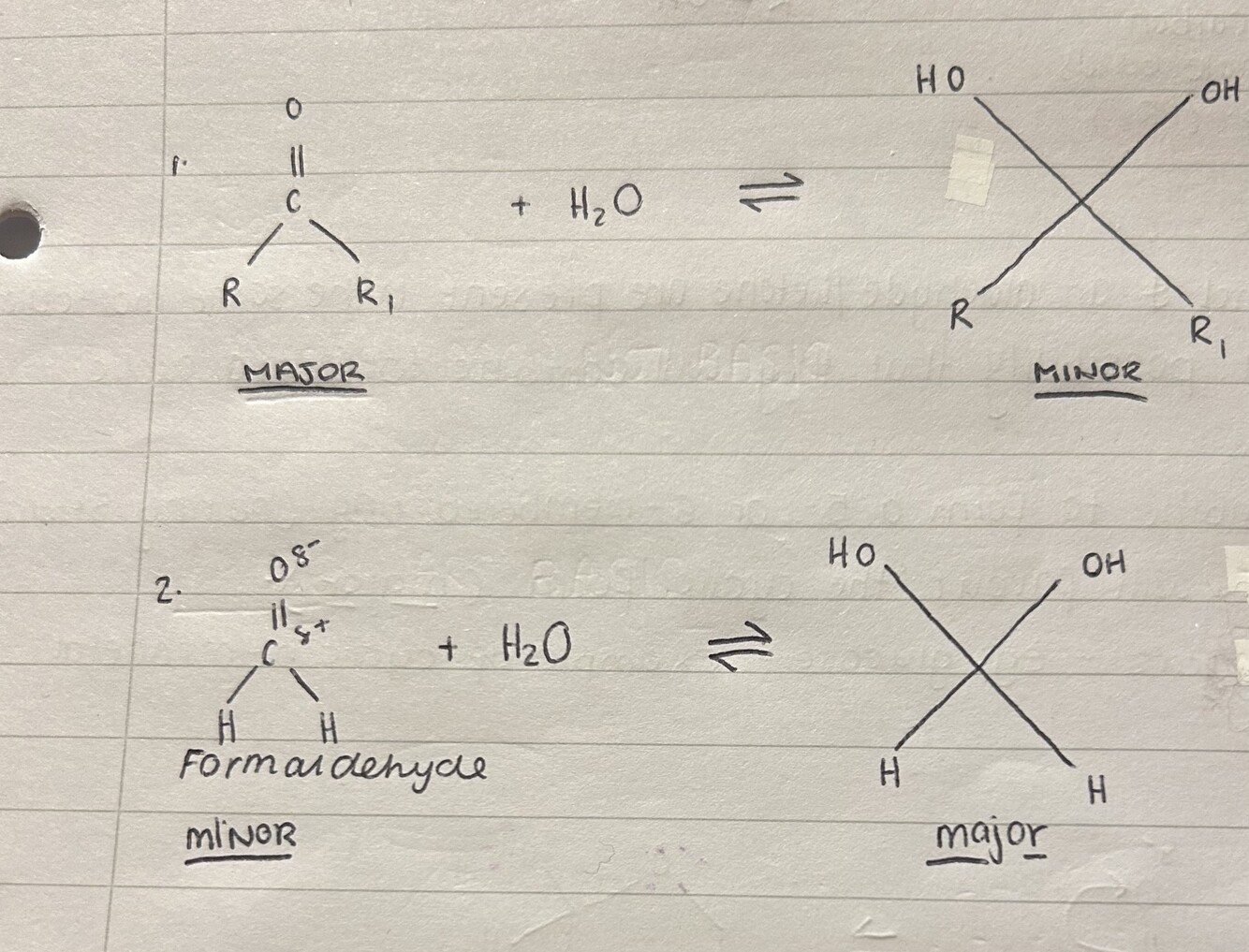
Why is the major the reactant ketone in the hydration reaction of ketone (reaction favours the reverse reaction), and the major the product in the hydration reaction of aldehydes (favours forward reaction)?
• aldehydes are more reactive than ketones. • the alkyl groups in ketones push electron density onto the partially positive carbon atom in the C=O group. This makes the partially positive carbon less electrophilic. • aldehydes have a more polar C=O bond than ketones- less of the inductive effect. • This makes the carbon more electrophilic in aldehydes than ketones so aldehydes are ore reactive.
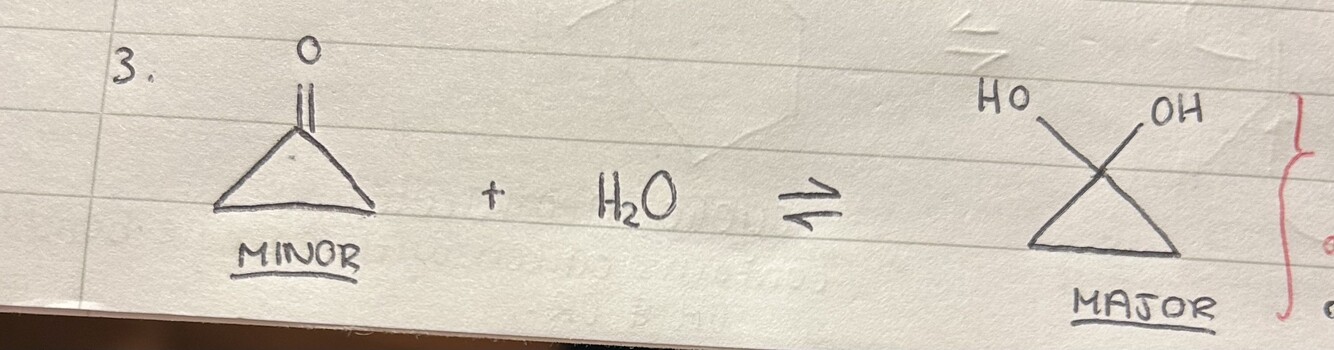
Write the hydration reaction of cyclopropanone. Why is the position of equilibrium sat on the right/ why does it favour the forward reaction?
The cyclopropanone has more ring strain than the product. Bond angle of 60. However, it is sp2 hybridised so wants a bond angle of 120. The product bond angle = 109.5- this is much closer to the desired 120. The product is more stable with less ring strain so the forward reaction is favoured.
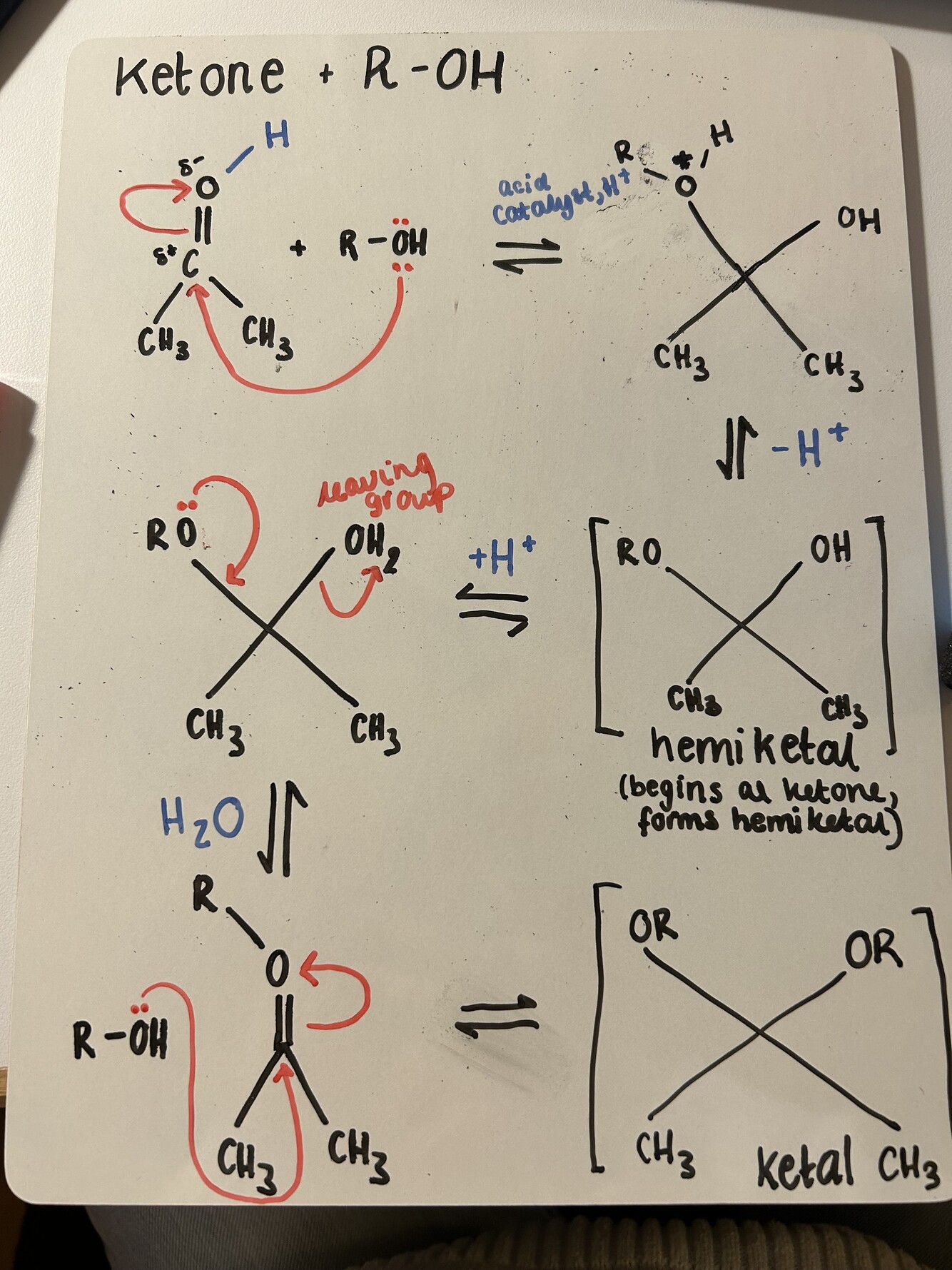
Draw the general mechanism of a ketone (propanone) with R-OH group. Label which is the hemiketal and ketal
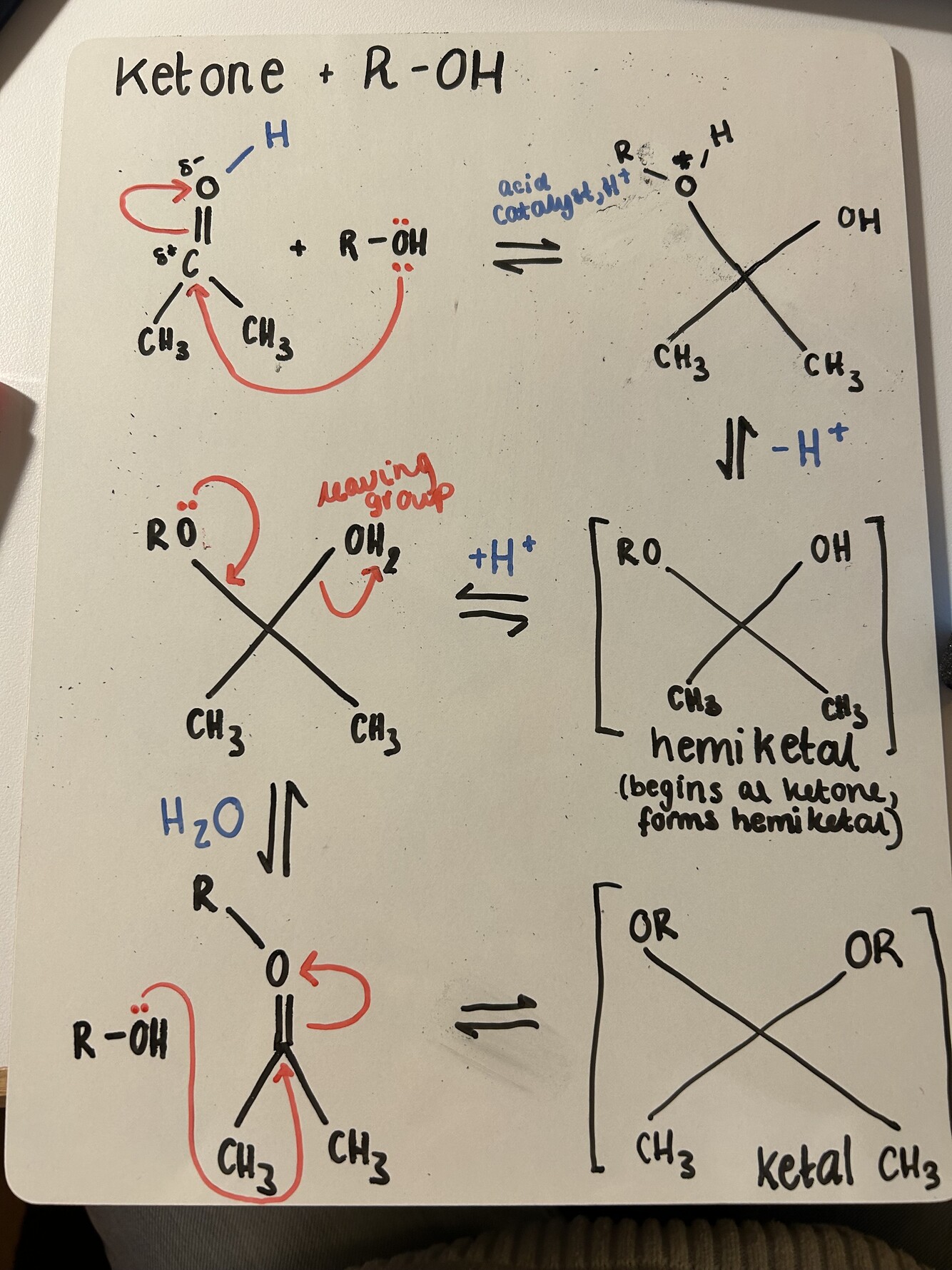
Difference between a ketal and hemiketal
Hemiketal has a carbon bonded (single bonds) to an OR and OH. Ketal has a carbon bonded (single bonds) to 2 OR groups.
Draw the mechanism of an aldehyde- ethanal with an R-OH group. Label which is the hemiacetal and the acetal.
Difference between acetal and hemiacetal
Hemiacetal has a carbon bonded to an OR and OH - single bonds Acetal has a carbon bonded two two OR groups (single bonds)
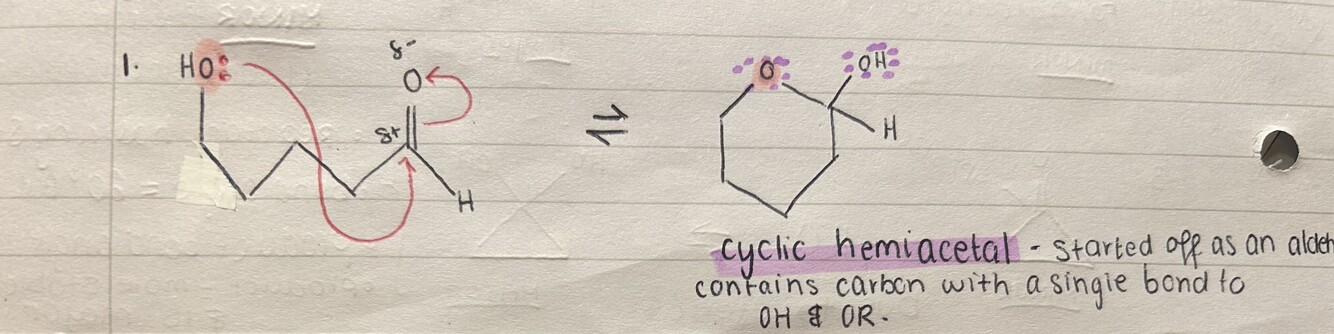
If an alcohol and an aldehyde/ketone are present in the same molecule, there is a possibility the groups will react to form….
hemiacetal/hemiketal.
If an alcohol and an aldehyde/ketone are present in the same reaction and they react and form a ring, the equilibrium will favour the forward reaction/cyclic form IF…..
a 5 or 6 membered ring is formed- no ring strain.
Give an example of a common group of compounds which are examples of cyclic hemiacetals
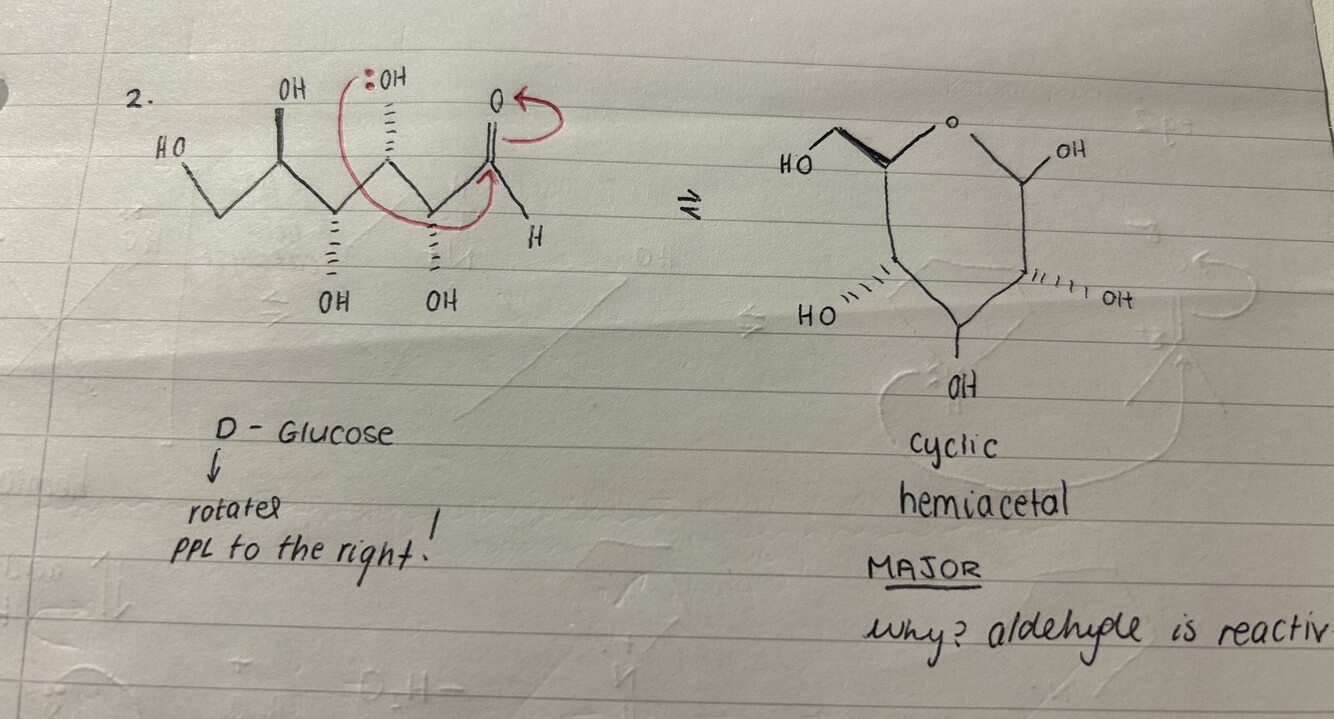
sugars- eg. glucose.
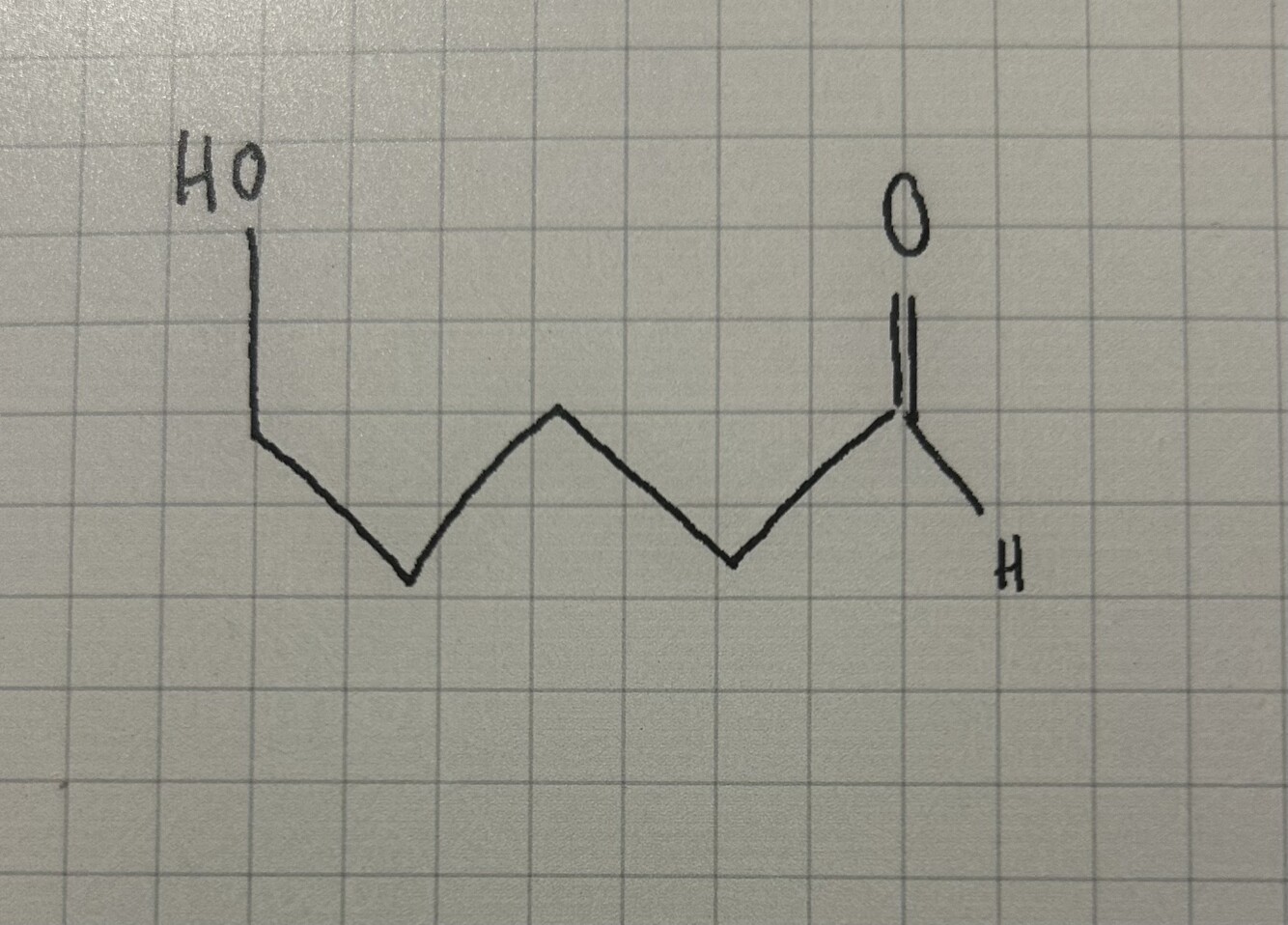
Draw the mechanism of the production of a cyclic hemiacetal from this molecule.
How does D-glucose become a cyclic hemiacetal. Which is the major/minor product and why.
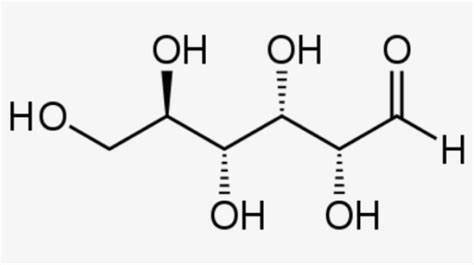
hemiacetal is the major- aldehyde is very reactive.
Draw the mechanism for propanone with NH2-R group. Label the what the hemiaminal, iminium and imine are in the process.
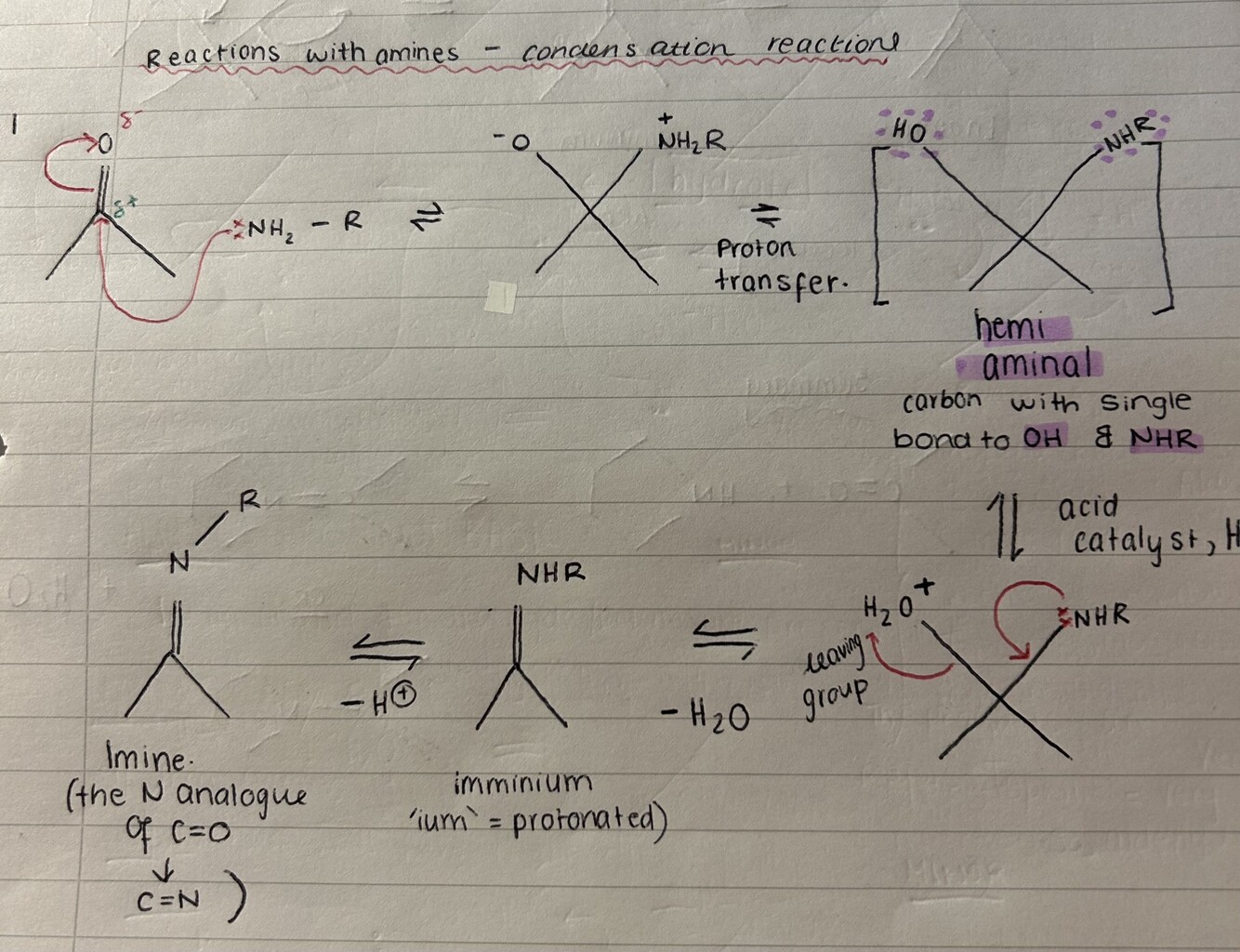
An imine (C=N) is the N analogue of…
C=O
Write the basic condensation reaction between amines and carboxyl groups.
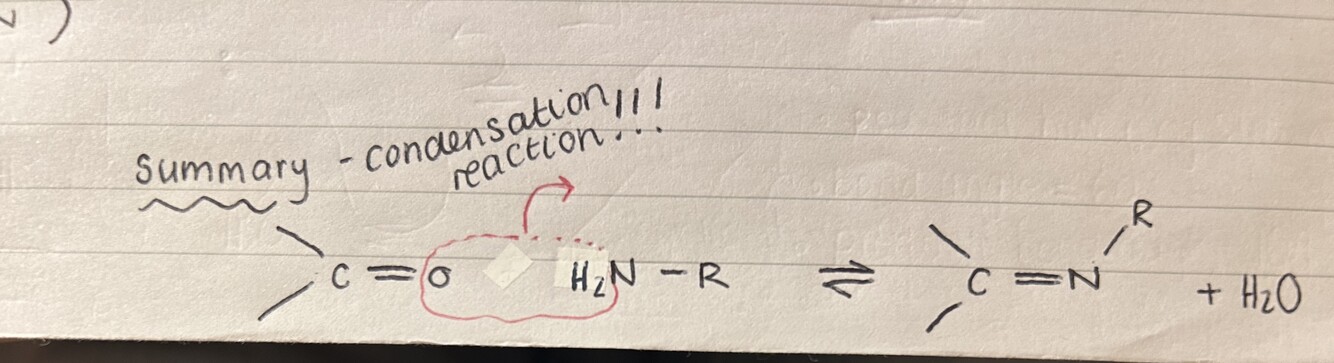
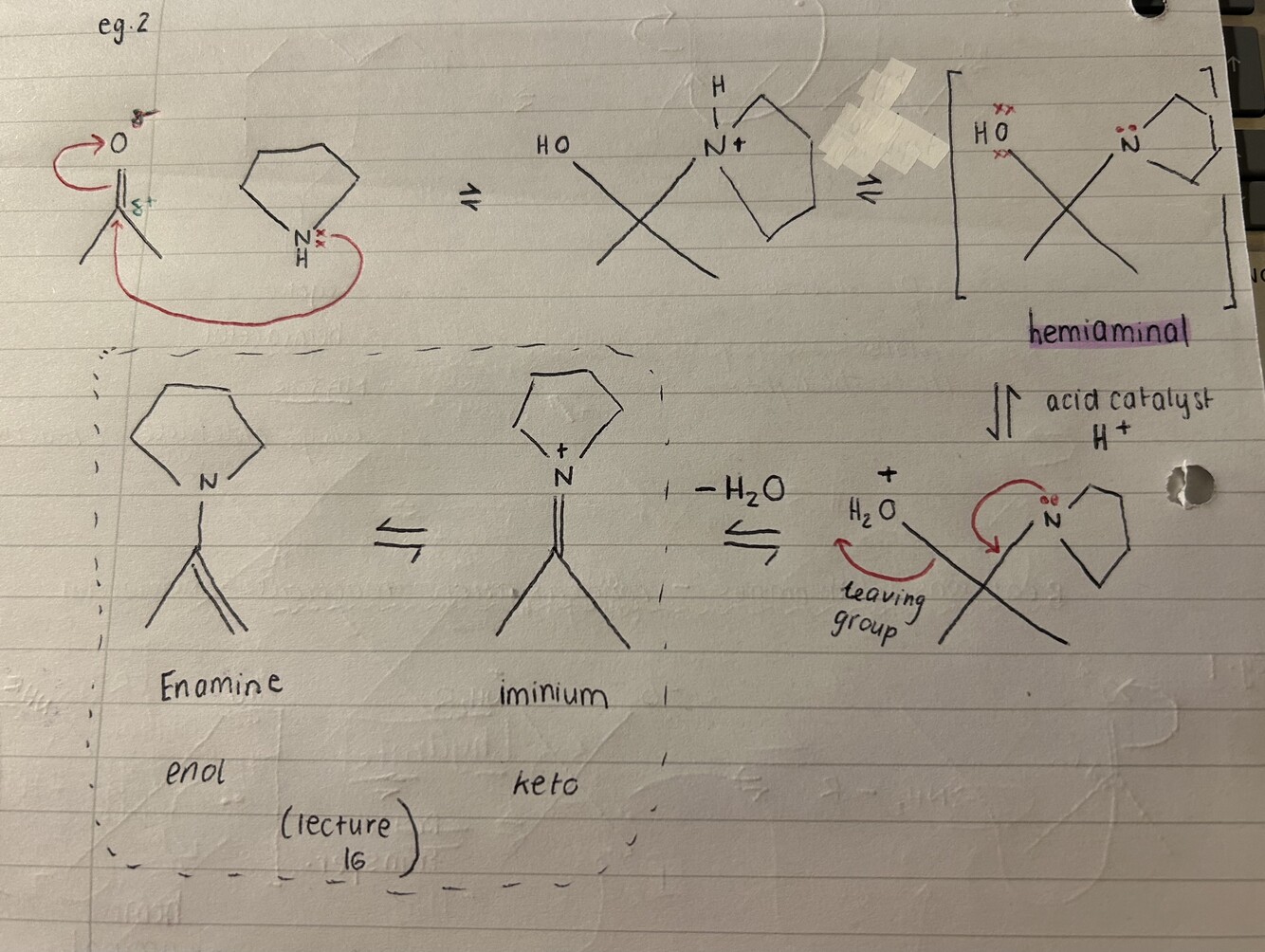
Draw mechanism for the condensation reaction between pyrrolidine and carbonyl compound. Name the keto and enol that may be produced