Conjugate additions 2
暂无描述。系统推荐的高质量记忆内容,适合每天坚持背诵学习。
卡片预览 (15 张)
What is met by Reterosynthesis
Essentially doing a reaction in reverse
What a synthons
Imaginary idea reagents, that don’t often exist in reality
What are the synthetic equivalents of these synthons
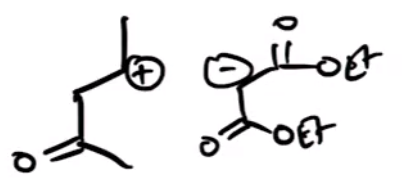
• Enone on the left, as the C=C allows the carbon to be electron deficient • Dicarbonyl remains the same
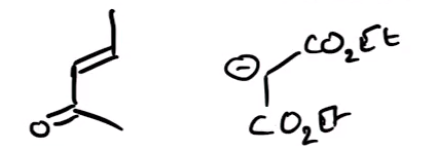
If we want a 1,4-addition to occur over a 1,2-addition, what are the reaction conditions required?
reflux
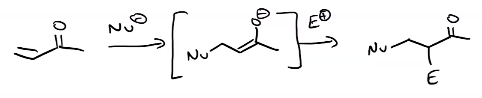
A 1,4-conjugate addition initally gives enolate (or enol if in acid) If we introduce a suitable electrophile to the reaction…
Then we can functionalise the enone twice Electrophile adds where C=C would protonate (can allow synethsis to be more efficient)
What is the final product of this reaction
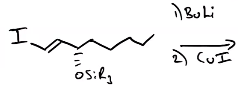
• BuLi will knock of the iodine to form a C-Li bond (will react like Grignards - Nucleophilic) • Then adding CuI turns the alcohol lithium into an alcohol copper
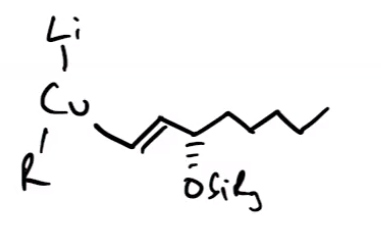
How will following two molecules react
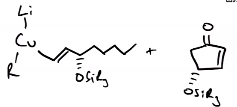
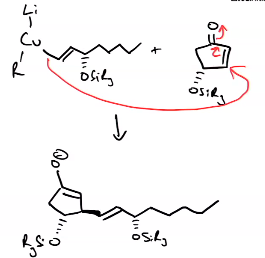
• 1,4-addition • Electrons from Cu attack the δ⁺ C=C • causes the electrons to transfer to the adjacent carbon and the C=O bond to break
How do the following reagent react
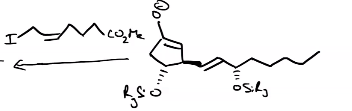
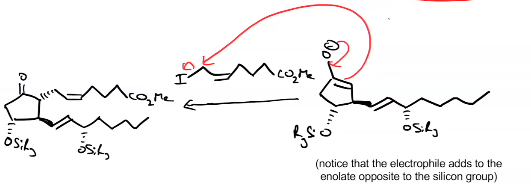
• LP comes down off oxygen, causing the e- from the double bond to attack the δ⁺C-I • (The sterochemistry of these reactions can be really easily controlled due to the substituents only adding in certain places)
How would you break down the following into its synthetic equivalents?
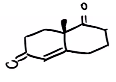
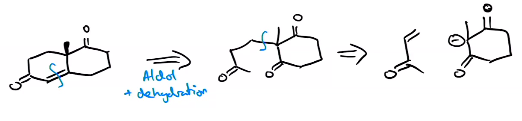
• Break first bond to form a 1,5-dicarbonyl • Break second bond to form an enone and a cyclic dicarbonyl
How will the follow reaction occur
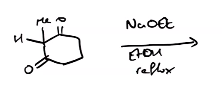
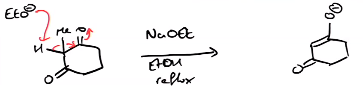
• EtO acts as a base, deprotonating on the ring • E- from the C-H bond move the adjacent C-C forming C=C and break C=O • Forms an enolate
How to the following reagents interact
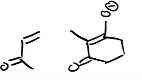
• 1,4-addition • LP comes down from oxygen, reforming C=O, and breaks adjacent C=C • E- from C=C attack the δ⁺ C of the C=C • Causes electrons to move onto adjacent carbon and break C=O bond
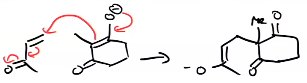
How do the following reagent interact
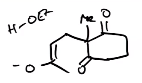
• LP comes down off oxygen, reforming C=O and breaks the C=C bond • Electrons from the C=C attack the H of the alcohol
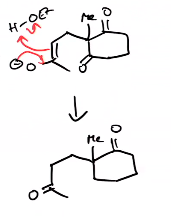
How do the following reagent react
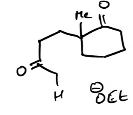
• The LP comes down off oxygen, causing the C=C bond to break • E- from C=C bond attack the δ⁺C of the other C=O, causing it to break • LP now oxygen deprotonates the alcohol
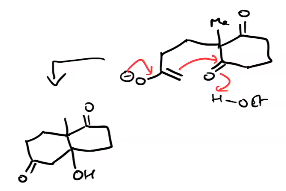
How do you reform the enoate from this point?
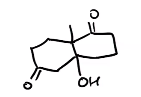
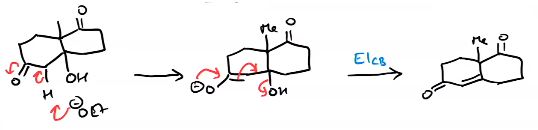
• Deprotonation using -OEt, leads to formation of C=C and breaking of C=O • LP from oxygen reforms C=O, and E- from C=C transfer to the adjacent carbon • This causes the C-OH bond to break • (the C-OH bond cannot break simply through the deprotonation due to it being a poor leaving group)
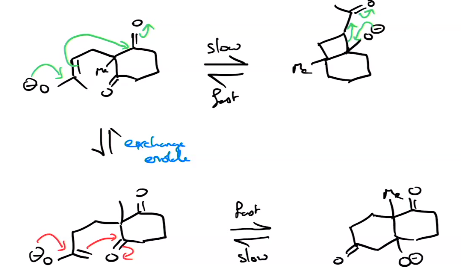
In the previous reaction forming the steriod rings, the EtOH will swap position of the enolates Why?
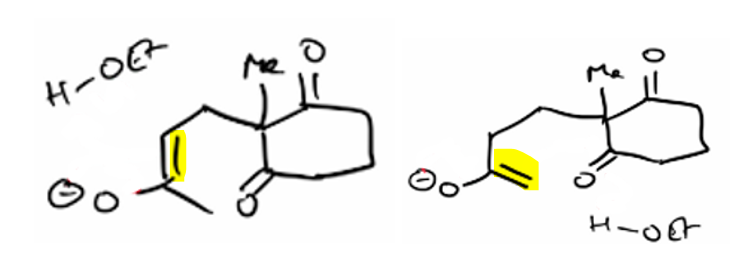
The reagent on the right would form a 4-member ring, if it attacked the carbonyl Due to the high strain of the ring, the reverse reaction of this is thermodynamically fast