Enzymes
No description yet. This curated deck is ready for daily study.
Card preview (24)
What is an Enzyme?
They are protein catalysts (except ribozyme) or biocatalysts which are transcribed and translated from the DNA. *Ribozymes are RNA molecules which can catalyse RNA cleavage, splicing, or peptide bond formation. Unlike protein enzymes, these catalytic RNAs are involved in RNA processing and regulation.
What are the characterisitcs of enzymes?
1.They are colloidal in solution: They are complex protein molecules and so form colloidal systems rather than true solutions. Due to this colloidal nature, they have very low rates of diffusion and are often considered hydrophilic colloids, providing a large surface area for chemical reactions. • Temperature and ph sensitive: They have an optimum ph and temperature outside of which, they will denature (configuration will not be suitable for forming enzyme-substrate complex). • Facilitate specific biological reactions: enzymes only catalyse specific biochemical reactions with specific substrates based on the strucutre of their active site. There are types of specificity: 1. Absolute specificity: The enzyme catalyzes the reaction for only one specific substrate (e.g., lactase acts only on lactose) • Group Specificity: The enzyme acts on molecules with specific functional groups, such as amino or phosphate groups. • Likage/Bod Specificity: The enzyme acts on specific types of chemical bonds, such as peptide or ester bonds, regardless of the rest of the molecular structure. • Sterochemical/Sterospecifcity: The enzyme acts only on a specific steric or optical isomer, such as D-glucose or beta-glycosidic bonds. Enzyme Specificity is faclated by the Lock and Key and Induced Fit model.
What are Coenzymes
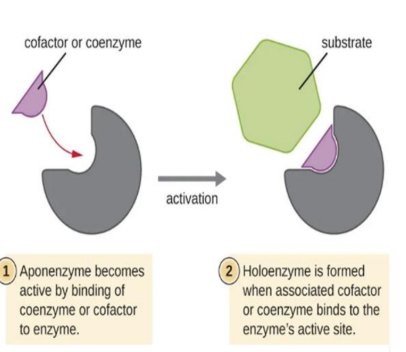
Coenzymes are organic non-protein molecules of low molecular weight which associate/bind temporarily with the enzyme; they are organic coenzymes. They act as essential carriers of electrons, atoms, or functional groups between biochemical reactions. (hydride/H- ion, hydrogen atoms, methyl groups and acyl groups). Once bound to a chemical group, the structure of the coenzyme is changed. Therefore, coenzymes can be considered as the second substrate to enzyme. Hence, they are called co-substrates. The conenzymes need to regenerate to participate in the reaction again. They are often derived from vitamins or vitamins themselves (e.g., B-vitamins, NAD⁺) to support metabolism. They are reusable, can be regenerated, and are necessary for energy production and enzyme function.
How are enzymes classified?
The International Union of Biochemistry and Molecular Biology (I.U.B.M.B.) initiated standards of enzyme nomenclature which recommended that enzyme names indicate both the substrate acted upon and the type of reaction catalyzed. * Before this union, enzymes were classified by adding -ase to the substrate. Eg. Lactase acts on glucose. I.U.B. classification relies on a numeical system (E.C. system) The EC number or Enzyme Commision number is a four-component identifier which classifies an enzyme according to class, subclass, sub-subclass and the final compontent being a serial number within that sub-subclass. There are 7 enzyme subclasses listed by the I.U.B. • Oxydoreductase/Oxidoreductase • Trasferase • Hydrolase • Lyase • Isomerase • Ligase • Translocase
What o the 7 classes of enzymes do?
• Oxydoreductases: These enzymes catayse oxidation-reducation reactions. The substrate is oxidised and becomes a H+ donor. Eg. Dehydrogenases, Peroxidases and Reducatases • Transferases: transfers a functional group from one molecule (donor) to another (acceptor). Eg. Kinases and methyltransferases. • Hydrolases: catalyse hydrolysis by adding water to cleave a bond. Eg. Esterases, Proteases and Lipases. • Lysases: Lyases are enzymes cleaving C-C, C-O, C-N, and other bonds (by means other than hydrolysis or oxidation), elimination, often creating new double bonds or rings, or conversely adding groups (H2O, CO2, NH3) to double bonds. They are involved in decarboxylation (e.g., pyruvate decarboxylase), deamination, and dehydration reactions. • Isomerases: These enzymes catalyse geometric or structural changes within one molecule (intramolecular bond rearrangements), creating an isomer. Eg. Cis-transisomerases, glucose isomerase and topioisomerase. • Ligases: Ligases are enzymes catalysing the joining together of two molecules (ligation) coupled with the hydrolysis of ATP. E.g DNA ligase. • Translocase: Catalysing the translocation of hydrogen ions, inorganic cations and anions, amino acids, carbohydrates or other compounds across biological membranes, or facilitate their insertion into membranes. . They are vital for cellular processes, including protein targeting to organelles (e.g., mitochondria, endoplasmic reticulum) and secretory pathways, often using ATP or proton motive force for energy. Eg. ABC Transporters.
How are enzymes used in medicine?
• Diagnostic - measuring and monitoring enzyme levels in clinical samples (plasma) to detect tissue damage, metabolic disorders or infectious diseases. Eg. Liver damage: AST/ALT, measuring blood glucose using glucose oxidase, urea with urease, and alcohol via alcohol dehydrogenase. • Therapeutic - treat diseases by targeting, degrading, or replacing faulty molecules. Also used in enzyme deficiency. Eg. Thrombolytic therapy to dissolve blood clots. • Anlytical - purified enzyme used to ana,se substrate conc. Eg. Immobilized enzymes combined with electrochemical sensors create rapid testing devices (e.g., glucose sensors for diabetics, Immunoassays -ELISA (enzyme-linked immunosorbent assay Eg. Pregancy (hCG) test).
What are the two types of enzymes in plasma?
Plasma specific enzymes Plasma non-specific enzyme
What are plasma (functional) specific enzymes?
Plasma-specific (or functional) enzymes are synthesized by specific tissues (mainly the liver) and actively secreted into the blood to perform their primary physiological functions. They are therfore in higher conc in the plasma. Their plamsa conc is clinically important. • Coagulation factors • Complement factors • Lipoprotein lipase • Ceruloplamsin • Renin • Cholinesrerase
What are plasma non-specific enzymes?
Plasma non-specific enzymes are present in low concentrations in plasma but high concentrations in tissue or organs. They normally have low plasma conc; any increase in their plasma conc can result from cell damage. • Creatine Kinase • Alkaline phosphatase • Lactate dehydrogenase • Aspartate aminotransferase • Alanine transaminase Their concentration drastically increases in certain conditions: - Disease states of tissues - Hypoxia or infective insults (infection) - Excessive synthesis or induction (of enzyme) - Vigorous exercise (can damage muscle tissue etc). - Decreased renal clearance.
Which plasma non-specific enzymes are elevated in different tissues in disease states?
• Cardiac: Creatine KInase myocardial band (CK-MB), Lactate dehdrogenase (LDH), Aspartate aminotransferase (AST). 2 Liver: Alanine transmaminase (ALT), AST, Alkaline phosphatase (ALP) and Gamm-glutamyl transferase (GGT), • Biliary Tract: ALP, GGT, 5’-Nucleotidase (NT) • Muscle: Creatine kinase isoform in muscle (CK-MM). AST, Adolase • Pancreas: serum amylase and lipase • Prostate: Acid phsophatase (ACP), Prostate specific antigen (PSA) (glycoprotein enzyme) • Bone: ALP - pre beta • In many conditions G6PD, Cholinesterase and Ceruloplasmin also increase.
Enzymes which are specific markers for cardiac and liver diseases?
Marker for Cardiac Disease: CK-2 and CK-MB tests detect acute MI and minor myocardial injury. Enzymes starts to show after 3hrs, peak at 24hrs and return to normal after 2-3 dyas. Marker for Liver Disease: ALT (5-40U/L) and AST (5-35U/L) (normal range). These ranges drastically increase during bilairy tract obstruction and alcoholic hepatitis (50-100u/L) and severe viral toxic hepatitis (300-1000u/L). Normally, AST/ALT ratio less than 1 but in alcholic hepatitis this ratio is greater than 2. • Markers for Cholestasis (bile flow obstruction): ALP, GGT and 5’NT. • GGT and 5’NT are sensitive markers for alcohol abuse and obstructive liver disease.
How is Alkaline phosphatase used as a marker?
• ALpha 1 ALP - found in epithelial bilairy cells reaches 10% of total plasma ALP in obstructive jaundice. • Alpha-2 ALP (heat labile) - found in hepatic cells and can reach up to 25% of total ALP in plasma during hepatic disease. • Alpha 2 ALP (heat stable) - present during pregnancy. • ALP pre-beta: increases up to 50% of total ALP. • ALP pre-gamma: up to 10% of total ALP in Ulcerative Colitis.
What are th ranges for ALP (normal and diseased)?
Normal ALP is 30-115u/L • Moderate increase (2-3) times is associated with hepatic diseases like alcoholic hepatitis. • High (10-12 x normal) in extrahepatic obstruction: obstructive jaundice or intrahepatic cholestasis due to viral infection or drugs such as chloropromazine. • Drastically high (10-25x normal) in bone diseases such as Paget’s disease of bone, metastatic carcinoma of bone.
Enzymes which are specific markers for muscle, pancreas and prostate diseases?
Marker for muscle diseases: Aldolase is the earliest to rise but is non-specific. CK-MM is more specific. Marker for pacreatic diseases: Amylase: convert starch to maltose and is activated by Ca2+ and Cl- ion. In plasma there are two types: P-type pancreatic origin and S-type salivary gland origin. Normal range of P-Type is 50-120 U/L. But in acute pancreatitis it increases 1000 times but less during chronic Pancreatitis, Mumps and pancreatic duct obstruction. Lipase: convert triacyl glycerol to glycerol then to fatty acids. Normal range in plasma 0.2-1.0 U/L but increase 1000 times in acute pancreatitis and remain stable longer than amylase. More specific for pancreatic disease as it does not increase in Mumps and shows only a moderate increase in calcium dependent pancreatitis or biliary disease. Markers for prostate: Acid Phosphatase: Hydrolyses phosphoric acid ester at pH between 4-6. Secreted by prostate cells, RBC, other blood cells. All acid phosphatases were inhibited by tartaric acid. In prostate cancer ACP increases beyond its normal range 0f 0-0.6U/L. Prostate Specific Antigen (glycoprotein): produced by secretory epithelium of prostate gland help in increasing liquefaction of seminal coagulum. Its activity is associated with prostate activity, therefore more specific marker for prostate cancer than acid phosphatase.
Other enzyme markers
• Cholinesterase: Acetylcholinerase presence in nerve ending and RBC inhibited irreversibly by organophosphorus insecticides like parathion. Pseudocholinesterase present in liver cell and carries out non-specific hydrolysis of acyl esters. • G6PD: Glucose-6-phosphate dehydrogenase an important enzyme hexose monophosphate pathway and is drastically reduced in certain drug induced hemolytic anemia. • Ceruloplasmin Ceruloplasmin (ferroxidase) normal plasma level of 25-50 mg increases in all inflammatory conditions but is reduced during copper toxicity (Wilson’s disease).
Therapeutic uses of enzymes:
• Streptokinase is a potent thrombolytic (clot-busting) medication used intravenously to dissolve harmful blood clots in acute, life-threatening conditions. Its primary therapeutic applications include treating acute myocardial infarction (heart attack), pulmonary embolism, deep vein thrombosis (DVT), and arterial thrombosis. • Urokinase is a thrombolytic (clot-dissolving) medication used to break down dangerous blood clots by converting plasminogen to plasmin. It is primarily used to treat acute massive pulmonary emboli, severe deep vein thrombosis, and to clear blood clots from blocked intravenous catheters. • Recombinant tissue prothrombin activator: , is a thrombolytic agent used to break down blood clots in emergency conditions. Its primary uses include treating acute ischemic stroke (within 3–4.5 hours), acute myocardial infarction (heart attack), and massive pulmonary embolism. It is also used to clear occluded central venous catheters. • Papain, a proteolytic enzyme from raw papaya, is used as an anti-inflammatory agent to reduce pain, swelling, and edema associated with trauma, surgery, or inflammatory conditions like bursitis. It works by breaking down proteins and reducing inflammation-causing cytokines (TNF- , IL-6).
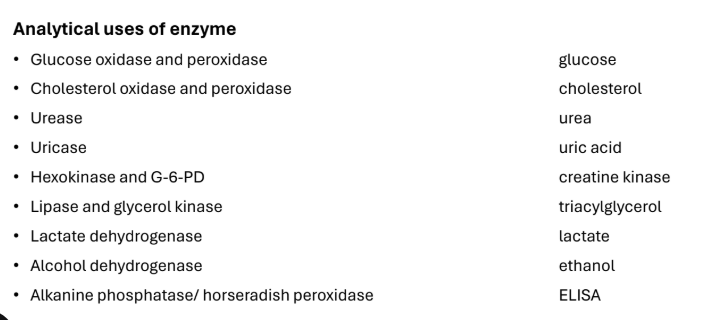
Aalytical uses of enzymes
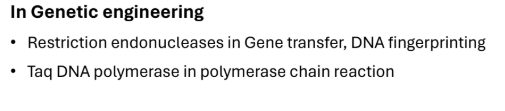
How are enzymes used in genetic engineering?
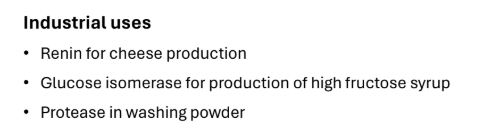
What are the industrial uses of enzymes?
Washing powder = detergent
How does the Enzyme Commission (E.C.) number work?
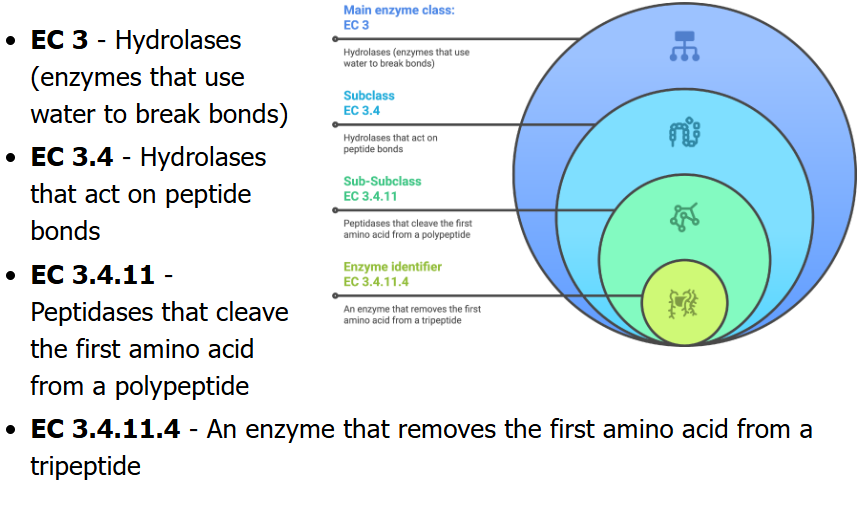
The E.C. number consists of four numbers separated by periods ‘.’, each representing a different level of classification.
What does the 1st digit of the EC system represent?
The first digit represents the class (of 7 enzymes); the broad category of the reactions catalysed. There are 7 main classes: EC 1: Oxidoreductases EC 2: Transferases EC 3: Hydrolases EC 4: Lyases EC 5: Isomerases EC 6: Ligases EC 7: Translocases
What does the 2nd digit of the EC system represent?
The 2nd digit represents the subclass. It specifies the type of reaction within the main class, often based on the type of bond or chemical group involved. Examples: EC 1.6: Oxidoreductases that act on NADP or NADPH EC 2.1: Transferases that only transfer one-carbon groups
What does the 3rd digit of the EC system represent?
The 3rd digit represents the sub-sublcass, which typically refers to the substrate or type of compound on which the enzyme performs its general reaction. Eg. EC 3.1.3. A type of hydrolase which acts on ester bonds specifically. EC 2.1.1 - Transferases which transfer groups with one-carbon and 4 H’s (methyltransfrases).
What does the 4th digit of the EC system represent?
The 4th digit uniquely identifies the specific enzyme that catalyzes a reaction within the given subclass; it acts a serial number for the enzyme. This digit distinguishes different enzymes that share the same class, sublcalss and sub-subsclass. The fourth digit is assigned sequetially (1, then 2 etc). Eg. EC 1.1.1.1 - An oxidoreducatase that dehodrogenates (oxidises) alcohol (Alcohol dehydrogenase). EC 2.1.1.1 - A transferase that specifically transfers methyl groups to DNA (DNA methyltransferase).