EL From Sep 2015
No description yet. This curated deck is ready for daily study.
Card preview (24)
What is atomic Number?
This is the number of protons in an atom. It is also the number of electrons in that atom.
What is atomic mass?
This is the number of protons and neutrons in an atom combined.
What is ionisation energy?
This is the energy to remove 1 mole of electrons from 1 mole of gaeous atoms (ie, 1 electron per atom) to form 1 mole of gaseous cations: X(g) –> X+(g) + e-
What is a cation?
A positively charged ion
What is an anion?
A negatively charged ion
Describe the simple model of the atom
Protons and Neutrons in the nucleus, surrounded by an electron cloud. (image to follow)
What are the maximum number of electrons that can be found in each shell?
S sub shell –> 2 P sub shell –> 6 D sub shell –> 10 F sub shell –> 14
Subtract the molecular mass of ammonia from the molecular mass of ammonium
NH4 - NH3 = 1 18-17=1
What is the difference between Ar and Mr?
• Ar* is the relative atomic mass • Mr* is the relative molecular mass
How is the relative atomic mass of each element relatd to carbon-12?
The average atomic mass of each element is 1/12 of the mass of carbon-12
What is Avogadro’s constant?
6.02 x 10²³ A mole!
What happens when hydrated crystals are heated?
The water of crystallisation is removed as steam An anhydrous solid is produced
What factors reduce the theoretical amount of product that should be produced?
• Loss of product • Impurities in reactants • Changes in temperature • Changes in pressure • Which way the equilibbrium lies
Balance the following equation KNO3 + C12H22O11 –> N2 + CO2 + H2O + K2CO3 Good luck.
48KNO3 + 5C12H22O11 –> 24N2 + 36CO2 + 55H2O + 24K2CO3
How do the reactivities of Group 1 and Group 2 elements change?
As you go down the group: The reactivity increases because there are more shells shielding the positive nucleus, so it is easier for the negative electrons to move away. As you go across the period: The reactivity decreases because more positive protons are added to the nucleus, so the electrons are more strongly attracted.
How do the first ionisation enthalpies change across a period?
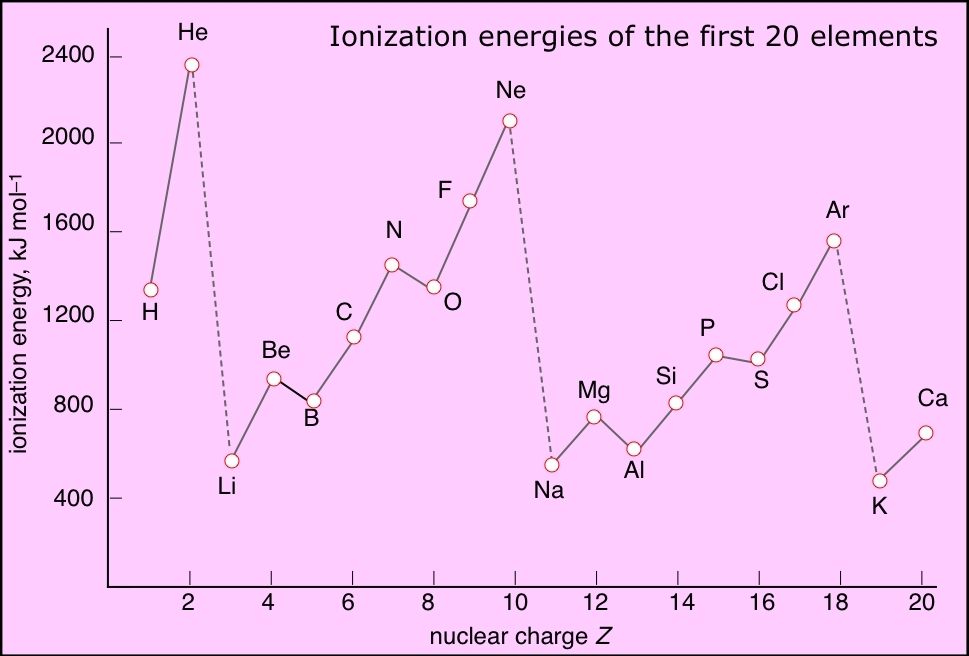
The first ionisation enthalpies of elements increase as you go across a period because there are more protons in the nucleus, so the electrons are held tighter.
How do successive ionisation enthalpies change?
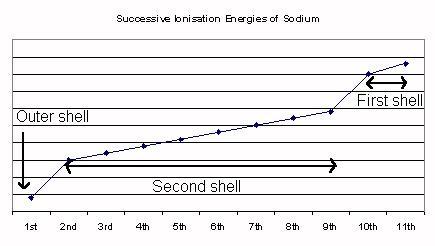
As more electrons are removed, the ionisation enthalpy increases because they are held more tightly to the nucleus, so it takes more energy to pull them away.
How do Group 2 elements react with oxygen and water?
Oxygen - produces metal oxide (‘M’ means any group 2 element) 2M(s) + O2(g) > 2MO(s) Water - form hydroxides and hydrogen M(s) + 2H2O(l) > M(OH)2(aq) + H2(g) The further down the element in the group, the faster the reaction.
Explain Valence Shell Electron Repulsion theory
Electrons in the valence shell are all negatively charged so repel each other; this means that when they form bonds they will station themselves as far away from other bonding pairs or nonbonding pairs as possible.
What is the significance of a loan pair of valence electrons in a compound?
The lone pair repels with greater force than a bonding pair.
What type of bond does and arrow represent and define the term?
Dative covalent bond: This means that one atom donates both electrons that make up the covalent bonding pair.
What is shape and bond angle if a molecule has 3 bonding pairs around the central atom and one lone pair?
Pyramidal, 107.3 degrees

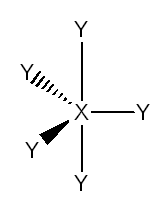
What is the shape of a molecule and bond angle if it has 5 bonding pairs around the central atom?
Bipyramidal 90 degrees and 120 degrees
The