3.1 Proton transfer reactions
No description yet. This curated deck is ready for daily study.
Card preview (24)
proton transfer reactions and Brønsted–Lowry acid–base behaviour
A hydrogen atom contains one proton and one electron. - When it ionizes by losing its electron, only the proton remains, so H⁺ is equivalent to a proton and the terms can be used interchangeably. During proton transfer: - the reactant that loses H⁺ loses a positive charge the product that gains H⁺ gains a positive charge. Proton transfer reactions are only possible between species that: - can release H⁺ possess a lone pair that can accommodate an additional H⁺. This behaviour is known as Brønsted–Lowry acid–base behaviour. Proton transfer reactions can be predicted and followed using the pH and pOH scales. - Different acids and bases share common properties but differ in strength depending on their equilibria in aqueous solution.
Brønsted–Lowry definitions of an acid and a base
A Brønsted–Lowry acid is a proton (H⁺) donor. A Brønsted–Lowry base is a proton (H⁺) acceptor. The acid is the species that donates H⁺ and accepts electron pair. The base is the species that accepts H⁺ and donates electron pairs. In aqueous solution, a proton may be represented as H⁺(aq) or H₃O⁺(aq). Distinguish between a base (proton acceptor) and an alkali (a soluble base that produces OH⁻ ions in aqueous solution).
development of the Brønsted–Lowry theory
Lavoisier (1777) proposed that oxygen was the “universal acidifying principle” and defined acids as compounds of oxygen and a non-metal (oxygen means “acid-former”). This theory was disproved by HCl, which contains hydrogen and chlorine only. Arrhenius (1887) defined acids as substances that dissociate in water to form H⁺ ions and anions, and bases as substances that dissociate to form OH⁻ ions and cations. He recognised that H⁺ and OH⁻ form water while the remaining ions form a salt. His theory was limited to aqueous systems and could not explain reactions without water or the basic properties of some insoluble substances. Brønsted and Lowry (1923) independently proposed that acid–base reactions involve proton transfer, overcoming the limitations of the Arrhenius theory.
reaction between HCl and NH₃ using Brønsted–Lowry theory
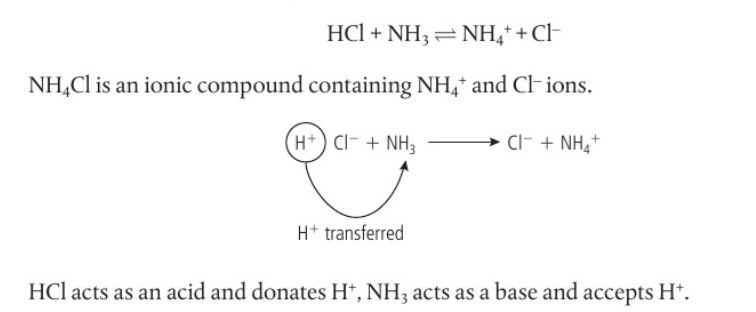
HCl + NH₃ → NH₄⁺ + Cl⁻ (NH₄Cl) HCl donates H⁺ and acts as the Brønsted–Lowry acid. NH₃ accepts H⁺ and acts as the Brønsted–Lowry base. NH₄Cl is an ionic compound containing NH₄⁺ and Cl⁻ ions. The reaction demonstrates proton transfer from HCl to NH₃. When HCl(g) and NH₃(g) react, a white smoke of ammonium chloride is observed.
Brønsted–Lowry acid and base in the following forward reactions
NH₃(aq) + H₂O(l) ⇌ NH₄⁺(aq) + OH⁻(aq) Acid: H₂O (donates H⁺) Base: NH₃ (accepts H⁺) H₂PO₄⁻(aq) + HCO₃⁻(aq) ⇌ HPO₄²⁻(aq) + H₂CO₃(aq) Acid: H₂PO₄⁻ (donates H⁺) Base: HCO₃⁻ (accepts H⁺)
Explain proton transfer reactions and Brønsted–Lowry acid–base behaviour.
• Hydrogen atoms are the simplest atoms, containing one proton and one electron. When they ionize by losing the electron and forming H⁺, all that is left is the proton. Therefore H⁺ is equivalent to a proton, and the two terms can be used interchangeably. During a proton transfer reaction: - the reactant loses H⁺ and so loses a positive charge - the product gains H⁺ and so gains a positive charge.
requiremtns for proton transfer reactions to occur
Proton transfer reactions are only possible between species that: - can release H⁺ - have a lone pair that can accommodate an additional H⁺. This behaviour is known as Brønsted–Lowry acid–base behaviour.
State the Brønsted–Lowry definitions of an acid and a base, and explain how to identify them in a reaction.
A Brønsted–Lowry acid is a proton (H⁺) donor. A Brønsted–Lowry base is a proton (H⁺) acceptor. - Deduce the Brønsted–Lowry acid and base by identifying the species that donates and accepts H⁺, respectively. - in aqueous solution, a proton may be represented as H⁺(aq) or H₃O⁺(aq). - Distinguish between the terms base and alkali.
What is a conjugate acid–base pair, and how can the conjugate acid or conjugate base of a species be deduced?
A conjugate acid–base pair is a pair of species differing by a single proton (H⁺). - Conjugate acid = species + H⁺ - Conjugate base = species − H⁺
Explain the development of the Brønsted–Lowry theory.
• Lavoisier (1777) proposed that oxygen was the “universal acidifying principle” and defined an acid as a compound of oxygen and a non-metal. The name oxygen means “acid-former”. This theory was disproved when HCl was shown to contain only hydrogen and chlorine, so any definition of an acid must be valid for all acids. • Arrhenius (1887) defined an acid as a substance that dissociates in water to form H⁺ ions and anions, and a base as a substance that dissociates into OH⁻ ions and cations. He recognised that H⁺ and OH⁻ form water, while the cations and anions form a salt. His theory was limited to aqueous systems and could not explain reactions occurring without water or the basic properties of some insoluble substances. • In 1923, Martin Lowry and Johannes Brønsted, working independently, proposed the Brønsted–Lowry theory, which focuses on the transfer of H⁺ ions during an acid–base reaction: acids donate H⁺, while bases accept H⁺.
Explain the reaction between HCl and NH₃ using Brønsted–Lowry theory.
HCl + NH₃ → NH₄⁺ + Cl⁻ - HCl transfers H⁺ to NH₃. - HCl acts as the Brønsted–Lowry acid and donates H⁺. - NH₃ acts as the Brønsted–Lowry base and accepts H⁺. - NH₄Cl is an ionic compound containing NH₄⁺ and Cl⁻ ions. When HCl(g) reacts with NH₃(g), a white smoke of ammonium chloride is observed.
Deduce the Brønsted–Lowry acid and base in the following reactions (consider only the forward reaction). 1. NH₃(aq) + H₂O(l) ⇌ NH₄⁺(aq) + OH⁻(aq) 2. H₂PO₄⁻(aq) + HCO₃⁻(aq) ⇌ HPO₄²⁻(aq) + H₂CO₃(aq)
• NH₃ accepts H⁺ to become NH₄⁺ → Brønsted–Lowry base • H₂O donates H⁺ to become OH⁻ → Brønsted–Lowry acid • H₂PO₄⁻ donates H⁺ to become HPO₄²⁻ → Brønsted–Lowry acid • HCO₃⁻ accepts H⁺ to become H₂CO₃ → Brønsted–Lowry base
Explain conjugate acid–base pairs in Brønsted–Lowry theory.
• Proton donation cannot happen in isolation; there must always be a species present to accept the proton. Therefore, a Brønsted–Lowry acid can only behave as a proton donor if there is also a Brønsted–Lowry base present to accept the proton. In the reaction: HA+B⇌A^− + BH+ • HA acts as the acid, donating H⁺ to B, while B acts as the base, accepting H⁺. In the reverse reaction, BH⁺ acts as the acid, donating H⁺ to A⁻, while A⁻ acts as the base, accepting H⁺. Thus, acids react to form bases and bases react to form acids.
What is a conjugate acid–base pair?
A conjugate acid–base pair consists of an acid and its corresponding base (or a base and its corresponding acid). - The members of a conjugate acid–base pair differ by one proton (H⁺)!! In the reaction: HA+B⇌A^− +BH+ the conjugate acid–base pairs are: - HA / A⁻ - BH⁺ / B
Explain the conjugate acid–base pair H₂O/H₃O⁺.
• H₂O and H₃O⁺ form a conjugate acid–base pair found in all acid–base reactions in aqueous solution. The reaction is: H2O(l) + H+ (aq) ⇌ H3O+ (aq) • A proton released from an acid readily associates with H₂O molecules, forming H₃O⁺ (the proton becomes hydrated). H₃O⁺ is called the hydroxonium ion, oxonium ion, or hydronium ion. In aqueous solution, hydrogen ions exist as H₃O⁺, although they are usually written as H⁺(aq) for convenience. In this conjugate pair: - H₃O⁺ is the conjugate acid. - H₂O is the conjugate base.
Identify the conjugate acid–base pairs in the reaction:

CH₃COOH / CH₃COO⁻ → conjugate acid–base pair CH₃COOH = acid CH₃COO⁻ = conjugate base H₂O / H₃O⁺ → conjugate acid–base pair H₂O = base H₃O⁺ = conjugate acid
How can the formula of a conjugate acid or conjugate base be deduced?
In a conjugate acid–base pair, the acid always has one proton (H⁺) more than its conjugate base. Therefore: - Conjugate acid = species + H⁺ - Conjugate base = species − H⁺
Conjugate acids of these polyatomic ions
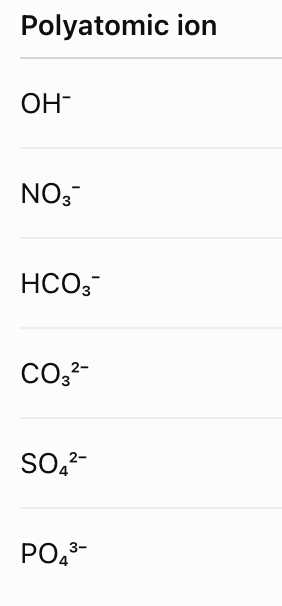
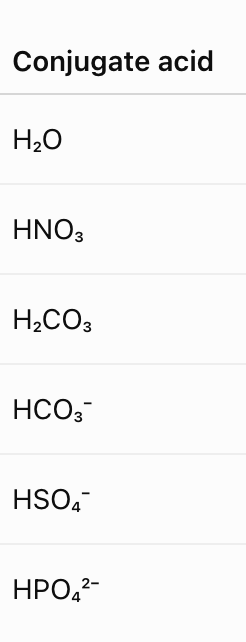
Why is NH₄⁺ different from the other polyatomic ions listed?
NH₄⁺ cannot accept H⁺ to form a conjugate acid. Instead, it loses H⁺, acting as a Brønsted–Lowry acid, to form its conjugate base: NH4 + ⇌NH3 +H+ Conjugate base: NH₃
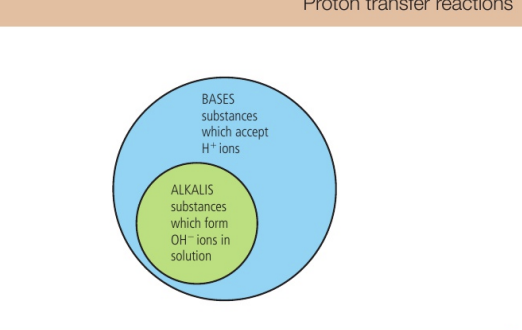
Distinguish between a Brønsted–Lowry base and an alkali.
A Brønsted–Lowry base is any species that can accept a proton (H⁺). An alkali is a soluble base that dissolves in water to form hydroxide ions, OH⁻.
Give examples showing that alkalis produce hydroxide ions in water.
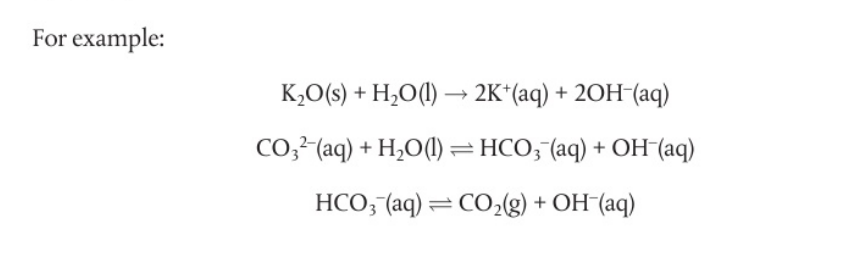
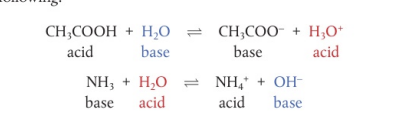
What is an amphiprotic species? Explain why water can act as both a Brønsted–Lowry acid and a Brønsted–Lowry base.
An amphiprotic species is one that can act as both a Brønsted–Lowry acid and a Brønsted–Lowry base. - Brønsted–Lowry theory describes acids and bases in terms of how they react together, so whether water acts as an acid or a base depends on what it is reacting with. - With CH₃COOH, water acts as a Brønsted–Lowry base, accepting H⁺: CH3COOH + H2O ⇌ CH3COO − + H3O + With NH₃, water acts as a Brønsted–Lowry acid, donating H⁺: NH3 + H2O⇌ NH4+ +OH−
What features enable a species to be amphiprotic?
To act as a Brønsted–Lowry acid, a species must be able to dissociate and release H⁺. To act as a Brønsted–Lowry base, a species must be able to accept H⁺, which means it must possess a lone pair of electrons, forming a coordination bond Therefore, amphiprotic species must possess both: - hydrogen that can be released as H⁺ - a lone pair of electrons that can accept H⁺.
Explain how HCO₃⁻ can act as both a Brønsted–Lowry acid and a Brønsted–Lowry base.
As a Brønsted–Lowry acid, HCO₃⁻ donates H⁺: - HCO3- (aq)+ H2O(l)⇌CO3^2− (aq) + H3O^+ (aq) As a Brønsted–Lowry base, HCO₃⁻ accepts H⁺: - HCO3^− (aq)+ H2O(l)⇌H2CO3 (aq)+OH^-(aq) - Therefore, HCO₃⁻ is amphiprotic because it can act as both a Brønsted–Lowry acid and a Brønsted–Lowry base.