3.2 Alkanes
No description yet. This curated deck is ready for daily study.
Card preview (24)
What are Alkanes?
Compounds of carbon and hydrogen with only single bonds between them
Why are shorter chain Hydrocarbons in higher demand?
They are more useful as fuels
What are the two types of Cracking?
• Thermal Cracking • Catalytic Cracking
What are the conditions required for Thermal Cracking?
• requires high temperatures (up to 1000 C) • and high pressure (up to 70 atmospheres) and produces alkanes and a lot of alkenes Remember that cracking is an endothermic reaction.
What are the conditions required for Catalytic Cracking?
• uses a lower temperature (around 450 C) • and slight pressure in the presence of a catalyst such as a zeolite or aluminium oxide to produce mainly aromatic hydrocarbons Remember that cracking is an endothermic reaction.
What is the Word Equation for Complete Combustion?

What conditions are necessary for Complete Combustion to occur?
Excess (plenty of) oxygen
What are the products of Incomplete combustion?
• Carbon Monoxide • Carbon (Soot)
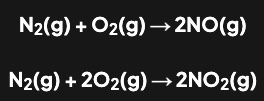
How are Oxides of Nitrogen Formed?
In a car engine, high temperatures and pressures are reached causing the oxidation of nitrogen to take place:
What are the Harmful effects of Acid Rain?
Acid rain can cause corrosion of buildings/statues, endangers plant and aquatic life (as lakes and rivers become too acidic) as well as directly damaging human health
What is the purpose of Catalytic Converters?
To reduce the amount of pollutants released in car exhaust fumes
What metal is a catalytic converter made from?
Platinum
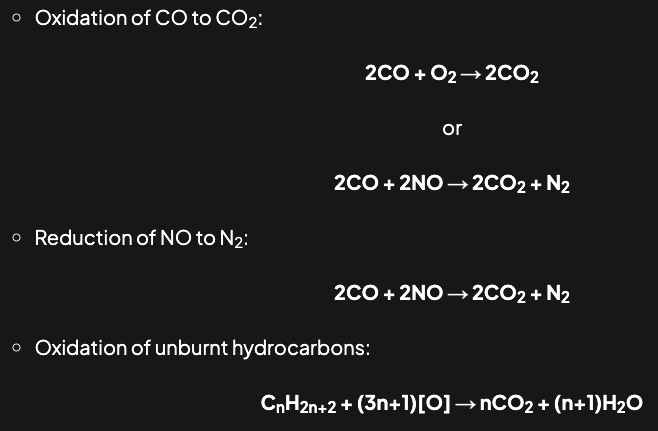
The reactions that take place in the catalytic converter include: • Oxidation of CO to CO2: • Reduction of NO to N2: • Oxidation of unburnt hydrocarbons:
How do we reduce sulfur dioxide emissions?
• The main way to reduce sulfur dioxide emissions is to treat the waste gases from coal fired power stations • The waste gases are passed into a scrubbing chamber which sprays a wet slurry of calcium oxide and calcium carbonate into the gases • This process is also known as sulfur scrubbing or flue gas desulfurisation
What is a Free Radical?
Any species with a free, unpaired electron
How can Alkanes undergo Free Radical Substitution?
Alkanes can undergo free-radical substitution in which a hydrogen atom gets substituted by a halogen (chlorine/bromine)
Why do Alkanes need UV light for Free Radical Substitution?
Alkanes are very unreactive
What are the Three steps of Free Radical Substitution?
• Initiation • Propagation • Termination
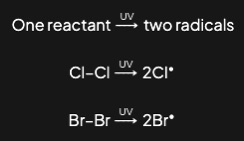
Free Radical Substitution What happens during the Initiation Step?
• In the initiation step the Cl-Cl or Br-Br is broken by energy from the UV light • Each atom takes one electron from the covalent bond • This produces two radicals in a homolytic fission reaction
Free Radical Substitution What happens during the Propagation Step? (P1)
• This refers to the progression (growing) of the substitution reaction in a chain reaction • Free radicals are very reactive and will attack the unreactive alkanes • A C-H bond breaks homolytically • Remember: Homolytic fissions is where each atom gets one electron from the covalent bond • An alkyl free radical is produced
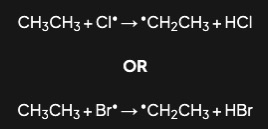
Free Radical Substitution What happens during the Propagation Step? (P2)
• … This can attack another chlorine / bromine molecule to form a halogenoalkane and regenerate the chlorine / bromine free radical • The regenerated chlorine / bromine free radical can then repeat the cycle
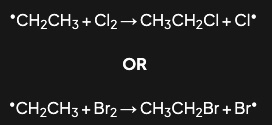
Free Radical Substitution Why is Free Radical Substitution not suitable for preparing specific haolgenoalkanes?
A mixture of substitution products are formed
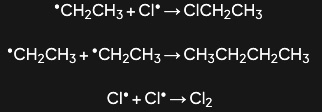
Free Radical Substitution What happens during the Termination Step?
• This is when the chain reaction terminates (stops) due to two free radicals reacting together and forming a single unreactive molecule • Two radicals → one product • Multiple products are possible, dependent on the radicals involved • For example, in the single substitution of ethane with chlorine: • Exam Tip - *If you are asked to give an equation for the termination step of a free radical reaction / mechanism, you should not give the equation reforming the original halogen as this is often marked as “ignore” on mark schemes *
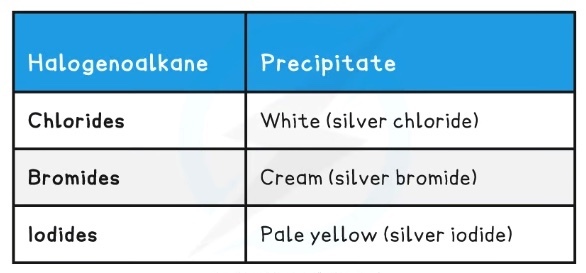
What happens when we react halogenoalkanes with aqueous silver nitrate solution?
This will result in the formation of a precipitate The rate of formation of these precipitates can also be used to determine the reactivity of the halogenoalkanes