Ch. 23: Transition Metals and Coordination Compounds
暂无描述。系统推荐的高质量记忆内容,适合每天坚持背诵学习。
卡片预览 (24 张)
crystal field theory
It is bonding model for transition metal complex ions. The model describes how the degeneracy of the d orbitals is broken by the repulsive forces between the electrons on the ligands around the metal ion and the d orbitals in the metal ion.
lanthanide contraction
The trend toward leveling off in size of the atoms in the third and fourth transition rows due to the ineffective shielding of the f sublevel electrons.
complex ion
An ion that contains a central metal ion bound to one or more ligands.
ligand
A neutral molecule or an ion that acts as a Lewis base with the central metal ion in a complex ion.
coordination compound
A neutral compound made when a complex ion combines with one or more counter ions.
primary valence
The oxidation state on the central metal atom in a complex ion.
secondary valence
The number of molecules or ions directly bound to the metal atom in a complex ion; also called the coordination number.
coordination number
The number of atoms with which each atom in a crystal lattice is in direct contact.
coordinate covalent bond
The bond formed when a ligand donates electrons to an empty orbital of a metal in a complex ion.
monodentate
Describes ligands that donate only one electron pair to the central metal.
bidentate
Describes ligands that donate two electron pairs to the central metal.
polydentate
Describes ligands that donate more than one electron pair to the central metal.
chelate (“key-late”)
A complex ion that contains either a bi- or polydentate ligand.
chelating agent
The coordinating ligand of a chelate.
Guidelines for Naming Complex Ions
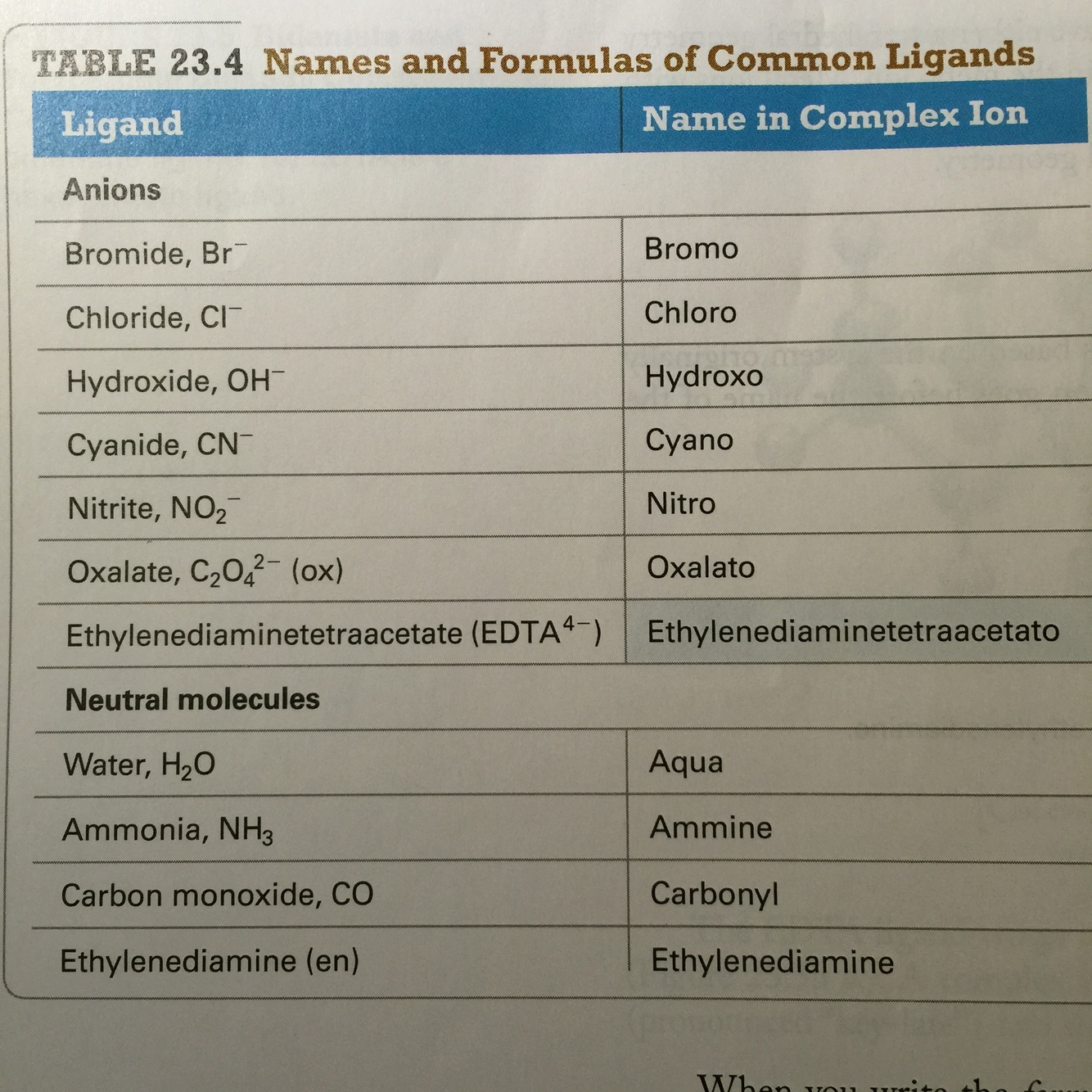
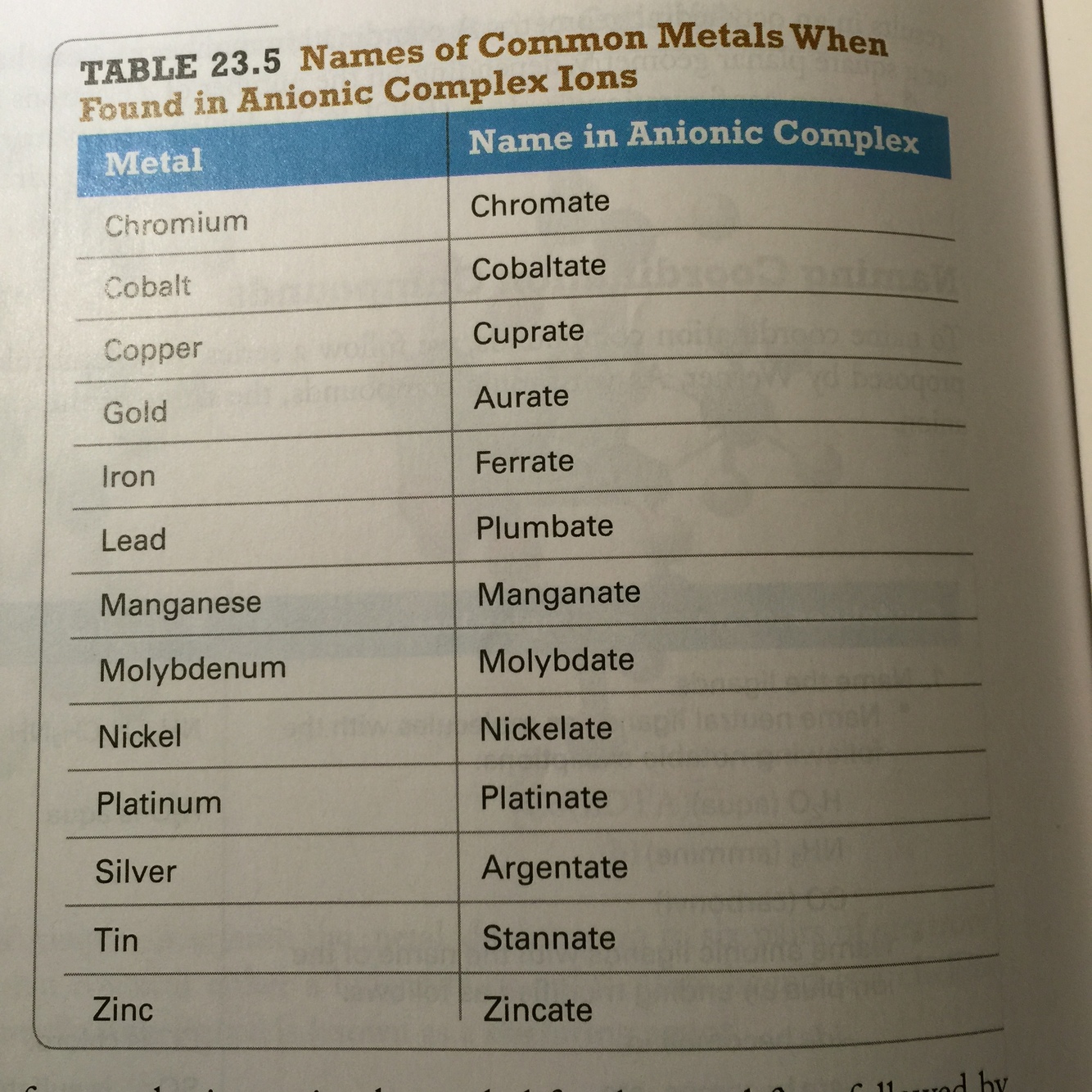
• Name the ligands. * Name neutral ligands as molecules with the following notable exceptions. H2O (aqua) NH3(ammine) CO (carbonyl) • Name anionic ligands with the name of the ion plus an ending modified as follows: -ide becomes -o -ate becomes -ato -ite becomes -ito • List the names of the ligands in alphabetical order before the name of the metal cation. • Use a prefix to indicate the number of ligands (when there is more than one of a particular type): di- (2), tris- (3), tetra- (4), penta- (5), or hexa- (6). If the name of the ligand already contains a prefix, such as ethylenediamine, place parentheses around the ligand name and use bis- (2), tris- (3), or tetrakis- (4) to indicate the number. Prefixes do not affect the order in which you list the ligands. • Name the metal. a. When the complex ion is a cation, use the name of the metal followed by the oxidation state written with a Roman numeral. b. If the complex ion is an anion, drop the ending of the metal and add -ate followed by the oxidation state written with a Roman numeral. Some metals use the Latin root with the ate ending. • Write the entire name of the complex ion by listing the ligands first followed by the metal.
Names and formulas of common ligands
Names of common metals when found in anionic complex ions
structural isomers
Molecules with the same molecular formula but different structures.
steroisomers
Molecules in which the atoms are bonded in the same order but have a different spatial arrangement.
coordination isomers
Isomers of complex ions that occur when a coordinated ligand exchanges places with the uncoordinated counterion.
linkage isomers
Isomers of complex ions that occur when some ligands coordinate to the metal in different ways.
geometric isomers
For complex ions, isomers that result when the ligands bonded to the metal have a different spatial arrangement. Cis-trans isomerism occurs in square planar complexes of the general formula MA2B2 or octahedral complexes of the general formula MA4B2. Fac-mer isomerism, which occurs in octaheral complexes of the general formula MA3B3.
optical isomers
Two molecules that are nonsuperimposable mirror images of one another.
strong-field complexes
A complex ion in which the crystal field splitting is large. CN- > NO2- > en > NH3