ChemPath: Porphyrias
No description yet. This curated deck is ready for daily study.
Card preview (24)
What is porphyria?
Disorders caused by deficiencies in enzymes of the haem synthesis pathway • This leads to the accumulation of toxic haem precursors • Deficiency of enzymes range for partial to complete
What are the two ways in which porphyria can manifest?
• Acute neuro-visceral attacks • Acute or chronic cutaneous symptoms
List some key features of haem.
• Organic heterocyclic compound • Fe2+ in the centre • There is a pyrolic (tetrapyrole) ring around the iron
What are the 2 major functions of haem?
• Carry oxygen • Faciliate redox reactions
Where is haem found?
Made in all cells
Which 2 cell types do porphyrias typically affect?
Erythroid and hepatic
Draw the haem synthesis pathway.
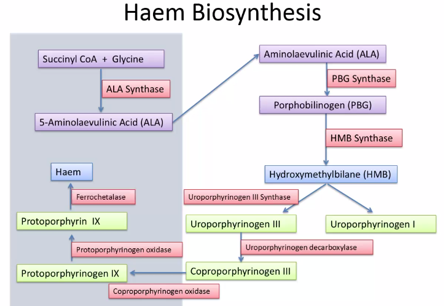
Which intermediate of the haem biosynthesis pathway is neurotoxic?
Aminolevulinic acid (ALA) Causes neuro-visceral symptoms
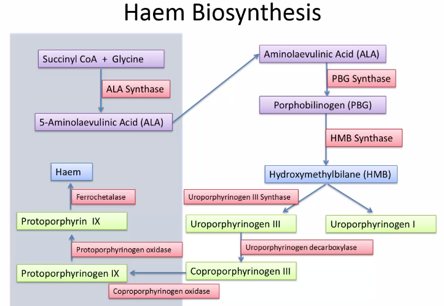
What types of porphyrin may be produced in the absence of iron?
• Metal-free protoporphyrins • Zinc protoporphyrin
How can porphyrias be classified?
Principle site of enzyme deficiency: • Erythroid • Hepatic Clinical presentation: • Acute or non-acute • Neurovisceral or skin lesions
Outline the pathophysiology of skin lesions in porphyria
Photosensitivity - porphyrinogens are oxidised and then activated by UV light into activated porphyrins. Activated porphyrins damage skin cells and trigger inflammatory pathways NOTE: porphyrinogens do NOT oxidise cells
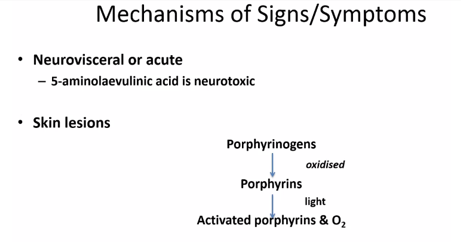
What is a key difference between porphyrinogens and porphyrins?
Porphyrinogens • Precursor to porphyrins • Colourless • Unstable and readily oxidised to corresponding porphyrin Porphyrins • Highly coloured
Which porphyrins appears in the urine and which appear in faeces?
• Porphyrins near start of the pathway are water soluble – urine (uro-) • Porphyrins near end less soluble – faeces (copro-) NOTE: someone with AIP will have dark red/brown urine due to porphyrin accumulation
List four types of acute porphyria and the enzymes involved.
• Plumboporphyria - PBG synthase • Acute intermittent porphyria - HMB synthase • Hereditary coproporphyria - coproporphyrinogen oxidase • Variegate porphyria - protoporphyrinogen oxidase
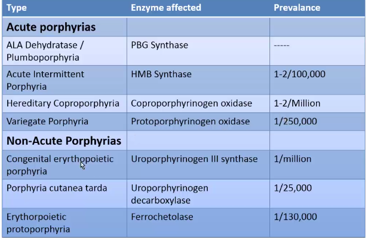
List three types of non-acute porphyria and the enzymes involved.
• Congenital erythropoietic porphyria - uroporphyrinogen III synthase • Porphyria cutanea tarda - uroporphyinogen decarboxylase • Erythropoietic protoporphyria - ferrochelatase
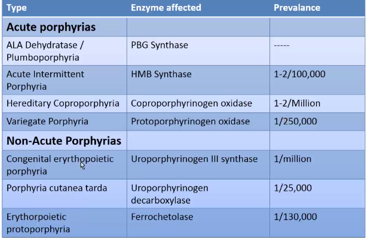
What is the most common type of porphyria?
Porphyria cutanea tarda
What is the most common type of porphyria in children?
Erythropoietic protoporphyria (EPP)
What does ALA synthase deficiency cause?
X-linked sideroblastic anaemia NOT a porphyria!
How can a mutation in ALA synthase lead to porphyria?
A gain-of-function mutation will results in increased throughput through the pathway leading to a build-up in protoporphyrin IX as it overwhelms the ability of ferrochetolase to convert it into haem. Similar clinical picture to EPP
What are the main features of PBG synthase deficiency?
• Causes acute porphyria • Extremely rare • Leads to accumulation of ALA • Abdominal pain (most important feature) • Neurological symptoms (e.g. coma, bulbar palsy, motor neuropathy)
Which deficiency causes acute intermittent porphyria? What is its inheritance pattern?
HMB synthase (aka PBG deaminase) Autosomal dominant
Outline the clinical features of acute intermittent porphyria (AIP)
Neurovisceral attacks: • GI symptoms - abdominal pain, vomiting, constipation • Neurological - polyneuropathy (paresthesia, weakness), seizures • GU symptoms - bladder dysfunction, red/brown urine • Autonomic dysfunction - tachycardia and hypertension • Psychiatric - hallucinations, anxiety, insomnia Important: there are NO skin symptoms (because no porphyrinogens are produced) NOTE: 90% will be asymptomatic
What is the mechanism behind the symptoms in AIP?
Rise in PBG and ALA
List some precipitating factors for acute intermittent porphyria.
• ALA synthase inducers e.g. steroids, ethanol, anticonvulsants (CYP450 inducers), barbiturates • Stress (infection, surgery) • Starvation/reduced caloric intake • Endocrine factors - sex hormones