Metal-Carbon σ-bonds
No description yet. This curated deck is ready for daily study.
Card preview (24)
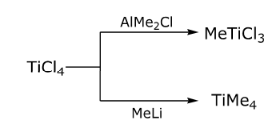
What are the 4 ways to make a Metal-Carbon σ-bonds?
1) Salt Elimination 2) Oxidative addition 3) Alkene Insertion 4) Ortho-metallation
Describe oxidative addition to form Metal-Carbon σ-bonds What groups are added? How does the geometry change?
• Low-valance complexes (e.g. Ir(I), Ni(0), Pd(0), and Pt(0) ), which are stabilised by phosphines undergo oxidative additions with alkyl, benzyl and aryl halides • Classically is a d⁸ square planar complex that does oxidative addition to give an octahdedral complex

The alkylating strength of the main group alkyls in salt eliminations decreases with….
Increasing covalent character of the M-C bond (less covalent = less reactive) E.g. MeLi is more polarised than AlMe₂Cl and hence will methylate 4 times compared to once for AlMe₂Cl
Describe Alkene insertion to form Metal-Carbon σ-bonds
• Hydride or an alcohol chain inserting onto a coordinated alkene to give you an alcohol chain on the metal centre • (Crucial step in the polymersation of alkenes)
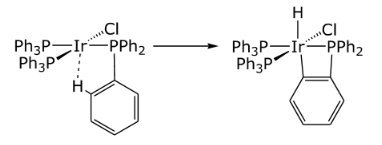
Describe Ortho-methylation to form Metal-Carbon σ-bonds
• Involves the cleavage of the ortho-C-H bonds of an aryl (usually phenyl) • (it is a common deactivating pathway of noble metal phosphine catalysts)
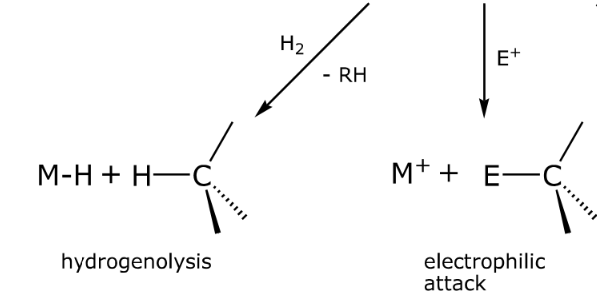
Metal-Carbon σ-bonds are useful to then undergo other types of chemsitry Why would you want to cleavage the newly formed M-C bond?
• To form new bonds with electrophiles e.g. halogen • hydrogenolysis (forming C-H bonds)
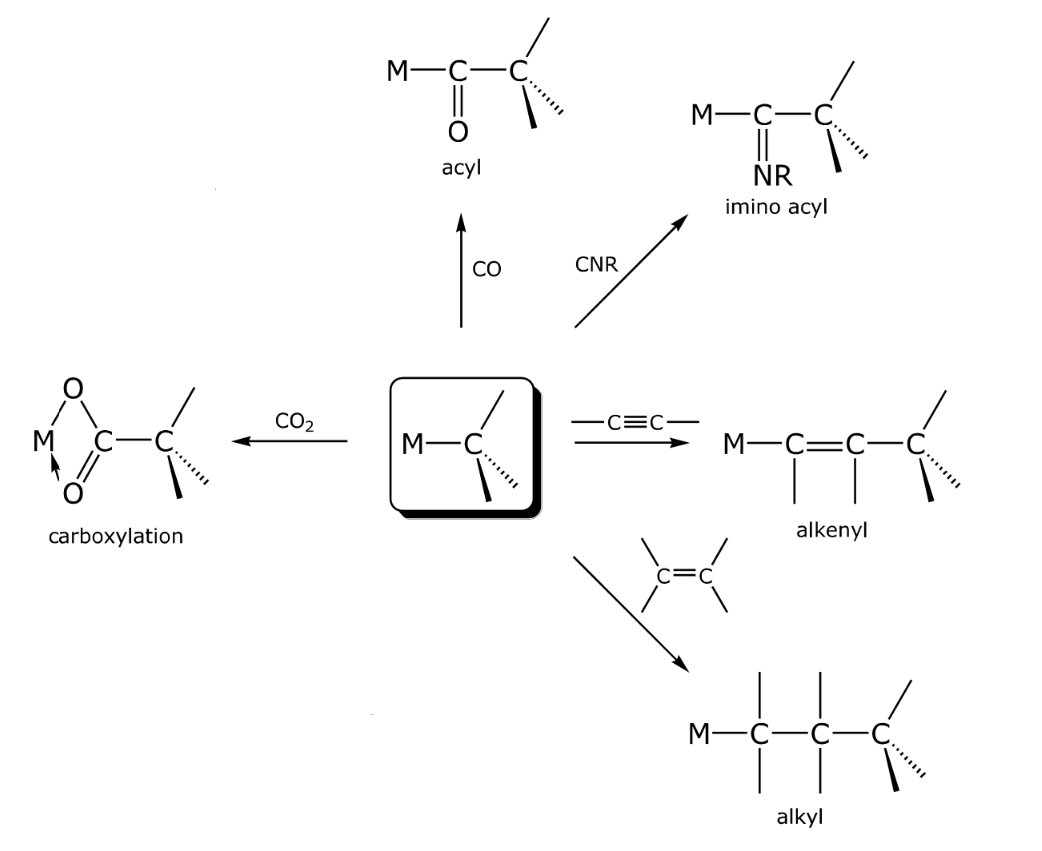
Metal-Carbon σ-bonds are useful to undergo other types of chemistry Why would you want to do a M-C bond insertion
• React with CO to add carbonyl groups between the M-C bond • React with alkenes, to extend the carbon chain, between the M-C • React with alkynes to add a C=C between the M-C
True or false: We can eliminate metal hydrides?
False Metal hydrides are similar to small alkyls which we cannot elimated
How can we make metal-hydride complexes?
• Beta-hydride elimination • Hydrogenolysis • Oxidative addition of H₂
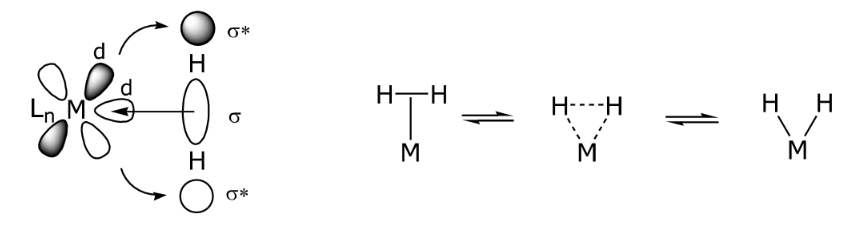
What two types of bonding can occur between metal hydrides?
• The hydrogen has a filled sigma bonding orbital and can donate electron density to the metal centre (σ-donation) • Also if metal has filled metal d-orbitals and hydrogen has empty σ’ orbital, there is π-back donation • However the π-back donation will weaken the H-H bond untill is breaks - also known as oxidative addition
What makes a Schrock Carbene? (metal-carbene complex) Hint: metal type, carbon properties, ligand types etc
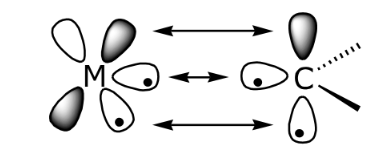
• Schrock Carbenes have early transition metals which are electron poor and high in oxidation state • their carbons are nucleophilic • their ligands are π-donors • They have two unpaired electrons in different orbitals (called a triplet binding)
How does the bonding occur in Schrock Carbenes?
• The carbon is acting as a two electron donor: ne electron through the sigma systen and one electron through the pi system • In total 4 electrons are involved in the bonding between the metal and carbon
What makes a Fischer Carbene complex? (metal-carbene complex) Hint: metal types, carbon properties, ligand types
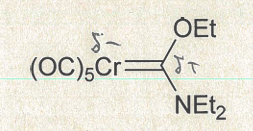
• Fischer Carbenes tend to be formed with late transition metals that are electron rich and hence a low oxidation state • Carbon is electrophilic (neutral ligands resulting in a δ⁺ carbon centre as metal is more δ⁻) • Ligands are π-acceptors • Ligands will donate their LP from p-orbitals into carbons empty p-orbitals, meaning carbon electrons for the C-M bond are actually paired, called a singlet binding
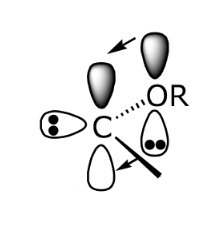
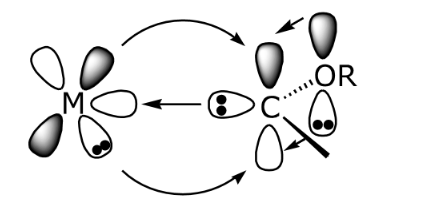
How does the bonding occur in Fischer Carbenes?
• sp² hybrided carbon • The LP on the carbon will donte to the metal • The metal can then back-donate a pair of electron from a d-orbital into an empty p-orbital on carbon
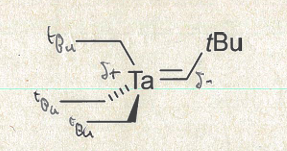
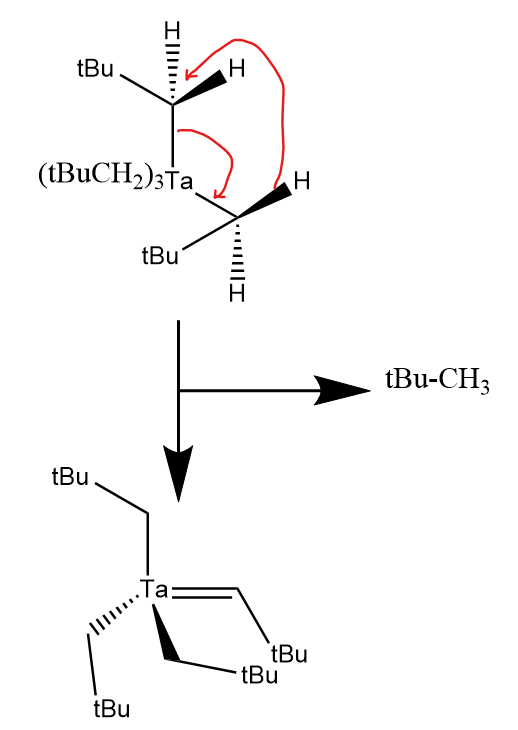
How do you make Schrock Carbenes? Explain how this takes place with the following Tantalum (V) species
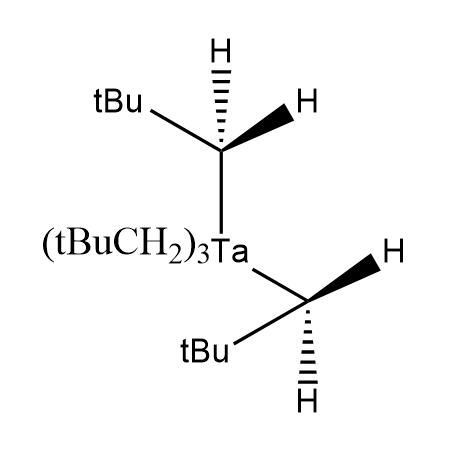
• α-hydrogen abstraction • a hydride from one of the ligands, transfers and attacks the other ligands • This breaks one Ta-C bond and allows a new Ta=C bond to form • Eliminating tBuCH₃
Why can’t this Tantalum (V) penta-alkyl species undergo beta hydride elimination
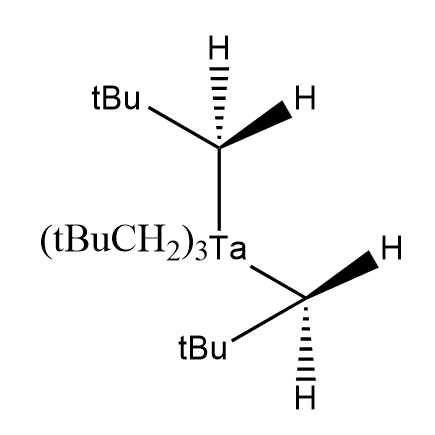
It has 5 alkyl groups on it which do not have a beta-hydrogen Instead all have a tert-butyl group in that poisition
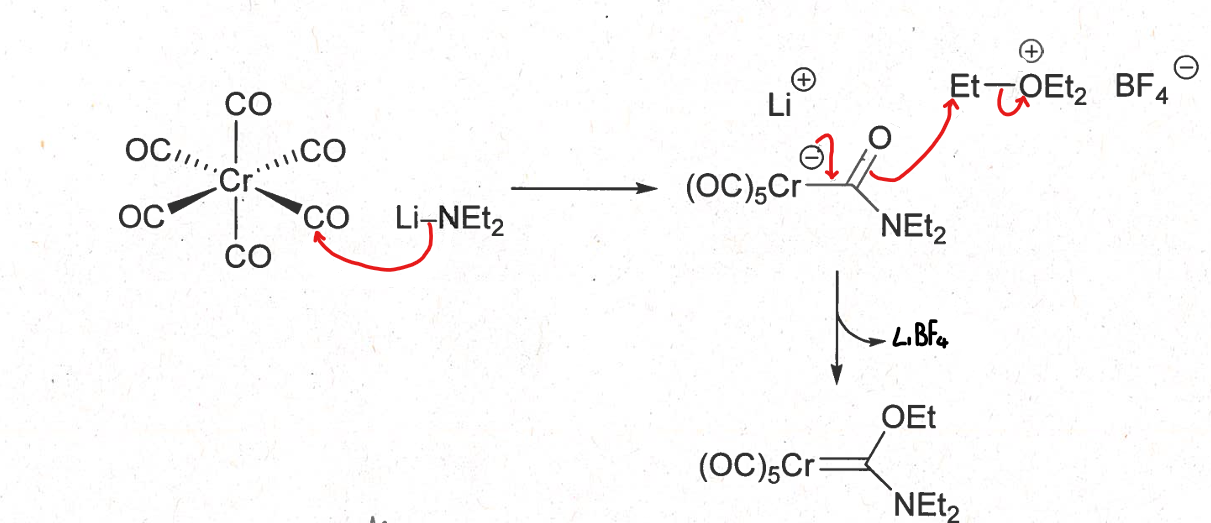
How do you make Fischer Carbenes? E.g. how would it occur with this Chromium (V) species
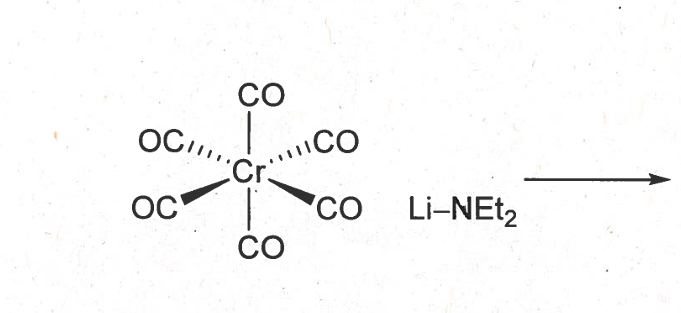
• Usually from metal hexa-carbonyl species reacting with a nucleophile • Where the nucleophile attacks one of the C=O ligands • Then we alkylate (e.g. triethyloxonium)
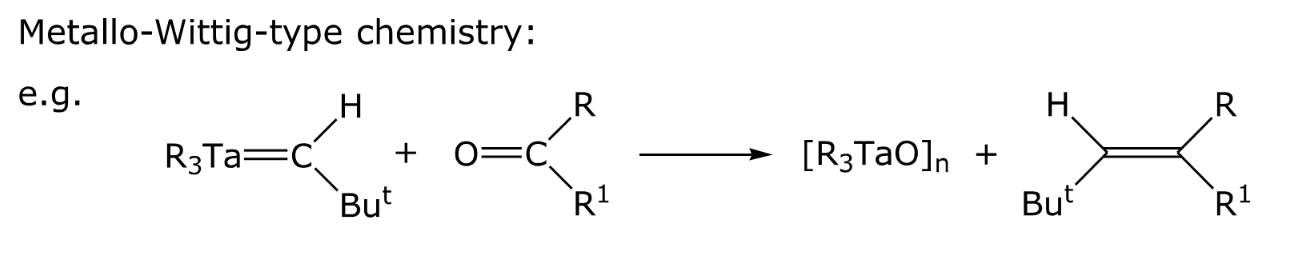
What is a big advantage of using Schrock Carbenes
• It is good at transferring CR₂ groups onto other things • E.g. reacting this Tantalum Schrock with a ketone we can form this alkene species
What is a disadvantage with using Schrock Carbenes
• They are highly reactive • Meaning many of these Schrock carbenes species (e.g. a titanium carbene species) cannot be isolated in its pure form
If we cant to form a titanium carbene, how can we overcome the issue of high reactivity?
• By using Tebbe’s reagents • It is a methylene-transfer reagent (an alternative to a Wittig reagent), and it can be regarded as a protected form of [Cp₂Ti=CH₂] which is unstable when unprotected
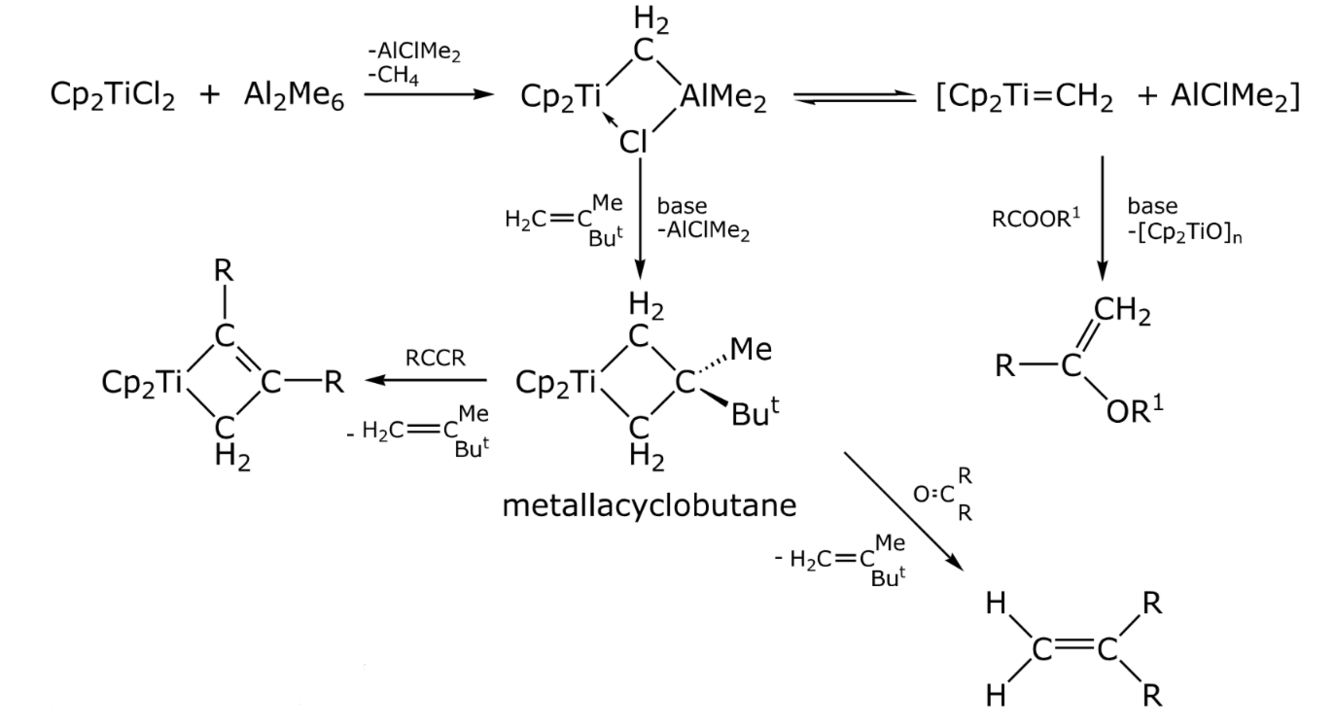
All Fischer Carbenes will generally have an oxygen substitued on How could we remove this?
Using an Amine

How does a cyclopropanation of a Fischer Carbene occur?
• A [2+2] cycloaddition reaction of a carbene with an alkenes give a metallacyclobutane (reversible)

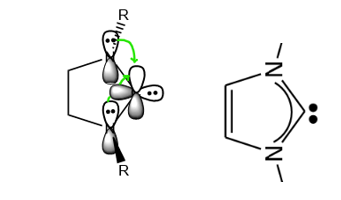
What is a N-Heterocyclic carbene (NHCs)?
• Relatively stable carbene with a lone pair • Stabilised through the nitrogen atom(s)
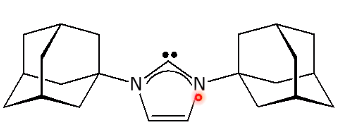
In terms of orbitals, how is a N-Heterocylic carbene stabilised?
Nitrogen lone pairs can donate into the p-orbital on carbon, to stabilise it Making it favourable for the 2E- on carbon to pair up in the sp² lobe (donate to a metal) singlet diamagnetic ground state (Note the R groups can also help stabilise due to being bulky and electron donating)