amount of substance
No description yet. This curated deck is ready for daily study.
Card preview (24)
complete this diagram
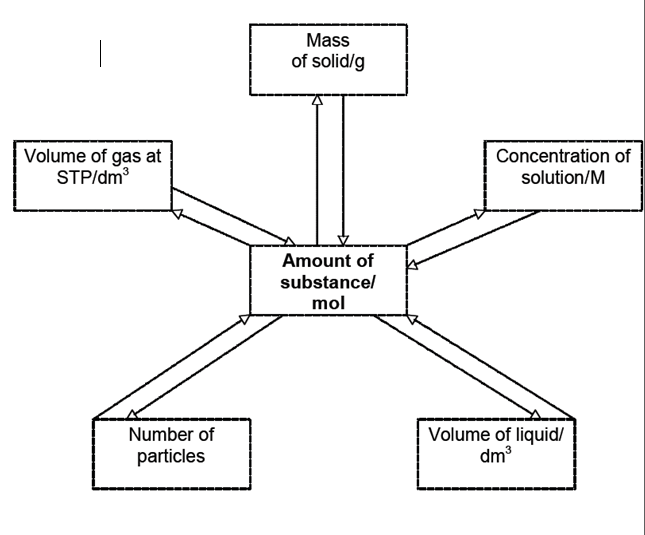
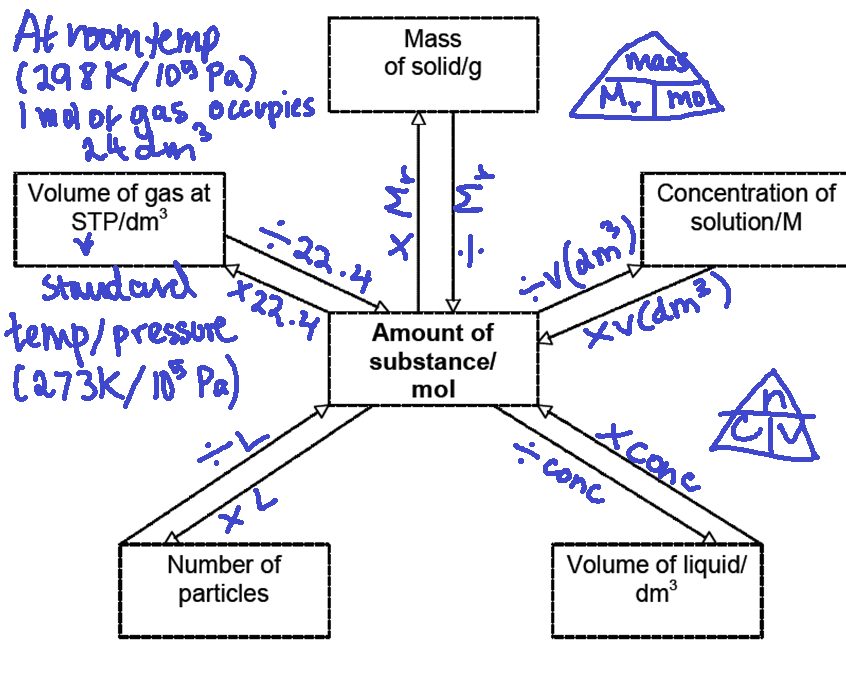
relative atomic mass definition
Average mass of 1 atom of an element compared to 1/12 the mass of one atom of 12C which has a mass of 12
what is the avogradro constant?
6.022 x 10²³ mol-1 the number of particles in 1 mol of a substance e.g. Carbon has a relative mass of 12 therefore 6.022 x 10²³ carbon atoms have a mass of 12g
explain how you would show which is the limiting reactant when 100g of TiCl4 reacts with 80g of Na using this reaction: TiCl4 + 4Na → 4NaCl + Ti
• the limiting reactant is the one that is completely used up in the reaction • calculate the number of moles of each reactant • moles of TiCl4 = 100/189.9 = 0.527 • moles of Na = 80/23 = 3.48 • use the molar ratio to see which is in excess • TiCl4 reacts with Na in a 1:4 ratio • therefore 0.527 mols of TiCl4 would require 4(0.527) = 2.108 mols of Na • we have 3.48 mols of Na • therefore Na is in excess so TiCl4 must be the limiting reactant
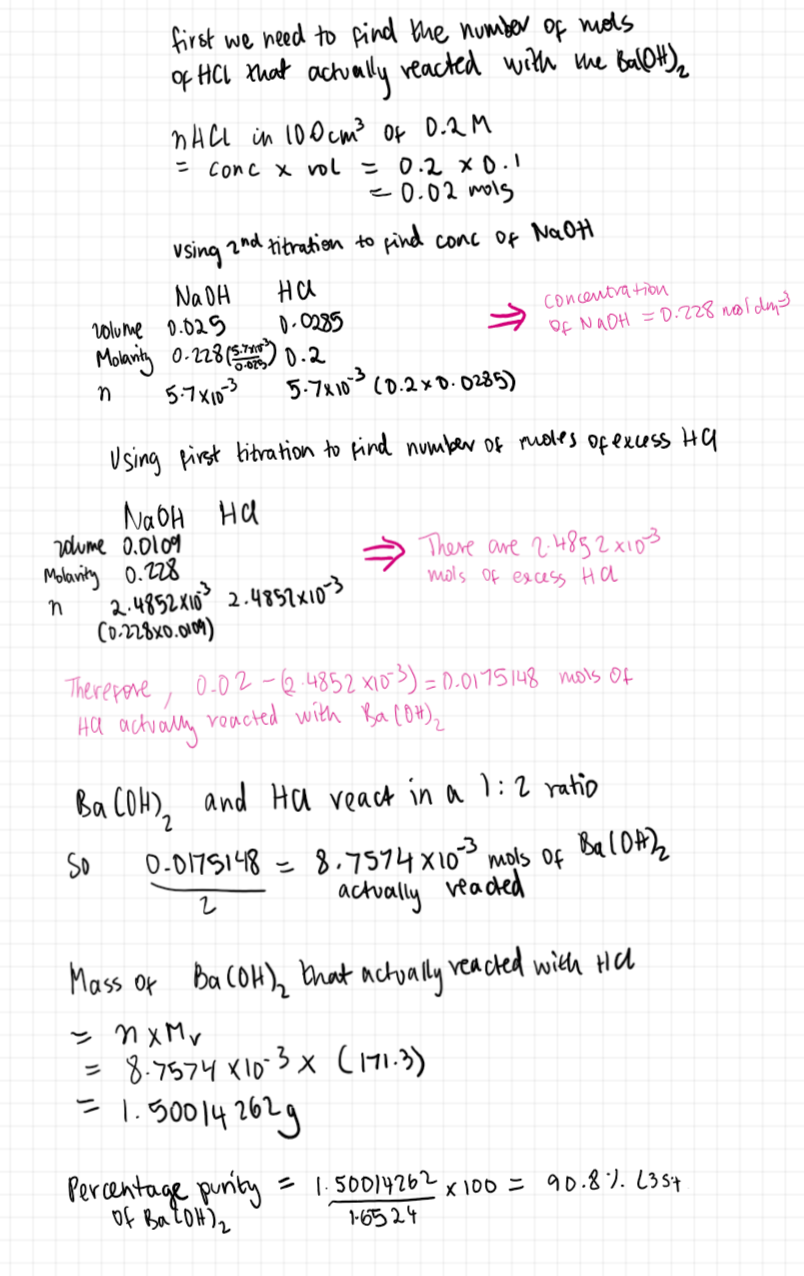
an impure sample of 1.6524g barium hydroxide reacted with 100cm3 of 0.2 mol dm-3 HCl when the excess acid was tritated against NaOH, 10.9cm3 of NaOH was needed 25cm3 of NaOh required 28.5cm3 of HCl in a separate titration calculate the percentage purity of the barium hydroxide sample
a student is carrying out a titration they rinsed the burette before filling it with sodium hydroxide solution state why they should use sodium hydroxide solution rather than water for the final rinse of the burette? [1]
water would dilute the NaOH and change its concentration
how to calculate percentage uncertainty for the use of the burette in a titration
total apparatus uncertainty / mean titre x 100
define relative molecular mass
the average mass of one molecule of an element or compound relative to 1/12th of the mass of an atom of 12C
difference between percentage yield and atom economy
atom economy - how efficiently atoms of reactants are converted to products. takes into account waste products and doesn’t use experimental data percentageyield- how efficient is the method. uses experimental values and does not take into account waste products
assumptions of ideal gas equation [6]
• all gas molecules in constant motion • collisions between gas molecules and walls of container create pressure • gas molecules are very small • mass of molecules negligible compared to the vol they occupy • no IMF between gas molecules • very high Ek
784 mg of impure citric acid C3H5O(COOH)3 is dissolved in water to form 250cm3 of solution 25cm3 samples were titrated with 0.05 moldm-3 NaOH(aq) 23.95 cm3 of NaOH was required find the mass, in mg, of citric acid dissolved in 250cm3 of the solution the Mr of citric acid is 192
1 mole citric acid reatcs with 3 moles NaOH moles NaOH = 23.95 x 0.05 x 10-3 = 0.001198 moles acid = 0.01198 / 3 = 0.000399 mass of acid in 25cm3 = 192 x 0.000399 = 0.07664g mass of acid in 250cm3 = 0.7664g = 766.4mg therefore 766mg (3s.f) of citric acid was dissolved in 250cm3 of solution
A student recorded the temperature of aqueous ethanoic acid in a polystyrene cup for three minutes. At the fourth minute, the student added sodium hydrogencarbonate. The student stirred the mixture and carried on recording the temperature every minute for several minutes. The student’s measurements are shown in Figure 2. A best-fit line showing the temperature before mixing has been drawn. Draw an appropriate best-fit line on Figure 2 and use it to find the temperature change at the time of mixing
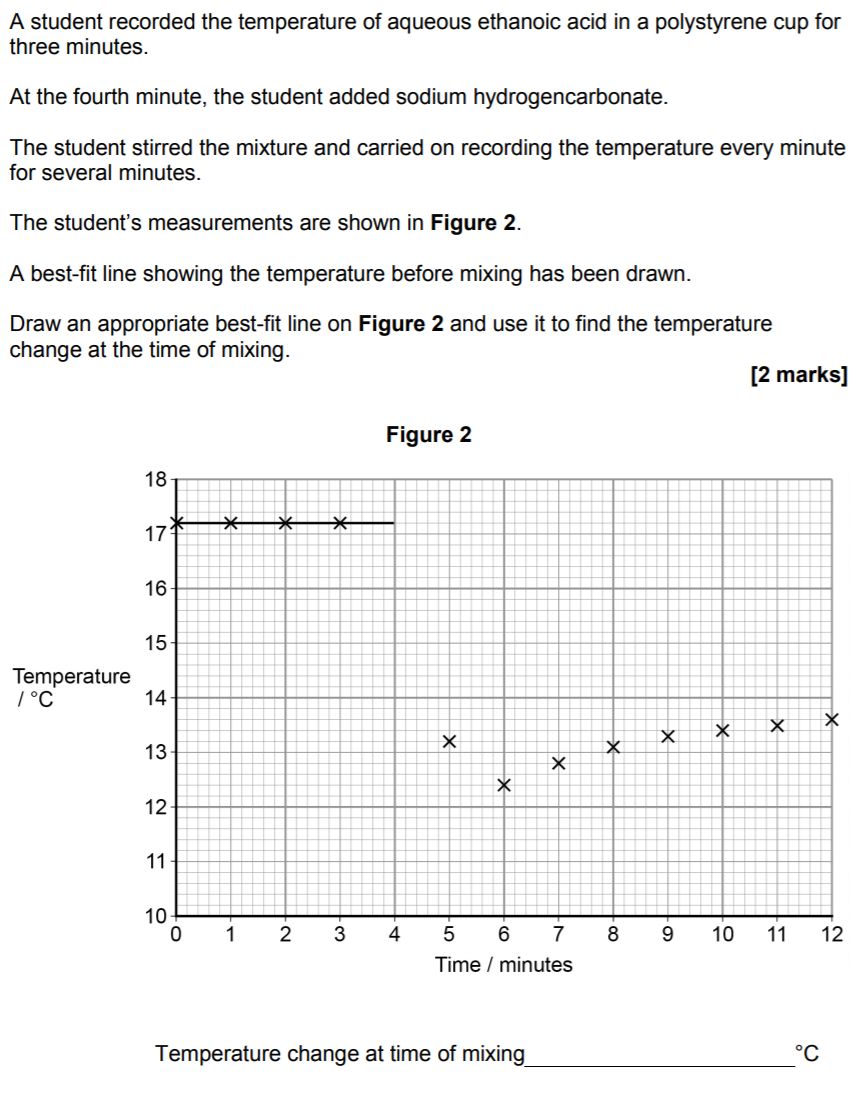
draw the line of best fit as a curve by hand (do not use a ruler) and extrapolate to the 4th minute and find the temp temp change = 17.2 - 11.4 = 5.8º
common ionic equation
when ppt forms - ion(aq) + other ion (aq) → ppt (s) neutralisation reactions : H+ (aq) + OH- (aq) → H2O (l) acid + carbonate : 2H+ + CO32- → CO2 (g) + H2O (l)
1) write the ionic equation of the reaction between chlorine and dilute sodium hydroxide solution 2) give the reaction between chlorine and cold water
1) Cl2 + 2HO- → OCl- + Cl- + H2O 2) Cl2 + H2O → HClO + HCl
write ionic equations for the following: a) reaction of aqueous potassium carbonate with nitric acid b) precipitation of lead(II)bromide when aqueous lead(II)nitrate is mixed with aqeous sodium bromide c) reaction of aqueous ammonia with sulfuric acid d) reaction of hydrochloric acid with aqueous potassium hydroxide
identify what is changing state or charge(species that stay the same state do not appear in ionic equations) a) carbonates react with acids to form a salt (so K+ and NO3- ions stay the same) ,carbon dioxide gas and water: CO32-(aq) + 2H+(aq) → CO2(g) + H2O(l) b) PbBr2 ppt forms from its aqueous ions: Pb2+(aq) + 2Br-(aq) → PbBr2(s) c) NH3(aq) + H+(aq) → NH4+(aq) d) neutralisation reactions all have the same ionic equation : OH-(aq) + H+(aq) → H2O(l)
describe how to prepare a burette for use
• rinse burette with deionised water, ensuring water flows through jet • discard water • rinse burette with solution you will be filling it with, ensuring it flows through the jet • discard solution • fill with solution
describe how to prepare a pipette for use in a titration
rinse pipette with deionised water discard water rinse with solution you will be filling it with discard solution
describe how to use a pipette to measure a given volume of a solution
attach pipette filler to top of pipette place pipette in solution and apply suction to draw solution up above the line on the pipette solution is released until the bottom of the meniscus at eye level sits on the line
describe how to carry out a dilution
pipette 25cm3 of the original solution into a clean volumetric flask add deionised water to the flask until the water is just below the line use a small disposable pipette to add deionised water very slowly until the bottom of the meniscus at eye level is on the line stopper the flask and invert several times to mix thoroughly
describe how to prepare a standard solution from a mass of solid
weigh out an accurate mass of a solid in a clean, dry beaker add enough deionised water to dissolve the solid, stirring with a glass rod transfer the solution to a 250cm3 volumetric flask using a funnel rinse the beaker and glas rod with deionised water, adding the wasings to the volumetric flask add more deionised water until the bottom of the meniscus at eye level is on the mark stopper the flask and invert multiple times to mix thoroughly
what kind of cemical should be used to prepare a standard solution (a solution for which the conc is accurately known)
has an accurately known Mr so that the number of moles can be determined (therefore hydrated salts not used) very pure has a high Mr so weighing errors are minimised does not absorb moisture from or lose moisture to environment
describe how to carry out a titration
• rinse burette with solution you will be filling it with, then discard rinsings and fill burette • rinse pipette with solution you will be filling it with, discard rinsings • use the pipette and a pipette filler to transfer 25cm3 of this solution into a conical flask • add 2-3 drop of indicator to the conical flask • add the solution from the burette, constantly swirling the conical flask, until the solution in the flask just changes colour. this is the rough titration • to reduce the effect of random error on titration results, repeat until you achieve 2-3 concordant results, making sure you add the solution from the burette dropwise near the end point • calculate the mean titre from the concordant results (within 0.1 cm3 of each other)
a burette has uncertainty ±0.05 cm3 in a titration the initial burette reading was 0.05cm3 and the final burette reading was 22.55cm3 what is the percentage uncertainty in the titre value?
titre value = 22.55 - 0.05 = 22.5 percentage uncertainty = 2 x 0.05/22.5 x 100 = 0.44% remember to multiply by two because you are using two readings
some of the solution from the burette may run down the inside of the conical flask how can you ensure all the solution added from the burette has a chance to react (apart from swirling the conical flask)?
squirt deionised water down the side of the flask to was the solution from the burette down into the solution below the amount of moles present in the pipetted solution will no change so this will not affect the titre achieved