3.3 Halogenoalkanes
No description yet. This curated deck is ready for daily study.
Card preview (22)
State the benefit to life on Earth of ozone in the upper atmosphere (1)
• Absorbs harmful ultraviolet radiation
CFC-11 is a greenhouse gas that can contribute to global warming. State and explain how CFC-11 is able to contribute to global warming (1)
• Absorbs IR Radiation • Has Polar bonds
Define the term electronegativity and explain the polarity of the C-Br bond in 2-bromopropane (3)
• The (relative) tendency / ability of an atom to attract a pair of electrons/ the electrons/ electron density in a covalent bond • Br is more electronegative than C (or vice versa) • So Br is δ- and C is δ+
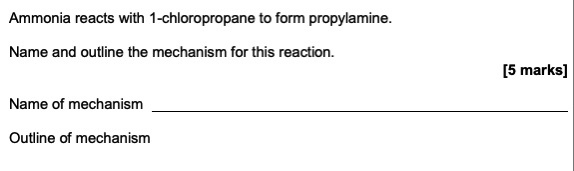
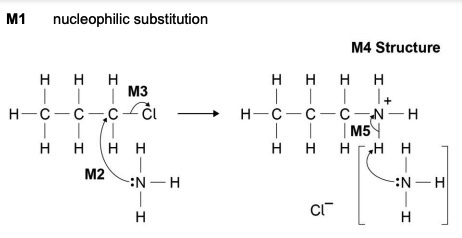
Outline the mechanism for the reaction of 2-bromopropane with an excess of ammonia (4)
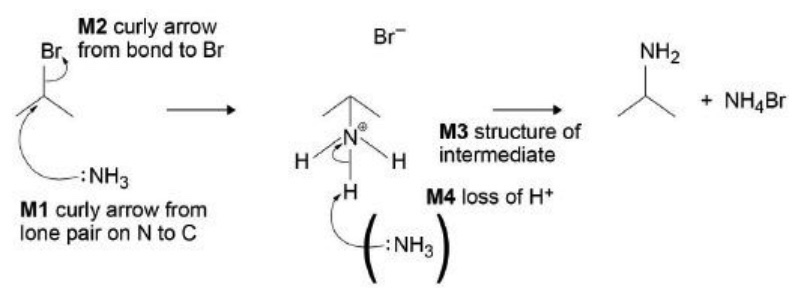
Reaction 1 occurs via a nucleophilic substtution mechanism Explain why the halogenoalkane is attacked by the nucleophile in this reaction (in general terms) (3)
• Bromine is more electronegative than carbon (difference in electronegativity) • C is partially positive / electron deficient • Lone/electron pair (on the nucleophile) donated to the partially positive carbon
In the upper atmosphere, it is more likely for CBrF3 to produce bromine atoms than it is for CClF3 to produce chlorine atoms. Suggest one reason for this (1)
• (The) C‒Br (bond) breaks more readily / is weaker than (the) C‒Cl (bond) (or converse)
Suggest one reason why the use of CFCs was not restricted until several years after Rowland and Molina published their research (1)
• lack of evidence that ozone was being depleted • lack of alternatives to CFCs
CFC-11 is a greenhouse gas that can contribute to global warming State and explain how CFC-11 is able to contribute to global warming (2)
• absorbs infrared radiation • molecule has polar bonds
State how chlorofluorocarbons (CFCs) form chlorine atoms in the upper atmosphere (1)
• C-Cl bonds broken (homolytically)
Give equations to show how chlorine atoms catalyse the decomposition of ozone (2)
• Cl● + O3 → ClO● + O2 • ClO● + O3 → Cl● + 2O2
Nitrogen monoxide (NO) catalyses the decomposition of ozone into oxygen Write the overall equation for this decomposition (1)
2O3 > 3O2
Explain why excess ammonia is needed in substitution reactions (1)
• Ammonia acts both intially as a nucleophile then as a base • Intermediate could react further (removes a proton)
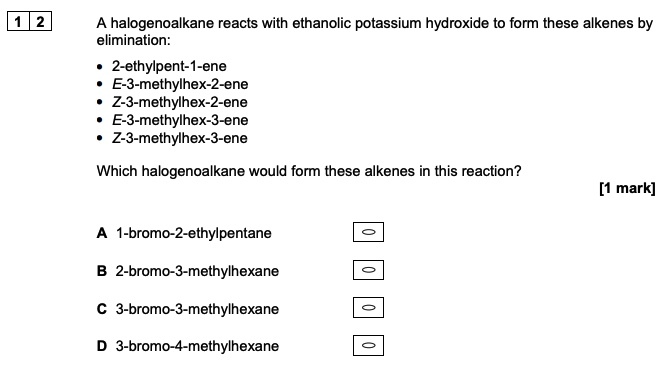
Contitions for Elimination (OH-)
• High temperatures, ethanolic
Contitions for Substitution (OH-)
• Room temperature, aqueous solution
Define the term substitution, as applied to a necleophilie substitution in a haloalkane (1)
Replacement of the halogen (atom) by the nucleophile
Define the term bond enthalpy as applied to a carbon-haolgen bond (1)
The amount of energy / enthalpy required / needed to break / split the carbon-halogen bond
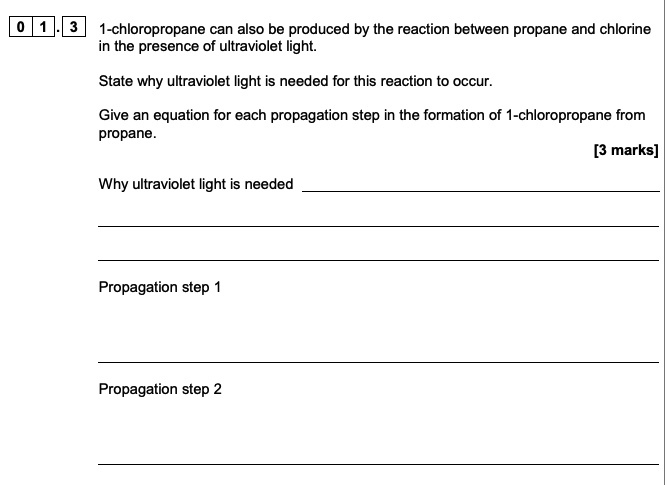
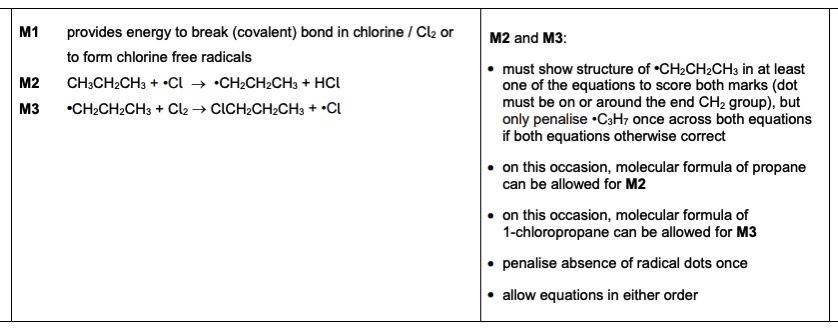
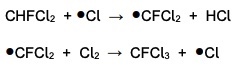
Give an equation for each of the two propagation steps in the conversion of CHFCl2 into CFCl3 (2)
Give two equations to show how chlorine free radicals decompose ozone (2)

c