Unit 4 Energy systems - Nutrition
No description yet. This curated deck is ready for daily study.
Card preview (23)
types of molecules
• Macronutrients * Carbohydrates (complex and simple sugars) * Proteins * Lipids (fats) * Water • Micronutrients * Vitamins * Minerals
sources of carbohydrates (7)
• Cereals • Root crops • Pulses • Vegetables • Fruit • Dairy • Processed sugars
functions of carbohydrates (4)
• Provide fuel for the body - through glucose being used to generate ATP • Acts as an energy storage - glycogen is a storage form of glucose • Cell membrane • DNA/RNA
types of carbohydrates
Monosaccharide (energy) Made of 1 sugar molecule Glucose, galactose, fructose Disaccharide Made of 2 sugar molecules Sucrose, lactose, maltose Polysaccharide (storage) Made of many sugar molecules Starch, cellulose, glycogen
structure of carbohydrates
Made up of Carbon, Hydrogen and Oxygen ONLY 1C : 2H : 1O ratio
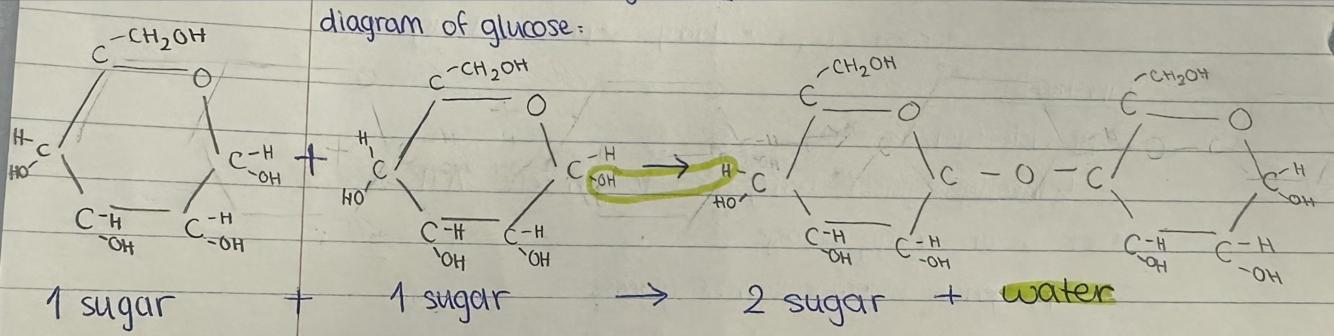
formation of disaccharide (2)
Type: Condensation Reaction monosaccharide + monosaccharide → disaccharide + water
formation of polyssacharide - 2
Storing Sugars - adding a glucose to a glycogen chain Polysaccharide + monosaccharide → polysaccharide + water
sources of lipids (fats) - 8
• Meat • Milk • Dairy products • Eggs • Fish oil • Seeds • Nuts • Vegetable oils
functions of lipids (4)
• Fuels • Energy storage • Cell membranes • Hormones
structure of lipids
• Made up of Carbon, Hydrogen and Oxygen only • Triglycerides are the most common form of lipid in the human body • 1 glycerol + 3 fatty acids
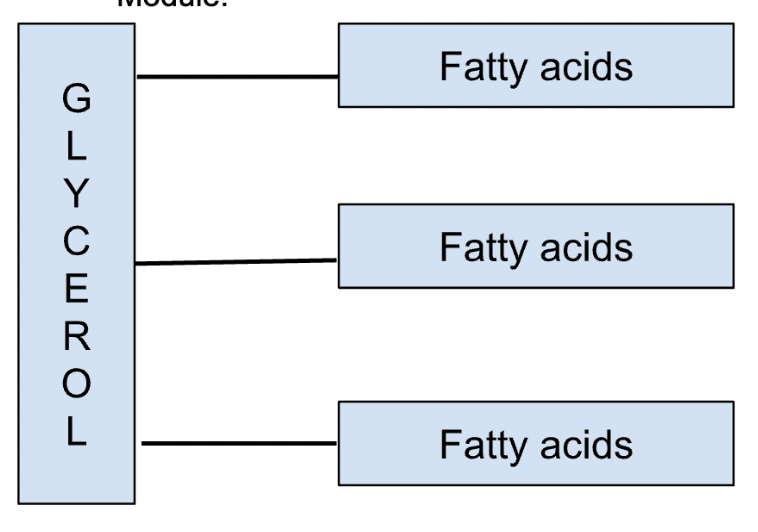
types of lipids (2)
• Unsaturated * Not all Carbons of the fatty acid tails have 2 hydrogens bonded to it * Not full of hydrogens • Saturated * All carbons of the fatty acid tails have 2 hydrogens bonded to it * Full of hydrogens
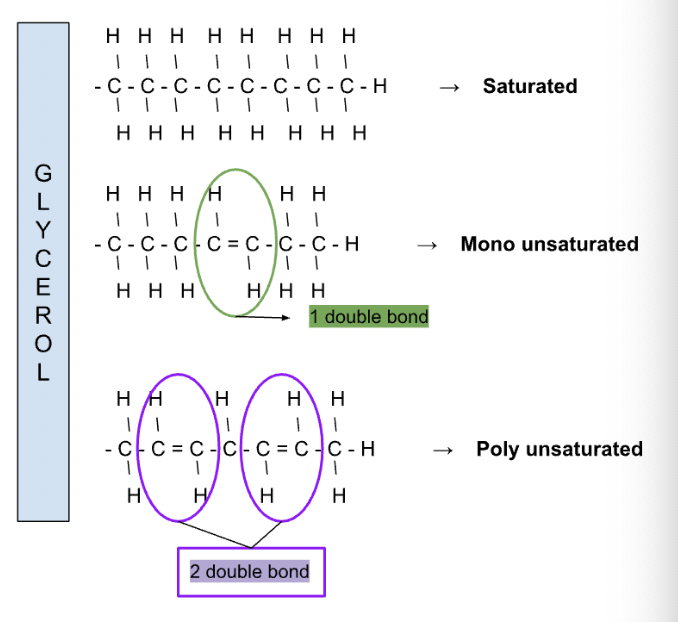
difference in structure between saturated and unsaturated (2)
saturated: * all carbon molecules at the end of fatty acid tail haev 2 hydrogen bonded to it * full of hydrogen unsaturated: 1. mono unsaturated = 1 double bond 2. poly unsaturated = 2 double bond
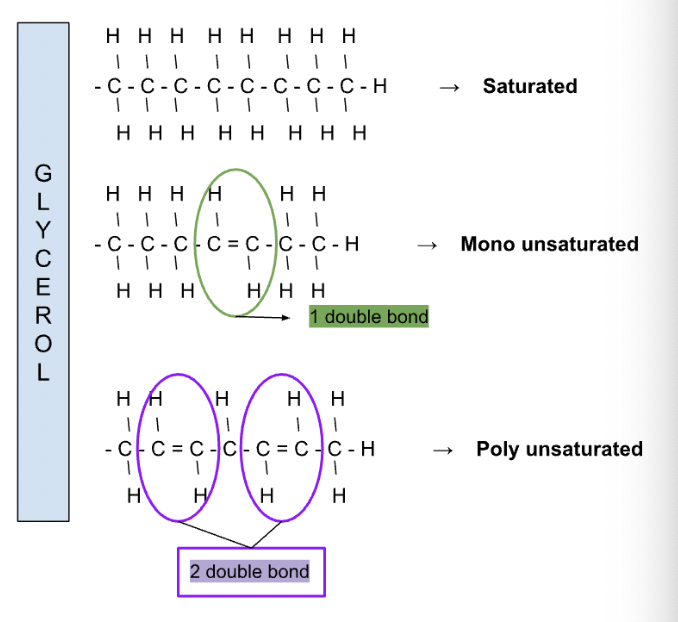
difference between unsaturated and saturated lipids
Unsaturated * Originate from plant-based foods (olive oil, olives, avocado, peanuts) * More healthy → increase good cholesterol Saturated * Originate from animal sources (meat, poultry, full-fat dairy products) * Less healthy → Increase bad cholesterol
source of protein -6
Meat Fish Dairy Eggs Pulses Cereals
functions of protein -6
Structure Transport molecule Communication molecule Enzymes Protection Fuel
structures of proteins
Made up of Carbon, Hydrogen, Oxygen AND Nitrogen A protein is made of repeating blocks of Amino Acids
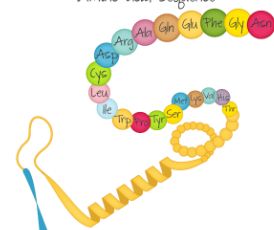
amino acids - 5
The building blocks of proteins form peptide bonds: * When two or more amino acids bond together, a peptide bond is formed. * forms a polypeptide, which can further fold into a specific 3-dimensional structure, creating a protein. * There are 20 different types of amino acids: Each with a unique structure * Roles in the body: precursors to enzymes, hormones, and neurotransmitters, metabolism, energy production, and cell signaling.
essential (3) vs non essential amino acids (4)
Essential * those that the body cannot synthesize (make) itself * Have to consume (eat) them * 9 Amino Acids Non-Essential * Those the body CAN synthesize itself * 5 Amino Acids Conditionally Non-Essential: * If body is healthy non-essential, if sick become essential * 6 Amino Acids
amino acids food source - 2
• Complete proteins: are sources that have all of the essential amino acids in them –>Animal based proteins, soy, buckwheat • Incomplete proteins: are those that do not have all the essential amino acids need to eat a combination to ensure complete AA consumption –>Grains, oats, pasta
healthy diet - 2
• Total amount of food energy consumed in a day - measured in calories or kJs • Recommended ratio depends on age, fitness level, height
how much energy is in macronutrients
Unit for food energy is the kilojoule (kJ) 1 calorie = 4,184 kJ Protein - 1720 kj / 100g Carbohydrate - 1760 kj / 100g Lipids - 4000 kj / 100g
endurance athletes - 3
• No set definition • Undergoing an activity for a prolonged period of time • Need to consume nutrients in different amounts due to their sport activity participation compared to non-athletes.
difference between endurance and non endurance athletes - 5
• Activity uses a lot of energy to perform • High amounts of thermoregulation (sweating) • Length of exercise leads to wear on muscles • Prolonged exercise • More frequent training sessions