Energetics & Equilibria 3: Chemical changes
No description yet. This curated deck is ready for daily study.
Card preview (11)
Define the standard state of a substance
The pure form at pressure = 1 bar and at the specified temperature.
Define: • ΔrHo • ΔrGo • ΔrSo
ΔrHo is the standard enthalpy change: the enthalpy change when one mole of reaction occurs at a specified, constant composition, and at standard conditions. ΔrGo is the standard Gibbs energy change: the Gibbs energy change when one mole of reaction occurs at a specified, constant composition, and at standard conditions. ΔrSo is the standard entropy change: the entropy change when one mole of reaction occurs at a specified, constant composition, and at standard conditions. Standard state implies pure substance: i.e. pure reactants form pure products Important: constant composition means the mixture is big enough that the concentrations of species don’t change throughout the reaction
Define ΔfHo, the standard enthalpy of formation of a compound.
The standard enthalpy change of a reaction where one mole of the compound is formed from its constituent elements, each in their reference states (i.e. most stable state at 1 bar), at a specified temperature. by definition, the standard enthalpy of elements in their reference states = 0, since no energy is required to put them into a state they’re already in (since stablest)
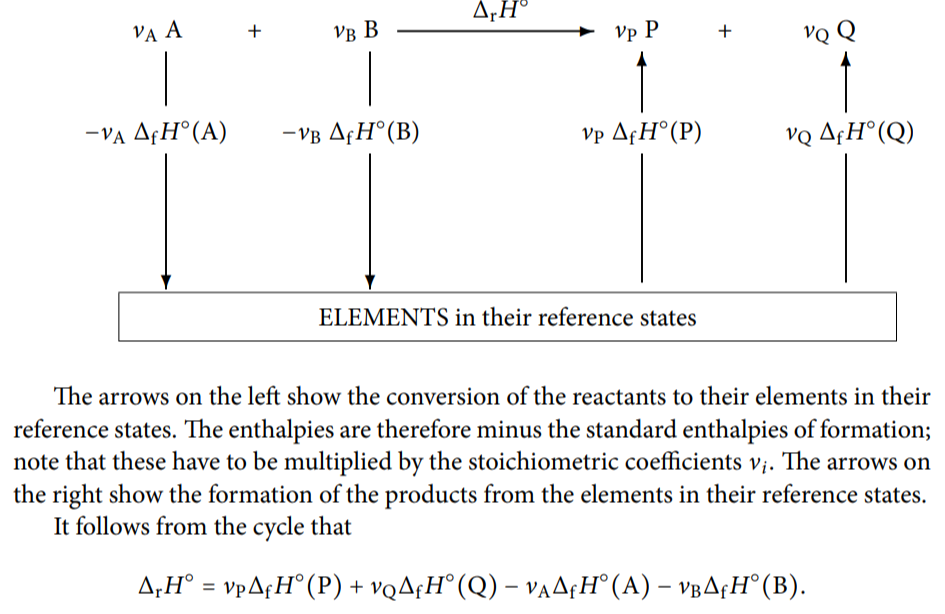
Draw a cycle which can be used to find the standard enthalpy change for generic reaction vAA + vBB –> vpP + vqQ.
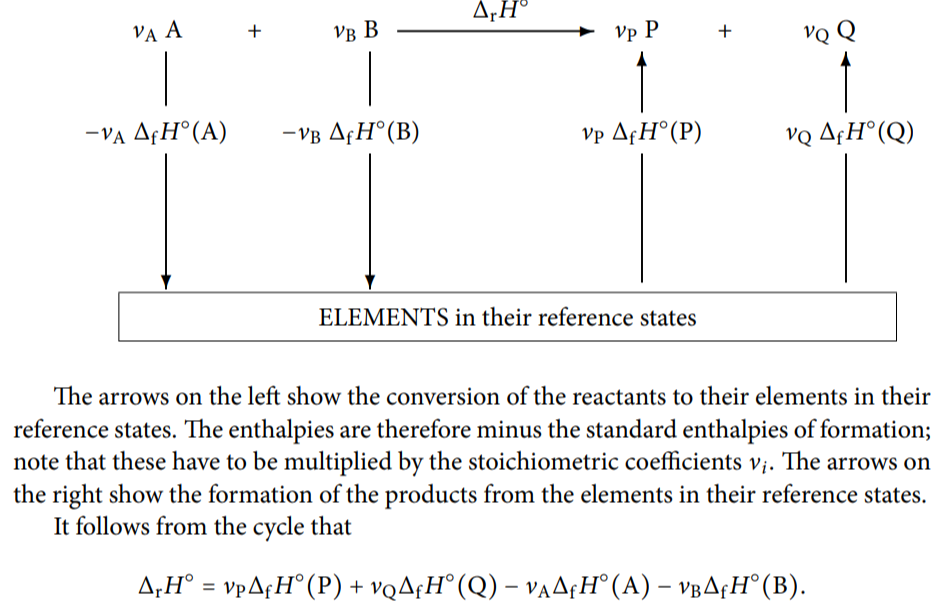
Give the expression for the standard entropy change for the generic reaction vAA + vBB –> vpP + vqQ.
ΔrSo = vpSom(P) + vQSom(Q) - vASom(A) - vBSom(B)
Give the expression for the standard Gibbs energy of a reaction.
ΔrGo = ΔrHo - TΔrSo
ΔrHo varies with temperature. Give the relationship giving ΔrHo at temperature 2, given knowledge of ΔrHo at temperature 1.
ΔrHo(T2) = ΔrHo(T1) + ΔrCpo[T2 - T1]
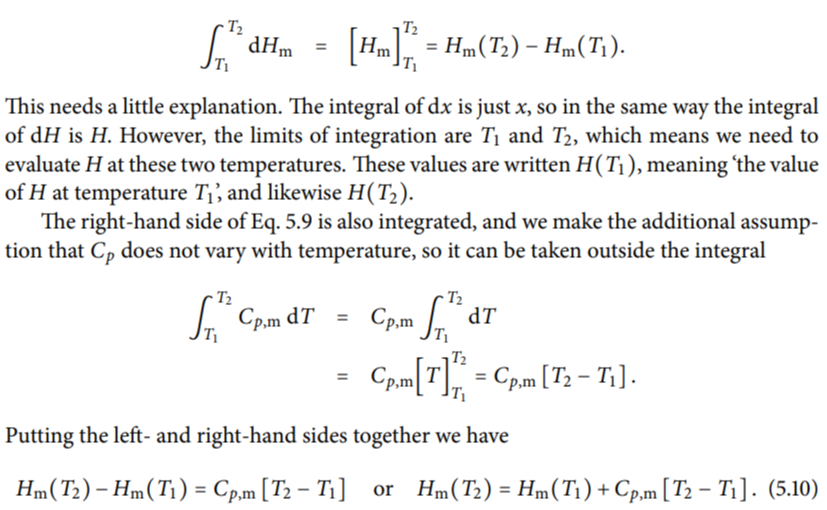
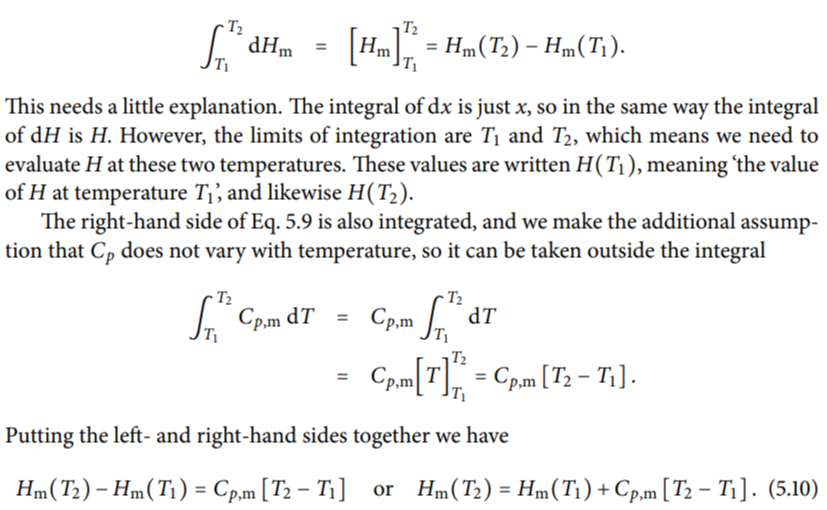
ΔrHo varies with temperature. Derive a relationship giving ΔrHo at temperature 2, given knowledge of ΔrHo at temperature 1. State any assumptions made.
Define standard molar heat capacity at constant pressure: Consider generic reaction vAA + vBB –> vpP + vQQ ΔrCpo = νPCop,m(P) + νQCop,m(Q) - νACop,m(A) - νBCop,m(B) Definition of heat capacity at constant pressure: Cp,m = (∂Hm/∂T)p (constant pressure) Cp,m = dHm/dT (constant pressure) (Everything is under standard conditions so can drop molar subscript) So ΔrCpo = dΔrHo/dT Assume heat capacity is constant in range T1 to T2, so: Return to Cp,m = dHm/dT (constant pressure) So dHm = Cp,mdT (constant pressure) Then integrate (image) Apply integrated relationship to definition of molar heat capacity at standard pressure: ΔrHo(T2) = ΔrHo(T1) + ΔrCpo[T2 - T1]
ΔrSo varies with temperature. State the relationship giving ΔrSo at temperature 2, given knowledge of ΔrSo at temperature 1.
ΔrSo(T2) = ΔrSo(T1) + ΔrCpoln(T2/T1)
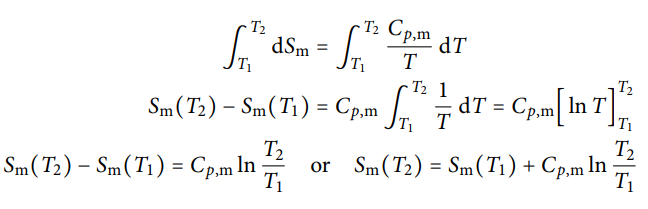
ΔrSo varies with temperature. Derive a relationship giving ΔrSo at temperature 2, given knowledge of ΔrSo at temperature 1. State any assumptions made.
Define standard molar heat capacity at constant pressure: Consider generic reaction vAA + vBB –> vpP + vQQ ΔrCpo = νPCop,m(P) + νQCop,m(Q) - νACop,m(A) - νBCop,m(B) Then derive relationship Recall dSM = Cp,mdT/T (constant pressure) Integrate between T1 and T2 (image) assumption: temperatures are not very different, so Cp is constant and can be taken out of the integral (Everything is under standard conditions so can drop molar subscript) ΔrSo(T2) = ΔrSo(T1) + ΔrCpoln(T2/T1)
Convert 1 bar to Pa
1 bar = 105 Pa