carboxylic acids
No description yet. This curated deck is ready for daily study.
Card preview (10)
how do boiling points of carboxylic acids compare to those of corresponding alcohols?
higher. presence of electron-withdrawing carbonyl group, C=O group results in a more polar O-H bond, compared to O-H bond in ROH. Hence, more energy is required to overcome the stronger intermolecular hydrogen bonds between carboxylic acid molecules.
can dimerisation occur for carboxylic acids?
yes. in liquid state, organic solvents or in vapour phase, the apparent Mr of the carboxylic acid is twice its original Mr. two carboxylic acid molecules can be joined together by hydrogen bonds to form a dimer. this does not happen in aqueous state as the carboxylic acid will form hydrogen bonds with water instead, which is in large excess.
how does solubility of carboxylic acids vary with the number of carbon atoms?
solubility decreases as the number of carbons increases. the c=o and -OH group can form hydrogen bonds with water molecules. the alkyl group is non-polar and id-id interactions exist between alkyl groups. solubility of carboxylic acids with longer carbon chains decreases because as the alkyl group/chain becomes larger/longer; the id-id interactions between the alkyl groups become predominant and these non-polar chains interfere with the hydrogen bonding between the c=o and -OH groups with the water molecules.
why do carboxylic acids have a lowker pKa than alcohols and phenols?
the strength of an acid depends on the stability of its conjugate base. a less stable conjugate base would mean that the acid is less likely to dissociate to produce H+ ions(equilibrium lie more to the left) and the acid is a weaker acid. carboxylate anions are stabilised by the delocalisation of negative charge over two highly electronegative oxygen atoms. this decreases the intensity of negative on the O atom and stabilises the carboxylate anion. stability of conjugate base: carboxylate >phenoxide>alkoxide same trend for acidity
how does the substituent on the carboxylic acid affect the acidity of the acid?
electron-donating substituents: - intensify the negative charge on the carboxylate anion - destabilise the conjugate base of the acid - decrease acidity electron-withdrawing substituents: - disperse negatibe charge on carboxylate anion - stabilises the conjugate base of the acid - increase acidity.
how does the boiling point of acyl chlorides vary with those of corresponding carboxylic acids?
lower absence of the -OH group mean that acyl chlorides cannot form intermolecular hydrogen bonds. Hence, less energy is required to overcome the weaker pd-pd interactions between acyl chloride molecules.
how does the boiling point of esters vary with carboxylic acids with the same number of carbons?
lower. the absence of the -OH group means that esters cannot form intermolecular hydrogen bonds. Hence, less energy is required to overcome the weaker pd-pd interactions between ester molecules.
how to name esters
first part of name comes from alcohol second part of name comes from carboxylic acid
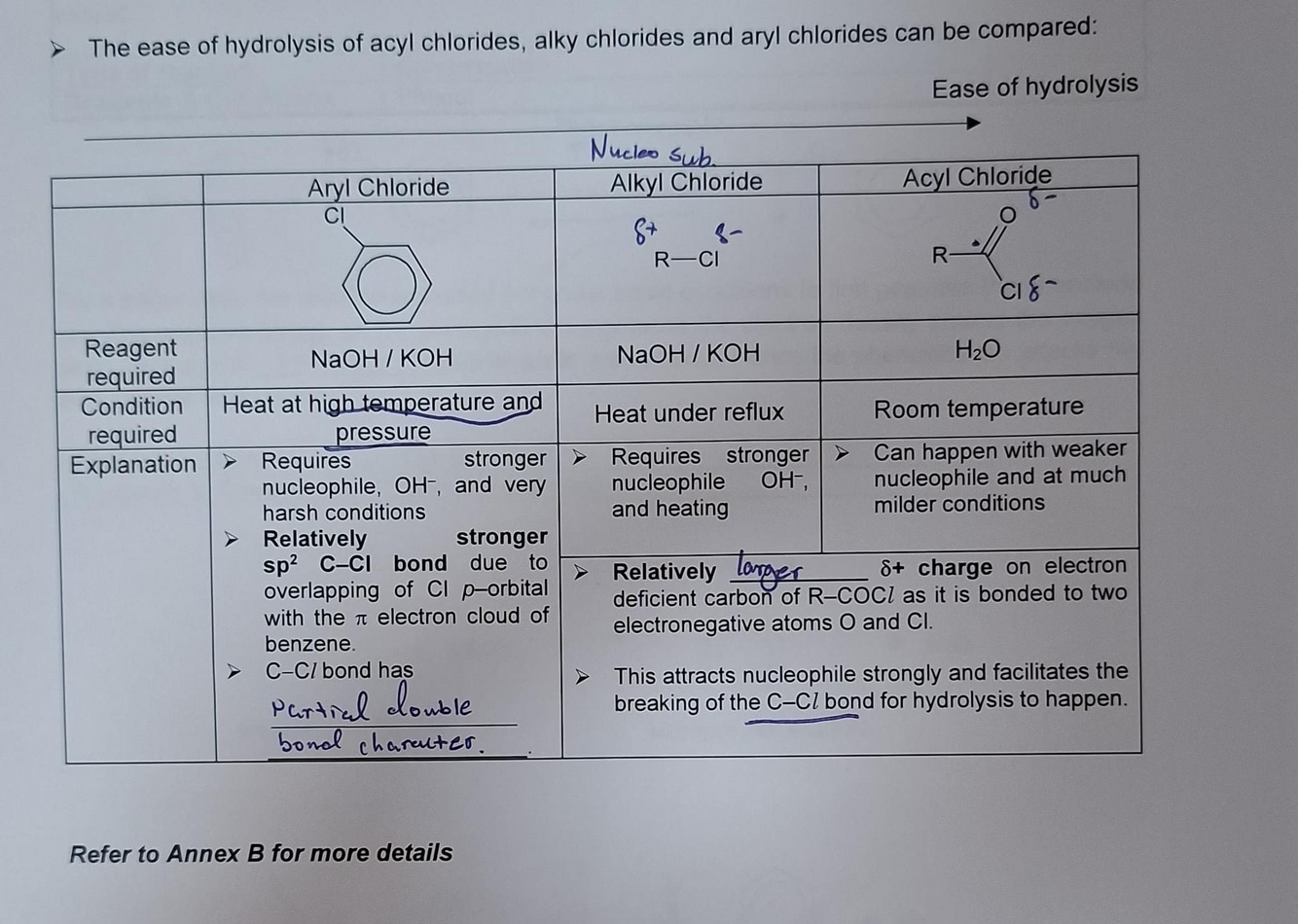
how does the ease of hydrolysis comapre for acyl chlorides, alkyl chlorides and aryl chlorides?
esters why is the condensation reaction between phenol and acyl chloride first carried out under basic conditions?
to generate a phenoxide ion, which is a stronger nucleophile as the negative charge of the phenoxide ion increases the electron density around the oxygen atom, allowing it to attack the acyl chloride more readily. the reaction between acyl chloride and phenol would be much slower than the same reaction with phenoxide salts as phenol is a weaker nucleophile. - the lone electron pair on the oxygen atom of phenol is able to delocalise into the benzene rinh, becoming less available for the condensation. **this also happens for phenoxide ion but there is more electron density on the oxygen atom due to 3 electron pair on the negatively charged oxygen compared to just 2.