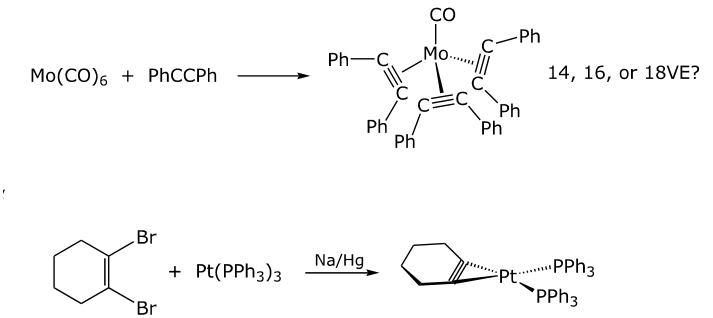
Metal-Carbonyls/Metal-Carbon π-bonds
No description yet. This curated deck is ready for daily study.
Card preview (24)
How does the bonding occur between a metal-carbonyl complex?
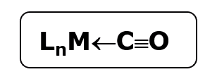
• The HOMO is CO is the sσ’ orbital containing a pair of E-, which are donated to the metal (sigma donation) • Empty π’ orbitals can reciece E- from the metal through π-back donation - this affect dominates • (known as synergeric bonding which results in a strengthening of the M-C bond)
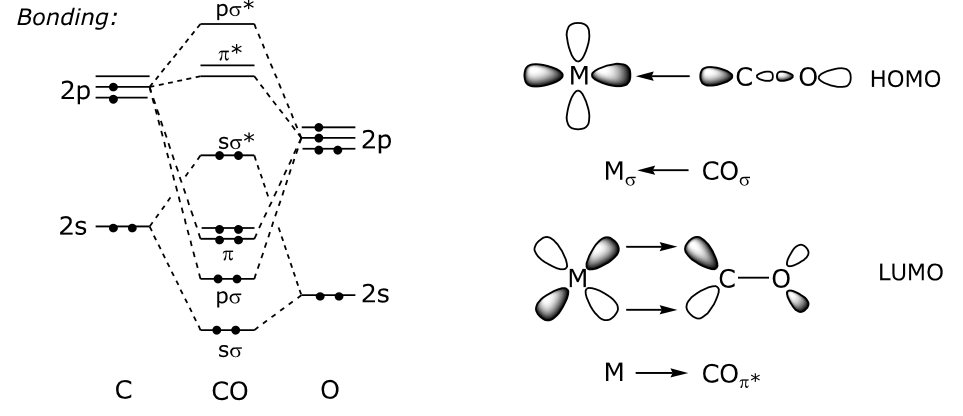
What affect does the π-back donation have on the strength of the C-O bond in a metal-carbonyl complex
Weakens the C-O This will result in a longer C-O and a decreased vCO on the IR spectra
the more electron rich the metal is in the metal carbonyl complex, the ……. stable the metal-carbonyl complex is
more stable The more π-back donation can occur, which stabilises the CO bound to the metal
What happens to the vibrating frequency of the C-O when bonded to a metal?
• The vibrating frequency decreases with the more M-CO bonds added • Does depend on the metal due to more electro rich metals π-back donating, resulting in weaker M-CO bonds • The H₃B-CO shows the effect of just sigma donation = higher frequency vibrations
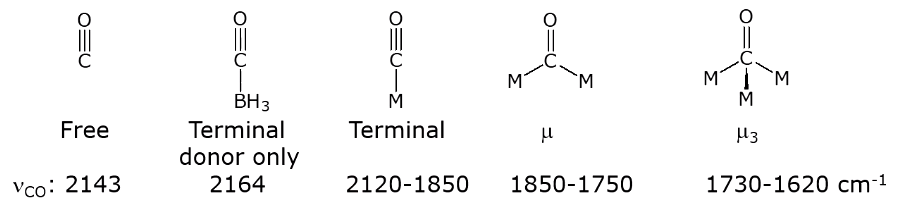
What happens to the IR vibration frequency of the C-O, when the bonded metal-carbonyl moves to a lower oxidation state
The lower the oxidation state, will mean they are electron rich and hence will π-back donate more Resulting in weaker C-O and hence lower frequency stretches

What happens to the IR vibration frequency of the C-O when electron donating ligands are also bonded to the metal?
The more electron donating the other ligands are, the lower frequency vibration of the C-O there is

What is one of the simplest ways to make a metal-carbonyl
Through reacting the metal with carbon monoxide gas

What is another way you can make a metal-carbonyl
• Through using a metal halide and reduce (Na) it to a lower oxidation state, which will make it favourable for CO to bind

What is two ways to remove a CO ligands from a metal?
• CO is easily eliminated by heat or photolysis
CO can be replaced in a metal complex by
Other neutral, two electron donors

What type of reaction is this?

oxidation Goes to a Mn +1 when we formed the manganese iodide species (both species are 18 electrons)
Why is reduction a more common process for metal-carbonyl species
The carbonyl species are good at withdrawing electron density through the pi-system So they stabilise metals in low oxidation states i.e. stabilise metals with a lot of electron density

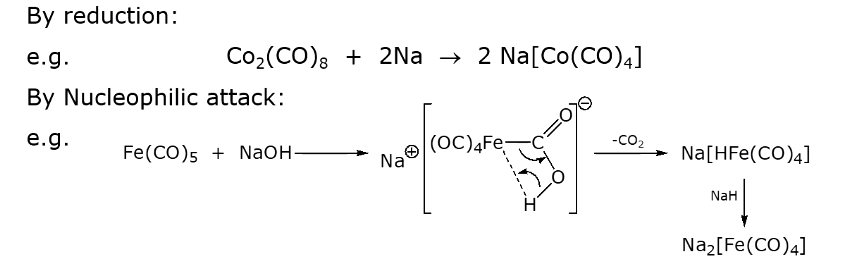
How would you reduce a metal-carbonly species?
• Either: by reduction using sodium • OR: Nu attack using sodium hydroxides which will attack the CO ligand
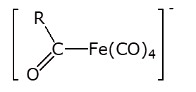
What is the end product of this reaction?

• R group will form a new bond to one of the carbonyls (1,1-migratory insertion) • The negative charge on the metal makes it nucleophilic for this reaction to occur
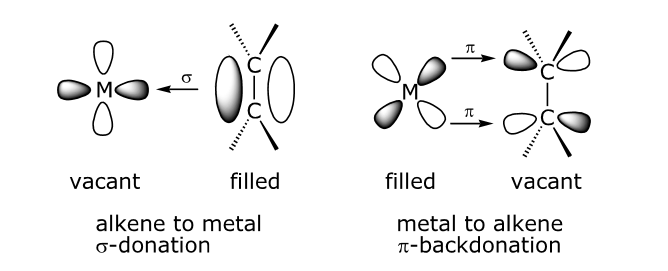
How does the bonding occur in a Metal-Alkene complex?
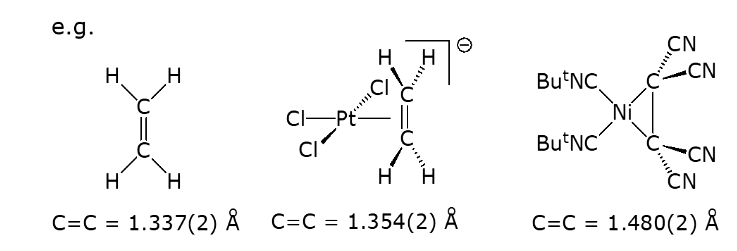
• The Alkene donates to the metal through the HOMO π-bonding orbital • The alkene accepts π-back-donation into the LUMO π’ antibonding orbital • (synergic again- the two components (back and forward donation) of the bonding are better balanced than the metal-carbonyl complexes)
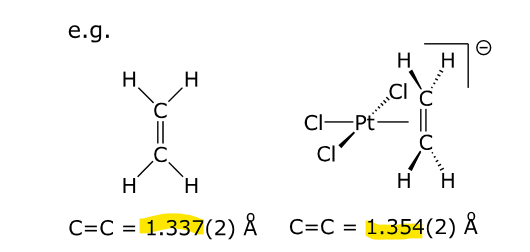
What affect does the metal-alkene bonding have on the bonding in the alkene
• Lengthening of the C=C bond - as it is weaker due to the back donation • Reduction of angles at C from 120° (sp²) to 109° (sp³) if there is enough back donation due to the breaking of the C=C
What does the extent of backbonding depend on?
• The energy of the frontier orbital of the M fragment • Steric effects • The alkene acceptor ability
Electron withdrawing group affect π-back donation how?
Electron withdrawing groups increase π-backdonation and decrease σ-donation
Alkene ligands can be switched in with which type of ligands?
• Switched for other neutral two electron donors

How do metal-alkene complexes react with nucleophiles
• Through a 1,2-migratory insertion • This is due to so much electron density can be donated from the alkene to the metal which results in it being positively charged - hence more susceptible to Nu attack

True or false? Alkynes are weaker π-acceptors than alkenes
False Alkynes are stronger π-acceptors than alkenes
Alkynes can donate how many electrons as a ligand?
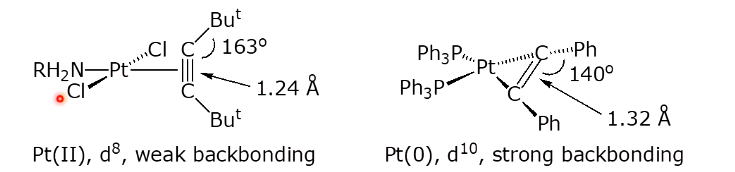
Alkynes have two orthogonal π-bonds and can act as 2 or 4 electron donor ligands
Significant amounts of back donation from the metal, can result in an alkynes being
sp² hybridised rather than sp hybridised notes the longer bond too
Alkyne ligands can be swithced in/out by which type of ligand?
• Neutral 2 or 4 electron ligands