Topic 14 - Particle Model
No description yet. This curated deck is ready for daily study.
Card preview (24)
SP14a - What does kinetic theory state?
Everything is made of tiny particles
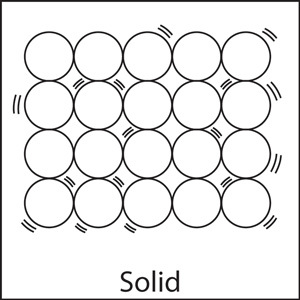
SP14a - Describe the properties of a solid
• Rigid • Fixed shape • Fixed volume • Cannot be compressed
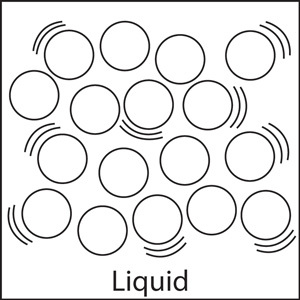
SP14a - Describe the properties of a liquid
• Not Rigid • No fixed shape • Fixed volume • Cannot be compressed(ish)
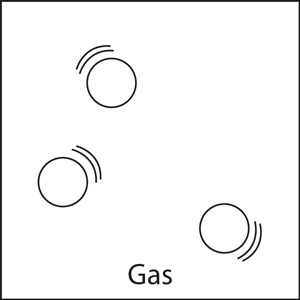
SP14a - Describe the properties of a gas
• Not Rigid • No fixed shape • No fixed volume • Can be compressed
SP14a - What happens when a substance changes state? (In terms of particles)
• The particles change their arrangement • This leads to a change in density • The mass is conserved as the amount of particles remains • This is a physical change as it can be reversed and no new substances are formed
SP14a - How does the density of a substance change between states and what is the exception?
• Generally, as substances go from solid → liquid → gas, they become less dense • This is because the particles become more spread out meaning there are less in a certain volume • Water is the exception to this as ice is less dense than liquid water
SP14a - What is density inc. formula?
Density is a measure of how many particles are packed in a space Density(g/cm³) = mass(g) ÷ volume(cm³) (ρ = m x V)
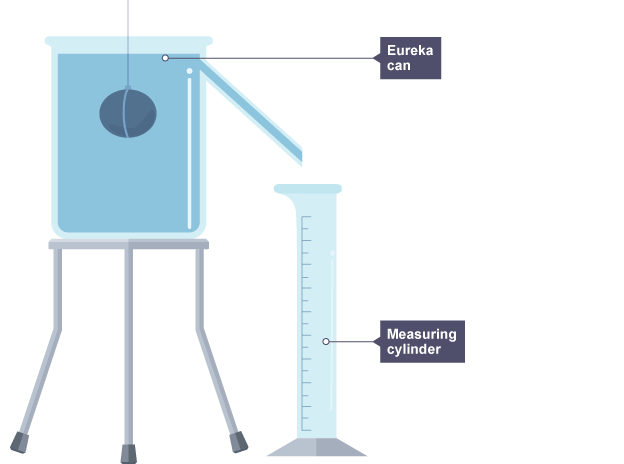
SP14a CP - How do you find the density of an irregularly shaped object?
• Set an electronic balance to 0 then place the object on it and record the mass • Set up a displacement can leading into an empty measuring cylinder and fill the can with water • Place the object in the can. If it floats, then push it down till it is just under the surface of the water • Read the value for the volume of water in the measuring cylinder (from the bottom of the meniscus) • This is the volume of the object. Do mass/volume to find the density
SP14b - What is thermal energy?
The energy stored in the movement of particles that has been transferred to the system by heating
SP14b - What is temperature?
A measure of the average speed/movement of the particles in a substance
SP14b - What is specific heat capacity?
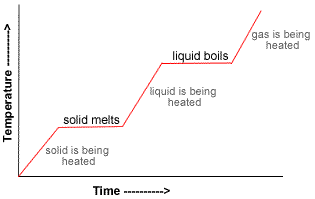
The amount of energy required to increase the temperature of 1 kg of a substance by 1°C (The diagonal lines of a heating curve)
SP14c - What is the formula for specific heat capacity?
ΔQ = m x c x Δø Change in energy(J) = mass(kg) x specific heat capacity(J/kg°C) x change in temperature(°C)
SP14b - What is specific latent heat?
• The amount of energy required to change the state of 1kg of a substance (The horizontal parts of a heating curve) • This energy is given out when the doing the opposite state changes are equal to how much it takes • (energy needed for evaporating = energy released form condensing)
SP14c - What is the formula for specific latent heat?
Q = m x L Energy = mass x Specific latent heat
SP14b - Describe the appearance of a heating curve describing what is happening
• Time on x-axis temperature on y-axis • There will be a diagonal line going up steadily upwards • Eventually it will plateau and be a horizontal line for a bit • It will then continue to rise diagonally then plateau and then rise once more • The diagonal lines are where energy is transferred and stored as thermal energy and increasing the temperature • During the plateaus, the energy is being used to overcome the forces that hold the molecules together resulting in changes of state
SP14d - What is the temperature of a gas and how can it increase?
• A measure of the average kinetic enegry of the particles in the gas • By heating it up (providing thermal energy) the particles will start to move faster meaning a higher temperature
SP14d - Why does an increase in temperature lead to an increase in gass pressure (for a fixed mass of gas)?
• A higher temperatures means that the particles in the gas are moving fatser. • This means that they will have more frequent collisions with the walls of their container. • This means that the force exerted on the container is higher leading to a higher temperature.
SP14d - What is the unit for pressure?
pascals (Pa) [where 1 Pa = 1 N/m²]
SP14d - What is absolute zero?
• Once the temperature of a gas has reduced to -273°C (or 0K) then the particles in the gas have a pressure of 0 meaning they aren’t moving. • This is only theoretical as gases would normally condense to a liquid once reaching this low a temperture
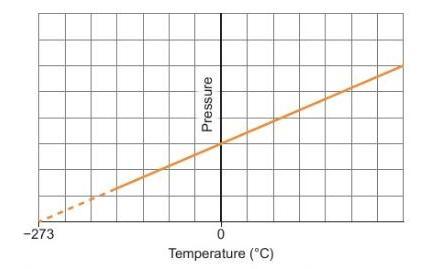
SP14d - What is the kelvin scale and how do you convert between celcius to kelvin v.v?
• The kelvin scale has the same intervals as celcius but 0 K is equal to absolute zero (-273°C) • To convert K - °C - 273 and °C - K + 273
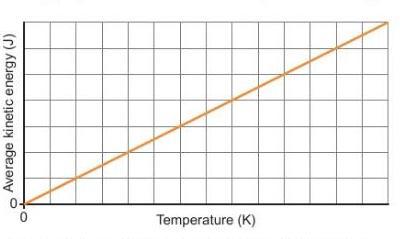
SP14d - Describe the relationship between kelvin and the avergae kinetic energy of gas
Directly proportional
SP14e - What is gas pressure?
When gas particles hit a surface, they produce a net force acting at right angles to the surface. We detect this as gas pressure
SP14e - Why does decreasing the volume of gas (at a fixed mass and temperature) increase the pressure?
• Inside a container, the pressure acts at right angles to the walls • If the same number of particles are in a smaller space, they will hit the walls of the container more often • This means the force on the walls increases. We detect this as a higher pressure
SP14e - What equation links pressure and volume for a fixed mass and temperature?
• P1 x V1 = P2 x V2 • This means that an increase in pressure or volume will cause a decrease of the other by the same proportion • They are inversely proportionate