Module 6 Organic Chemistry and Analysis - Exam Questions
No description yet. This curated deck is ready for daily study.
Card preview (24)
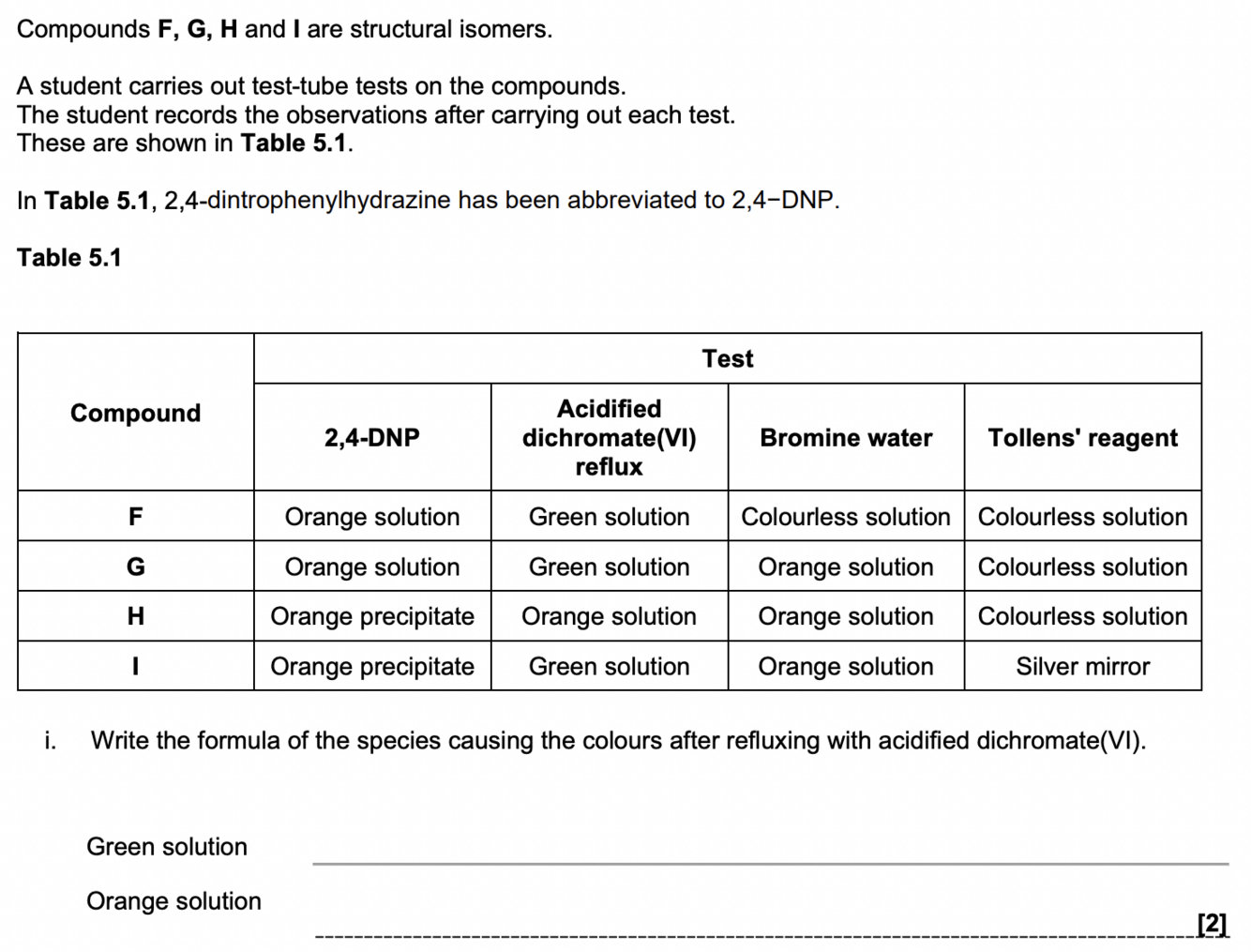
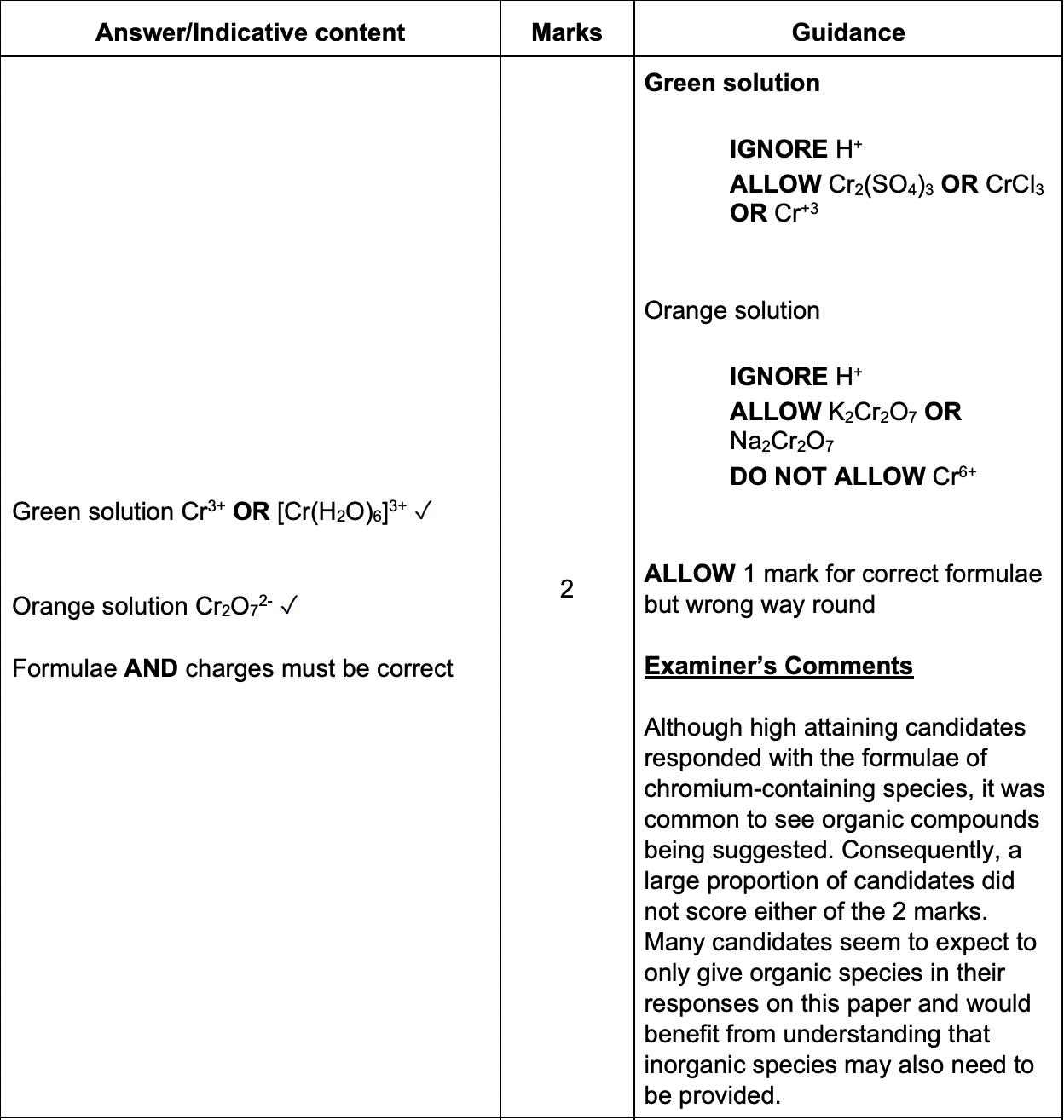
Cr₂O₇²⁻ contains Cr³⁺ ions which form a green solution
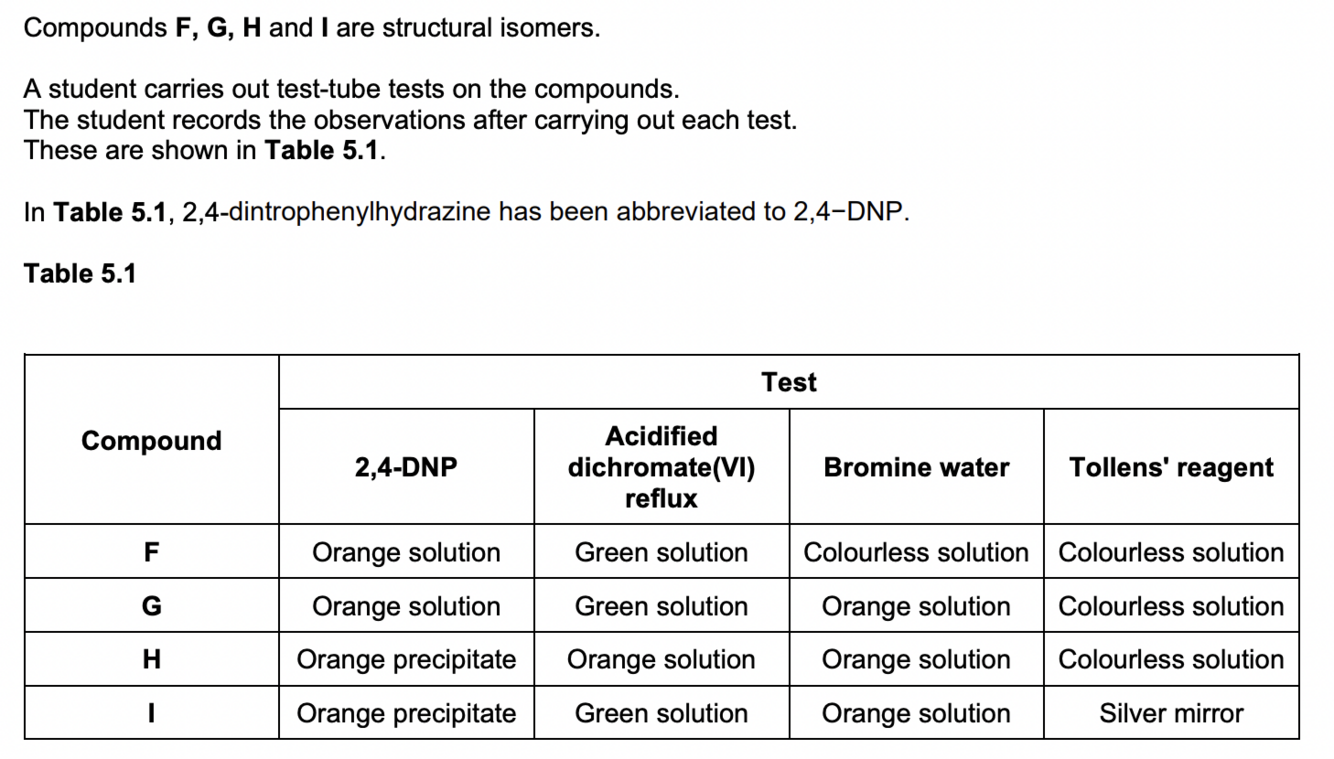
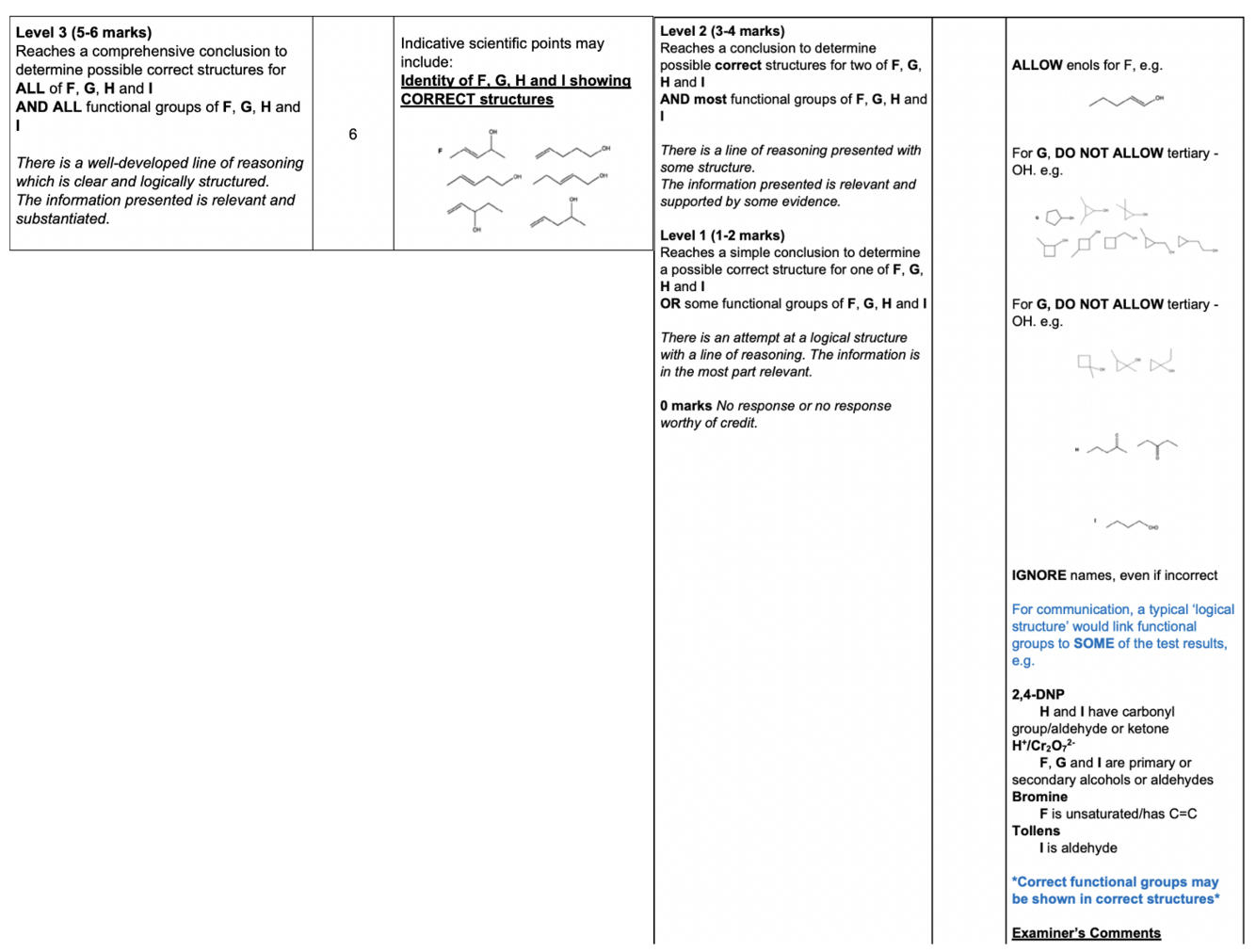
The student is provided with further information about compounds F–I. • They all have the molecular formula C₅H₁₀O. • One of the compounds is alicyclic. • The other compounds are unbranched. Use this further information and the student’s observations in Table 5.1 to answer the following. • How do the observations provide evidence for the possible functional groups in compounds F–I? • Suggest a possible structure for each of the compounds F–I. Show your reasoning. *[6]
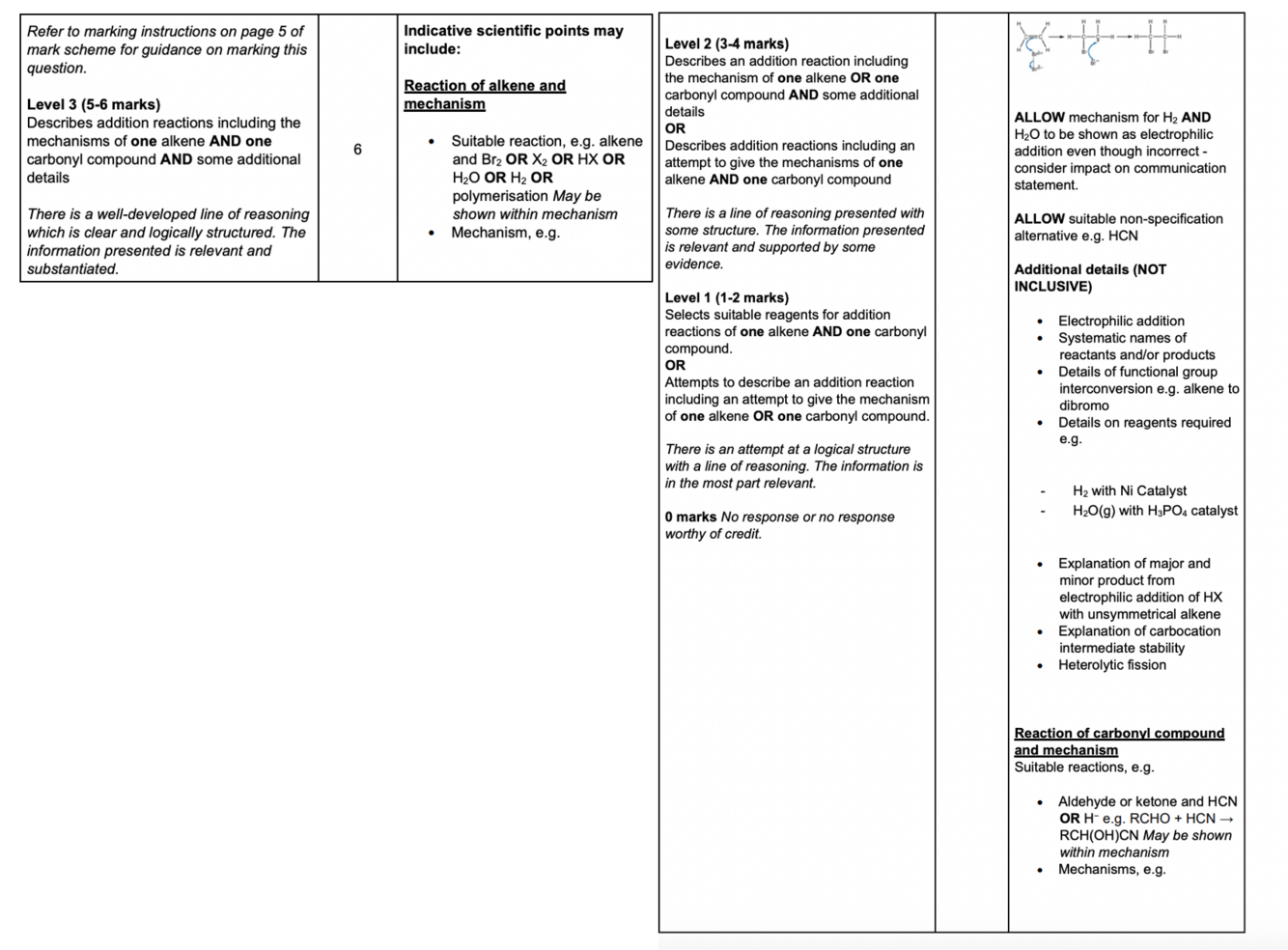
Alkenes and carbonyl compounds take part in addition reactions. Describe one addition reaction of an alkene and one addition reaction of a carbonyl compound. Include reagents and reaction mechanisms. [6]
C
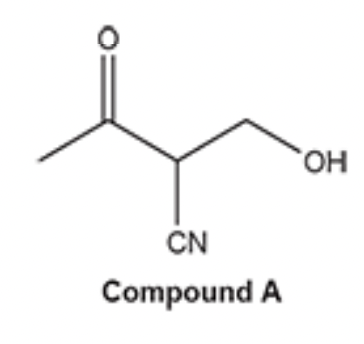
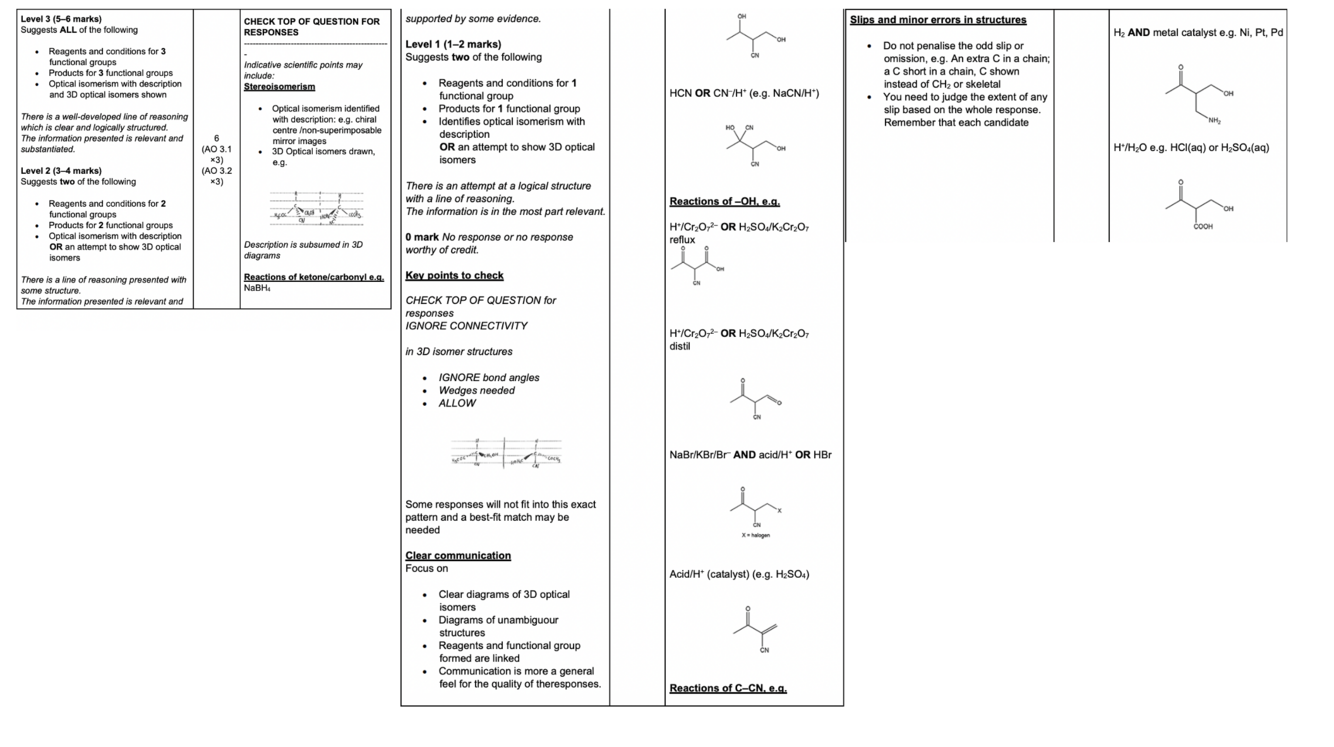
A chemist is investigating compound A, shown below, as a potential organic intermediate. Describe the type of stereoisomerism shown by compound A and suggest three reactions of compound A, one for each of the three functional groups using reagents of your choice. In your answer, show stereoisomers of compound A, your chosen reactants and conditions, and the structures for the organic products produced. *[6]
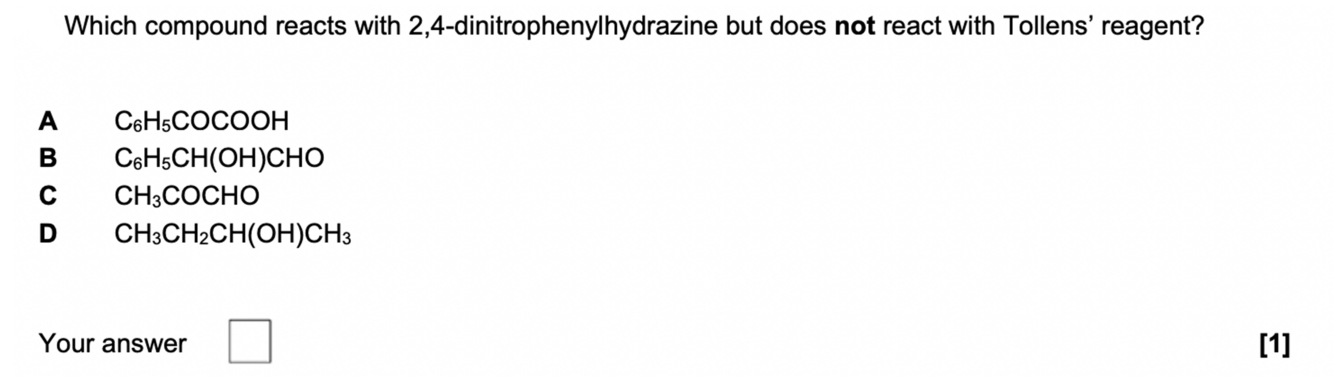
A
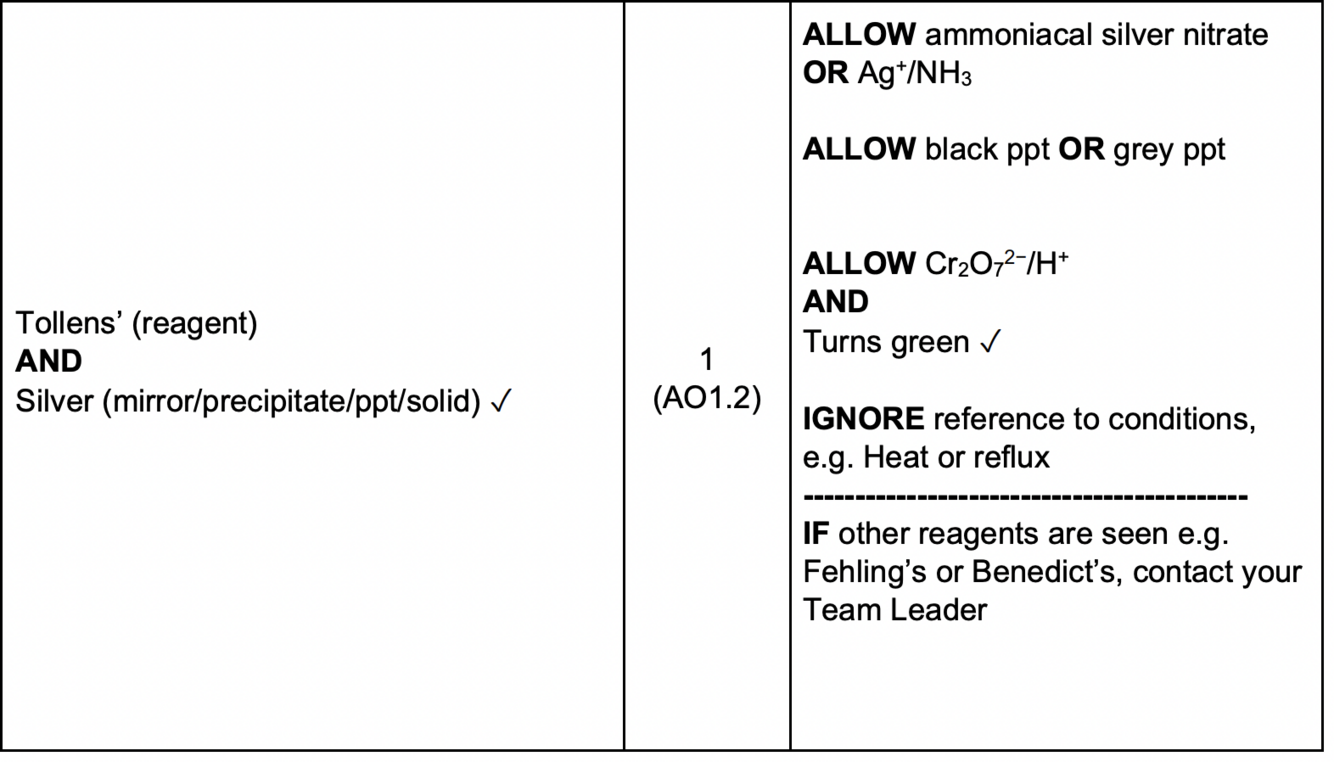
Carbon–carbon bond formation is used in synthesis to increase the length of a carbon chain. Describe the formation of carbon–carbon bonds in aliphatic compounds by two different mechanisms. Your answer should include mechanisms for each aliphatic compound. *(6)
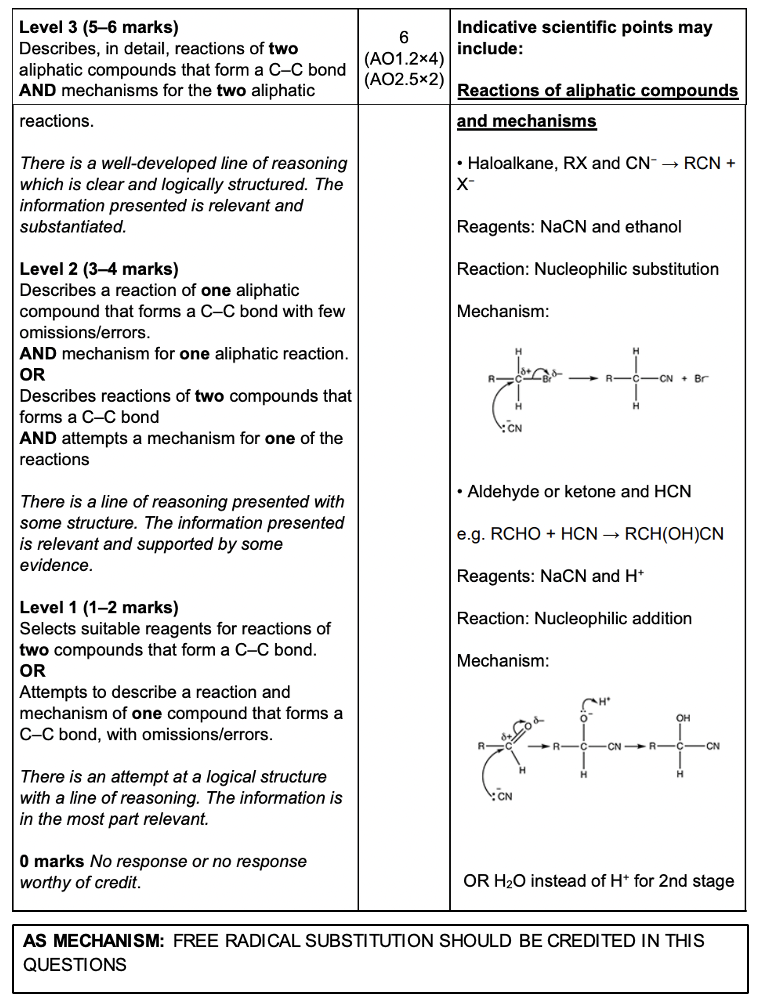
Describe a chemical test to confirm the presence of a carbonyl group. How could the product of this test be used to identify the carbonyl compound? Your answer should not include spectroscopy. [3]
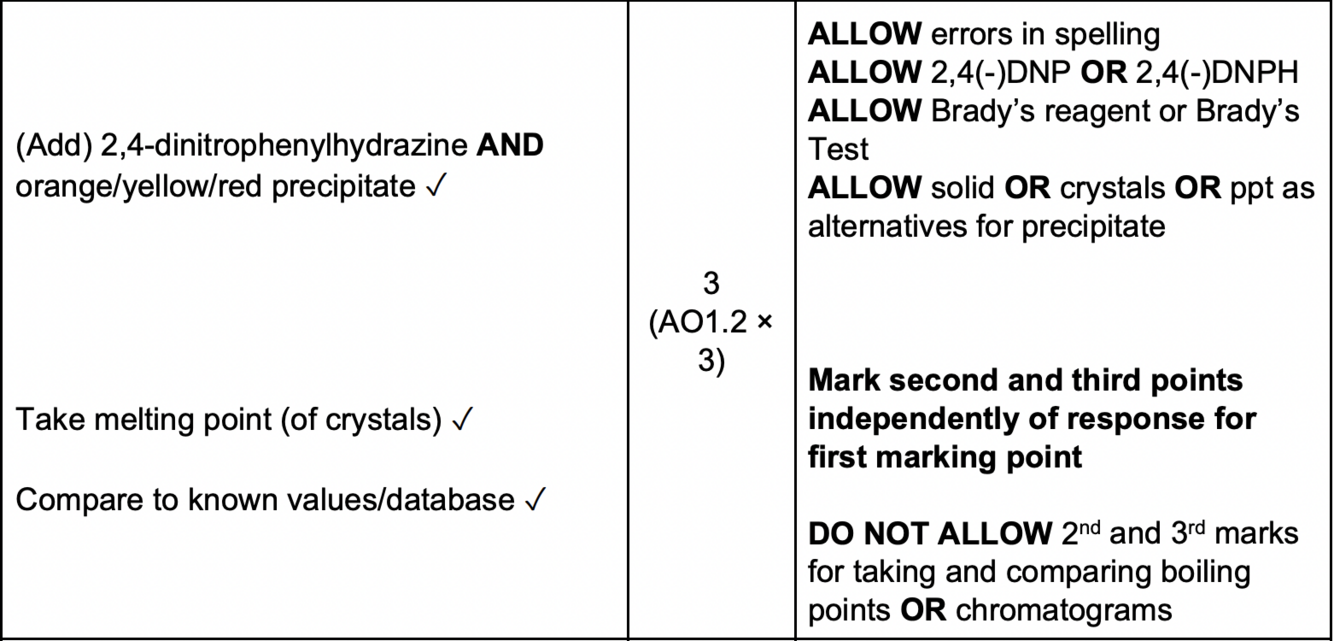
Describe a chemical test that would identify whether a carbonyl compound is an aldehyde. Your answer should include the reagent and observations. [1]
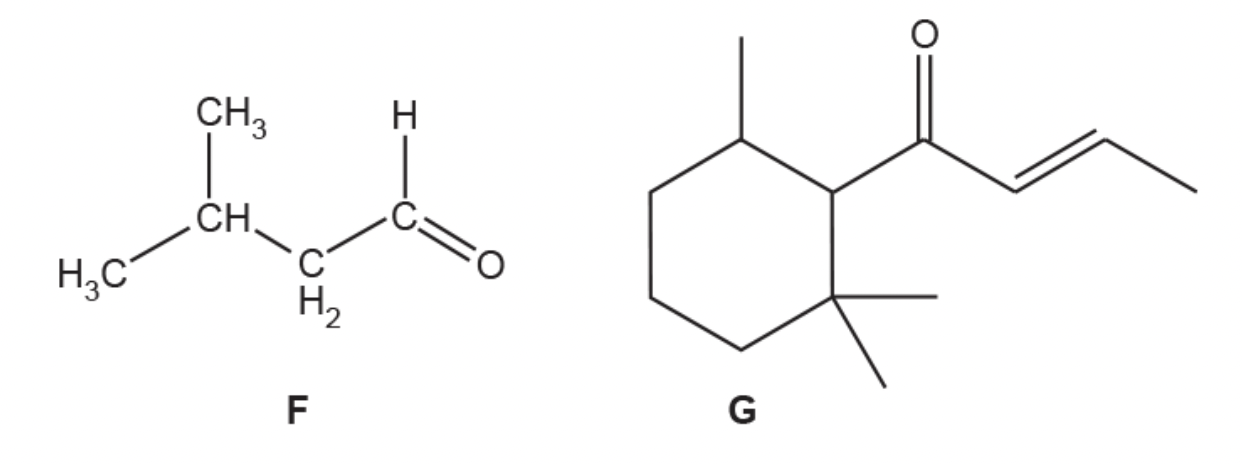
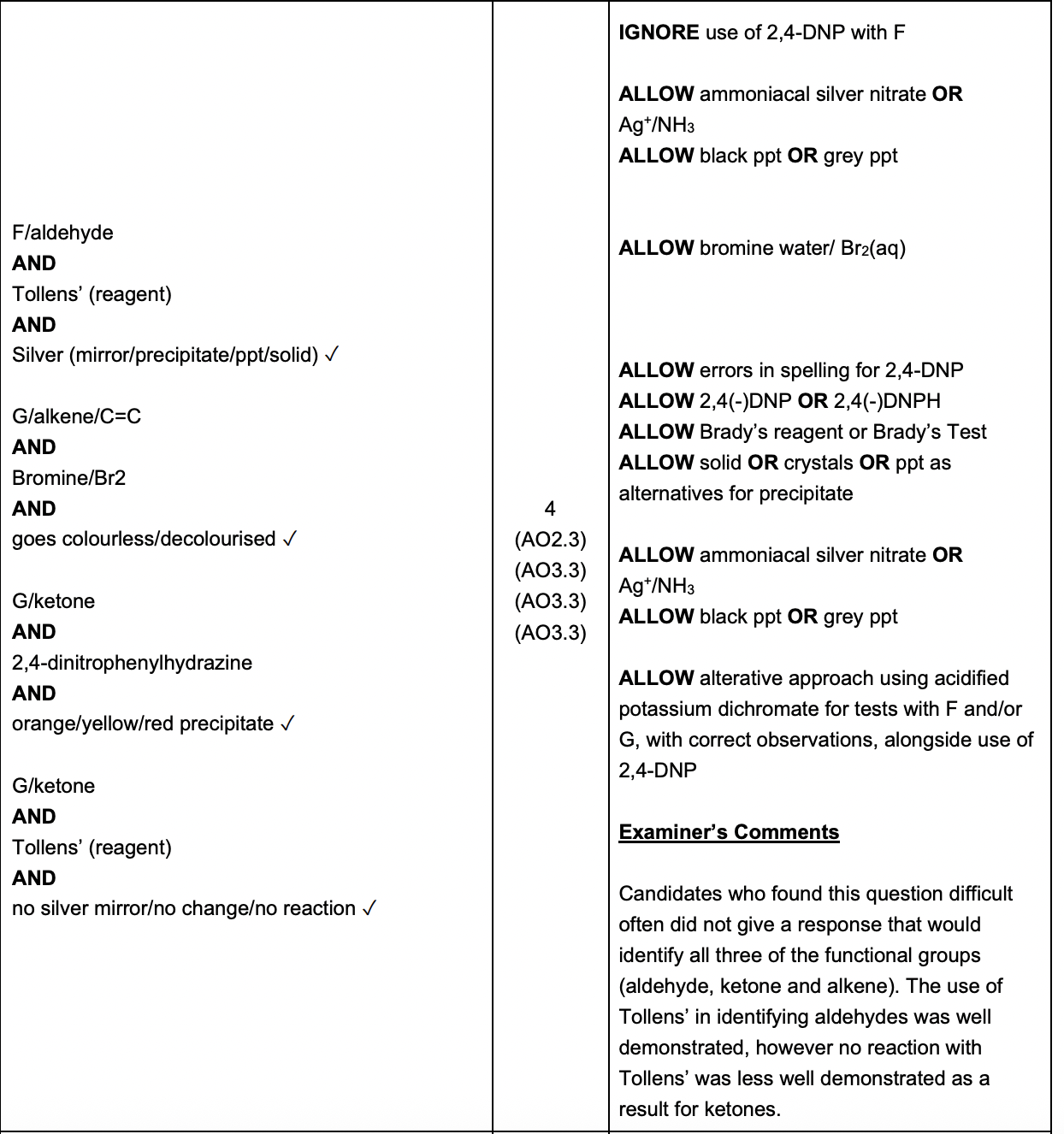
The carbonyl compounds, F and G, shown below, contribute to the flavour of coffee. Describe suitable chemical tests, with observations, that would confirm the presence of the functional groups in F and G. [4]
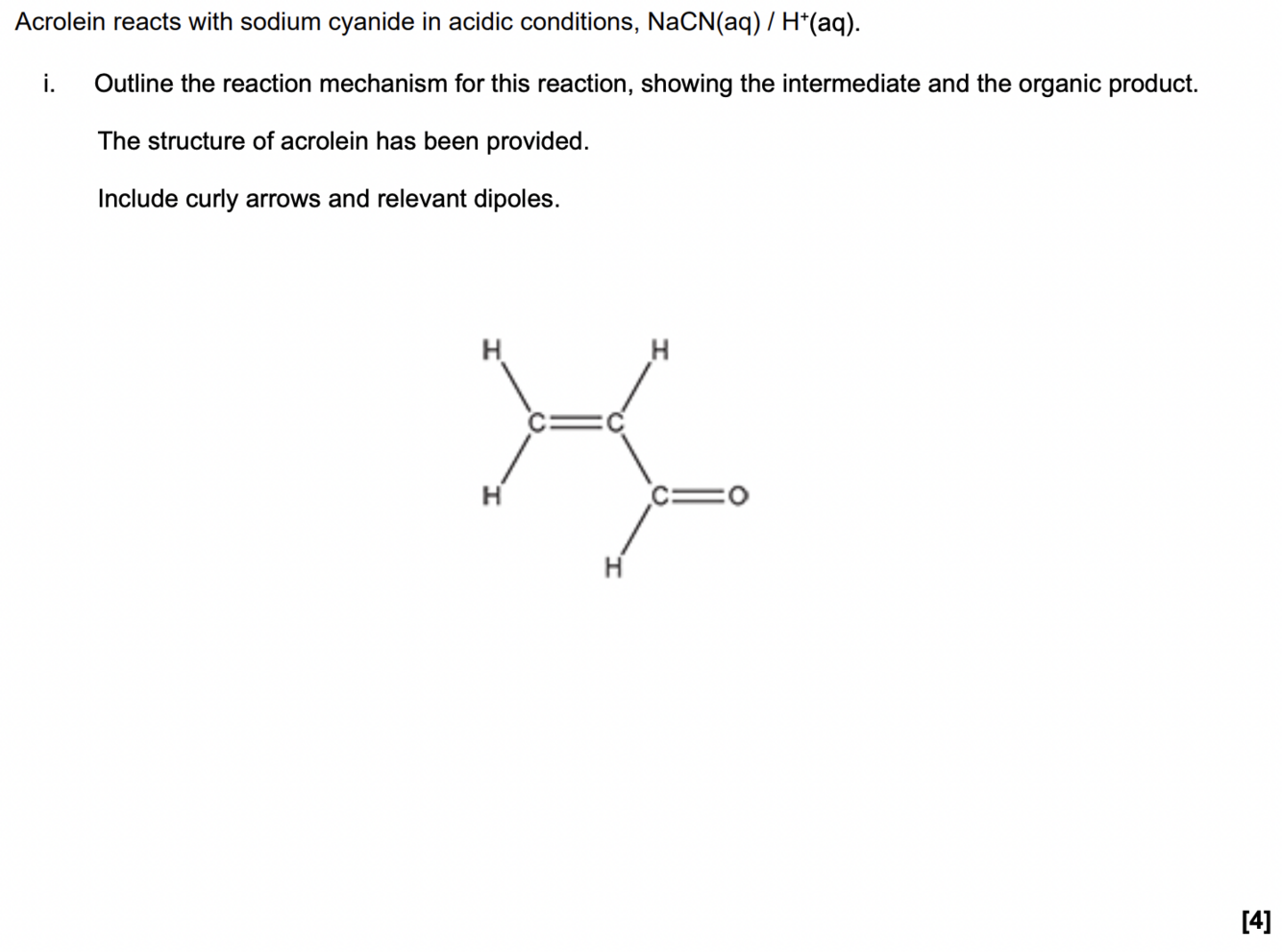
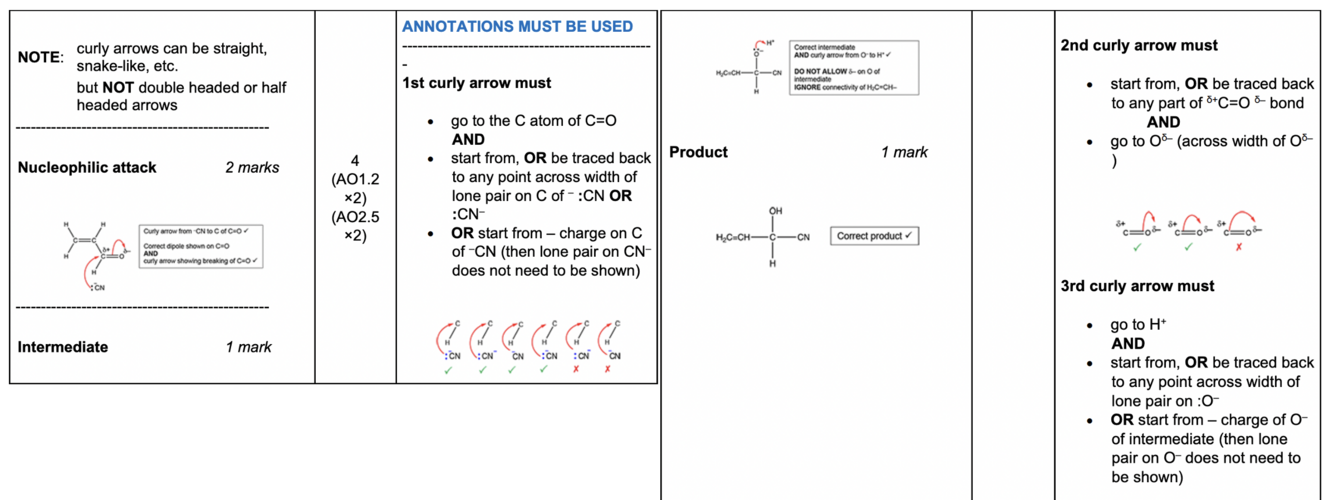
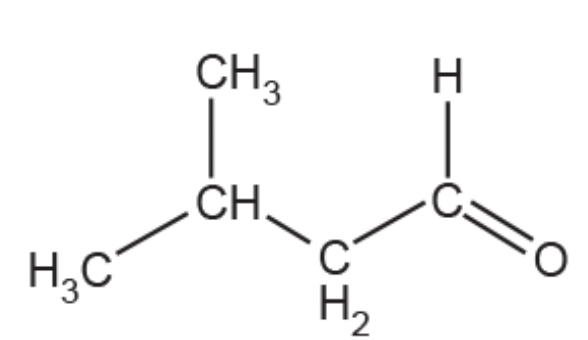
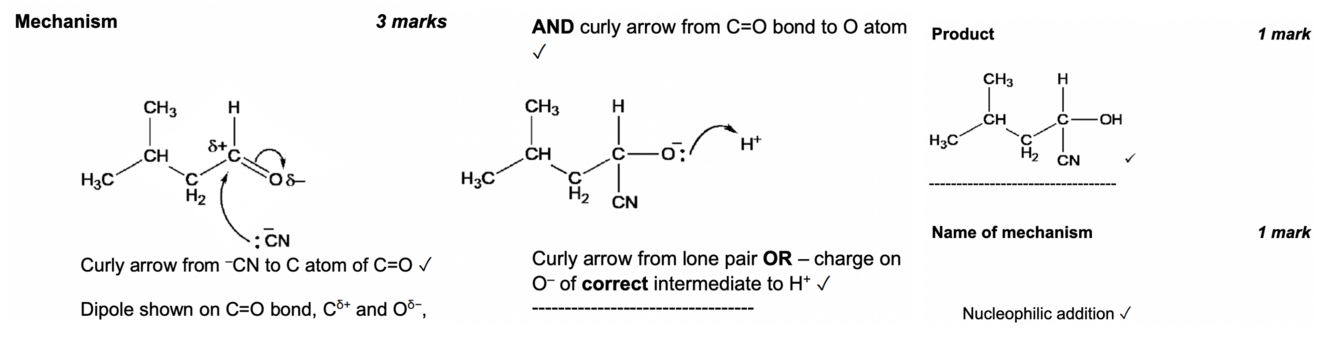
Compound F reacts with HCN using NaCN(aq) and H⁺(aq). Outline the mechanism for the reaction of F with NaCN(aq) and H⁺(aq) and state the name of the mechanism. The structure of F has been provided. Include relevant dipoles, lone pairs, the structure of the organic product and the name of the mechanism in your answer. [5]
This question is about organic compounds containing nitrogen. Salt H, (CH₃)₂CHNH₃Cl, is used in the manufacture of garden weedkillers. The flowchart shows the synthesis of the salt H from propanone. Complete the flowchart. Show structures for organic compounds. [5]
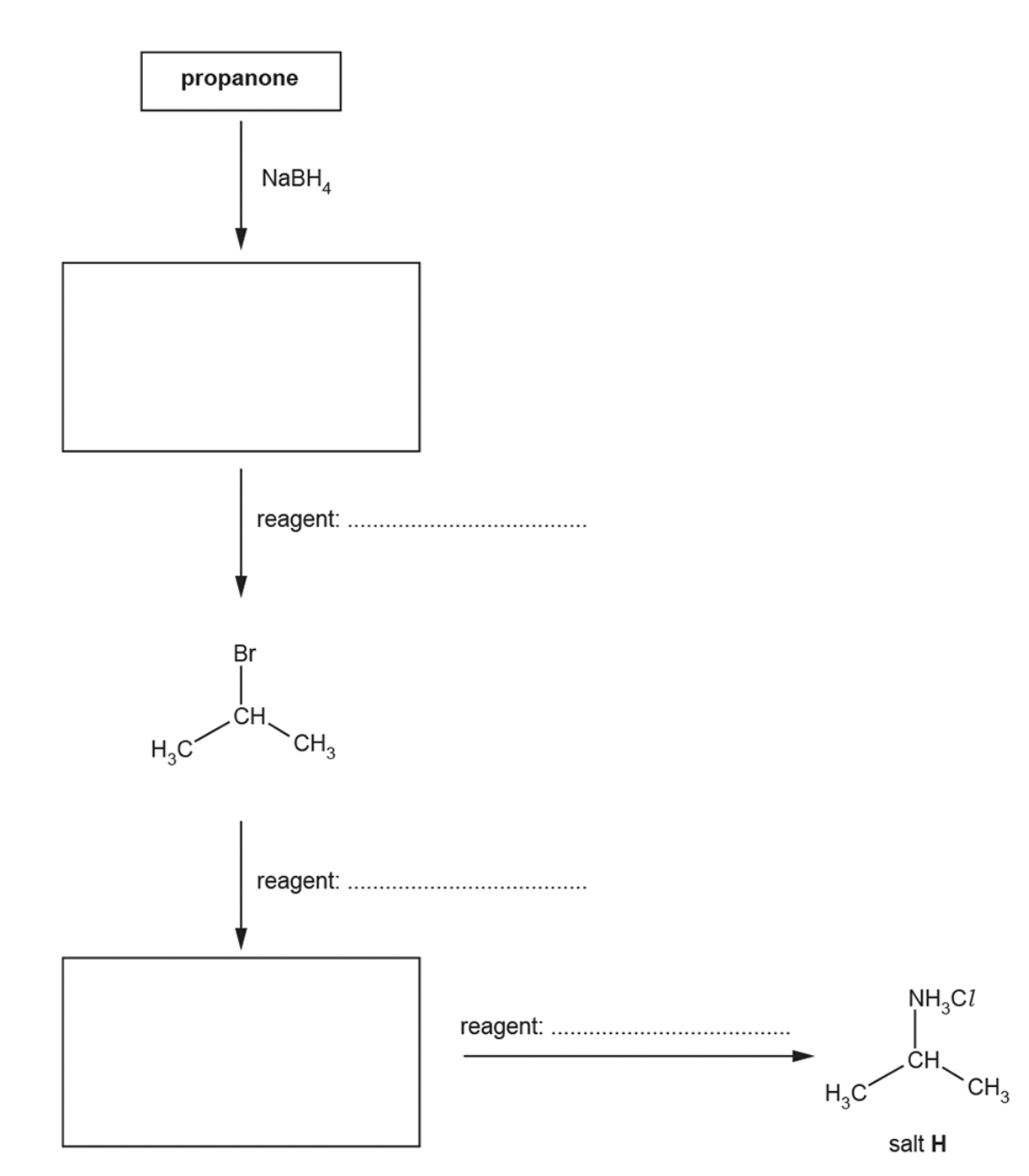
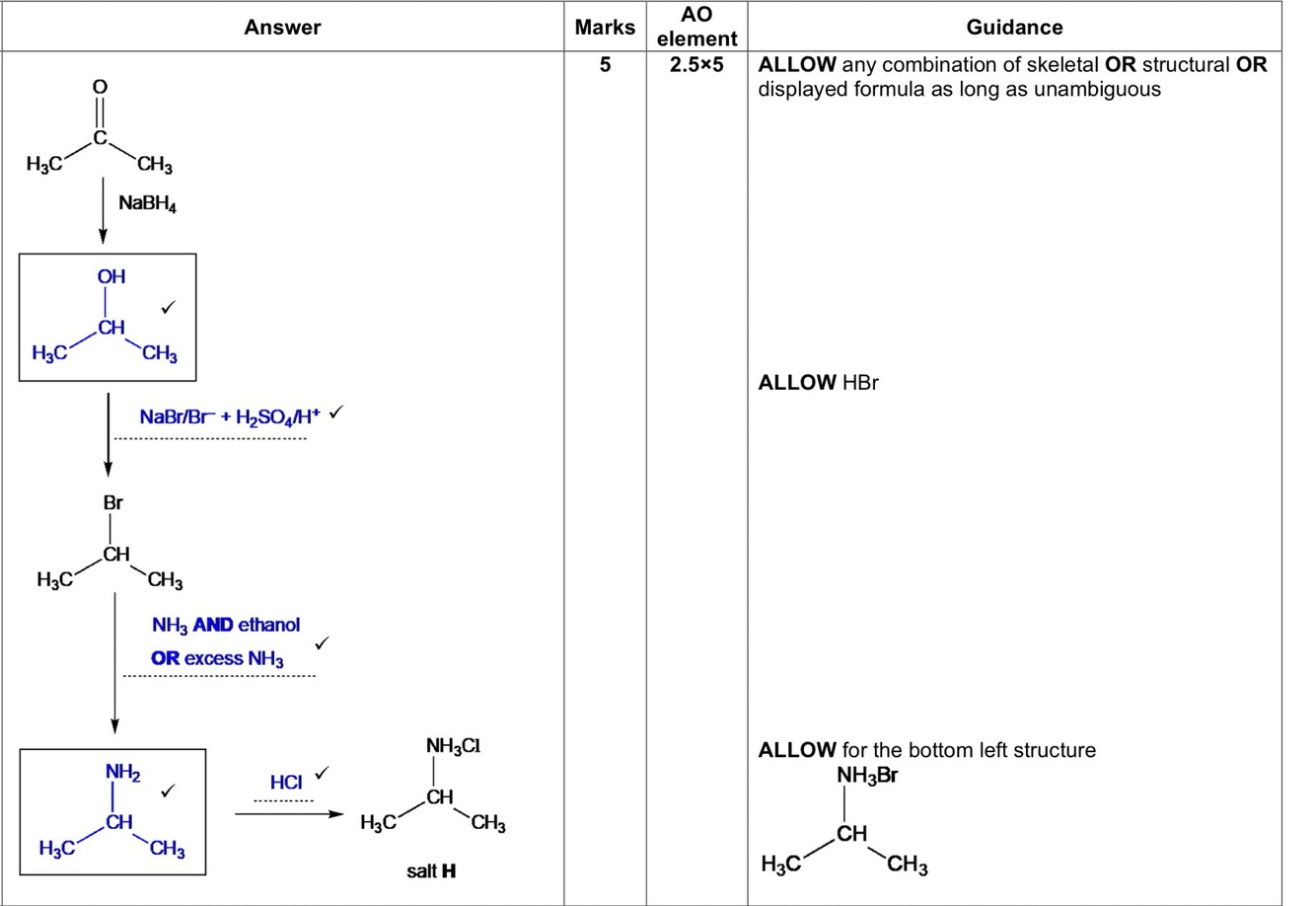
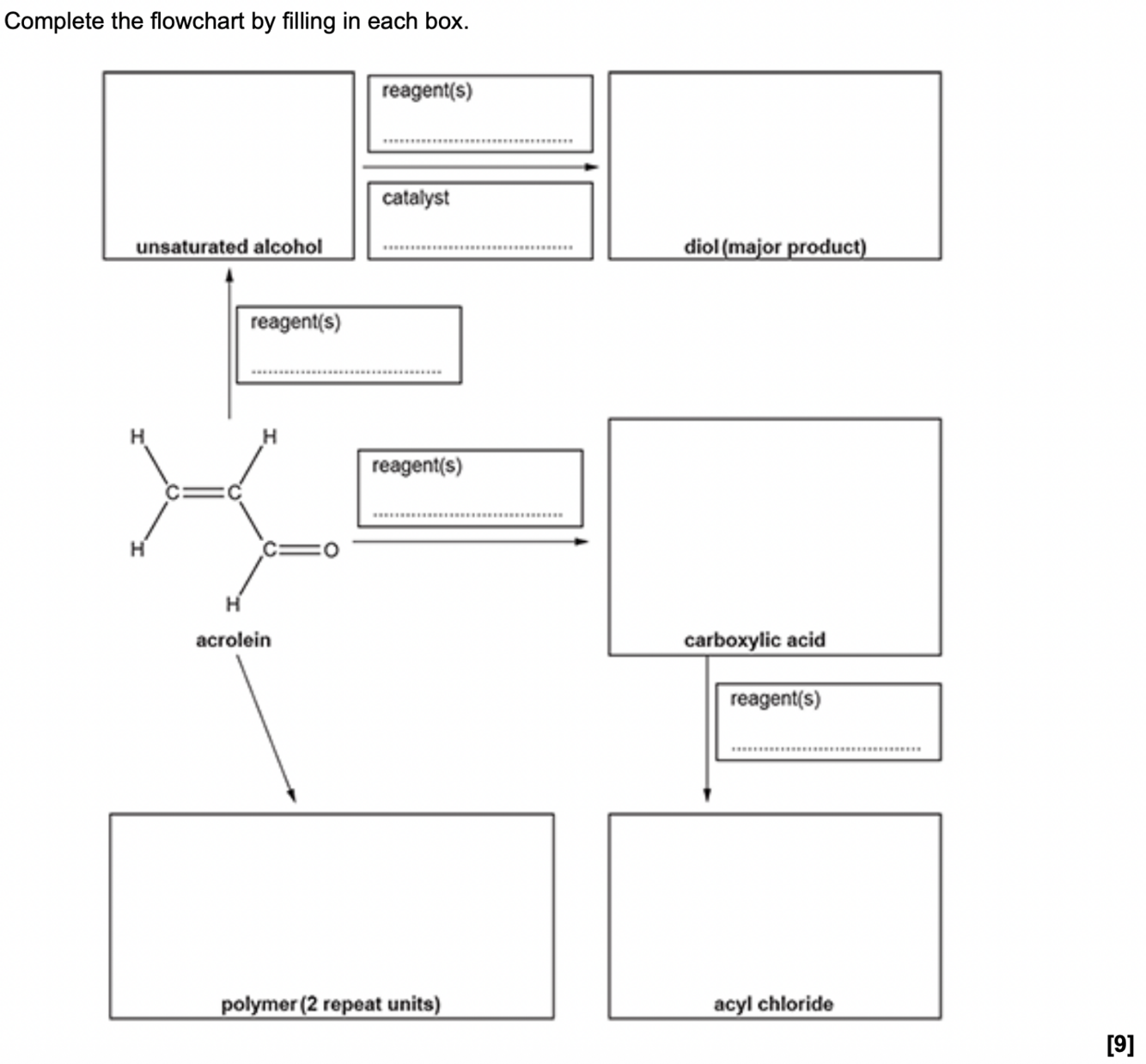
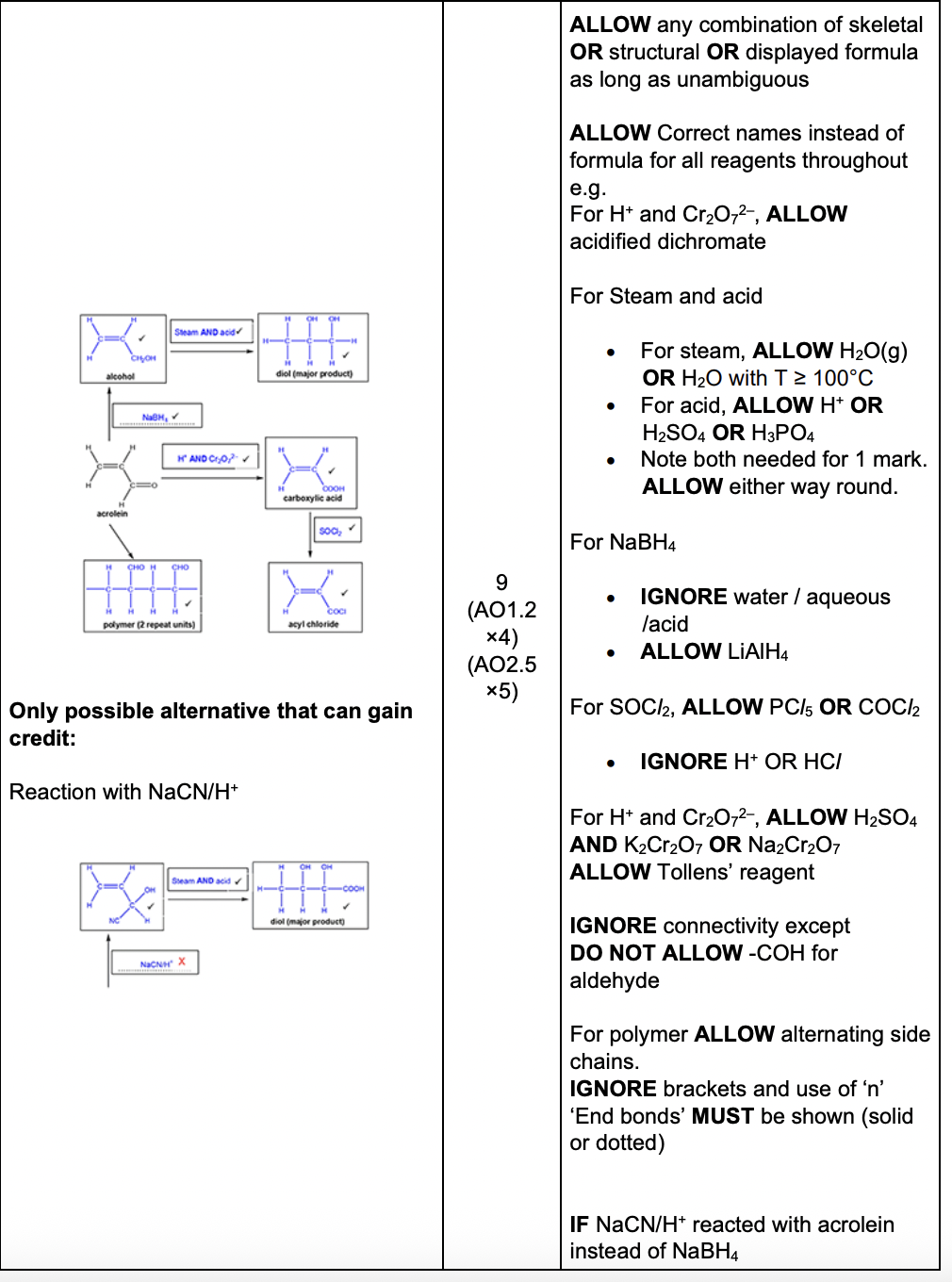
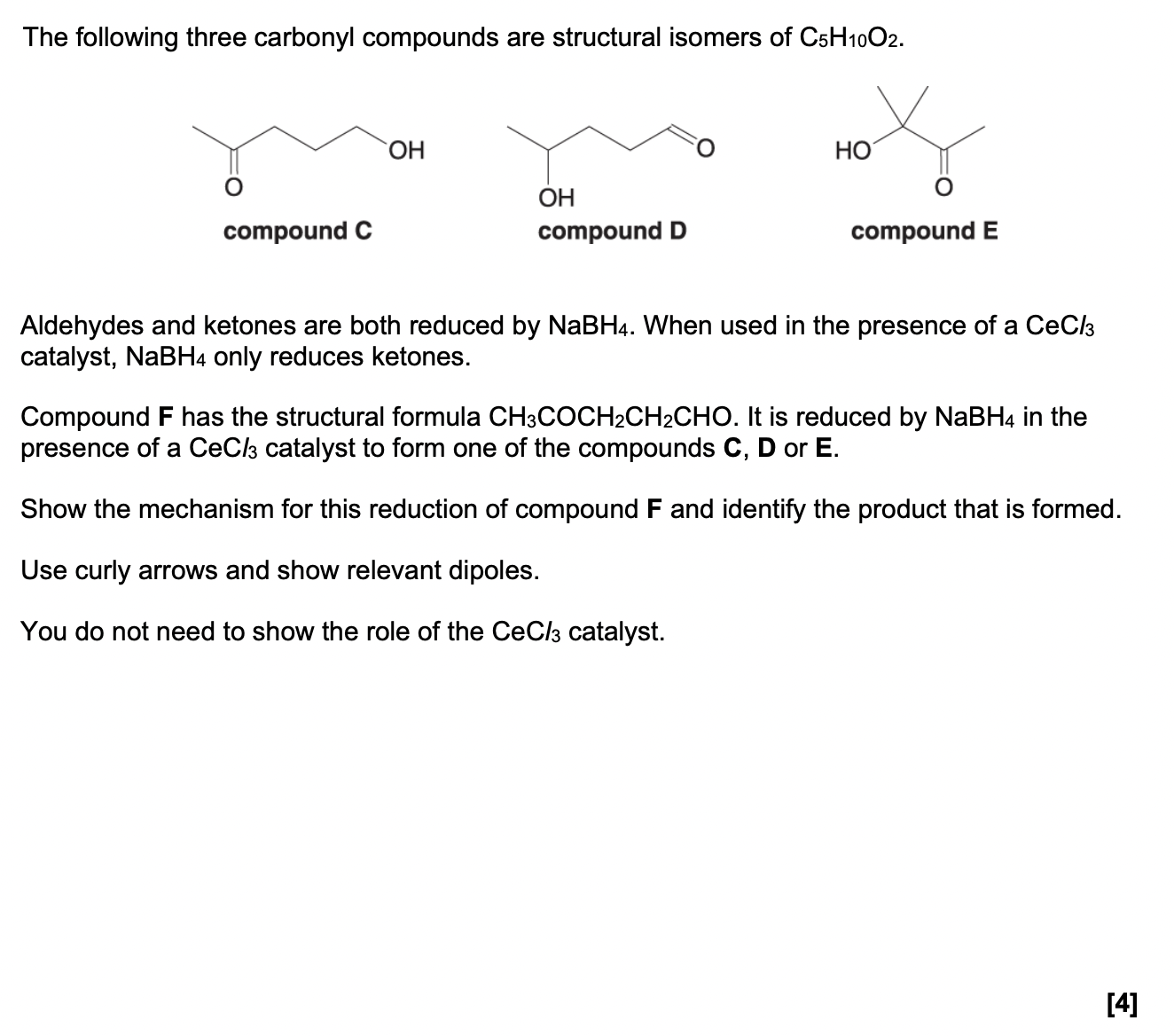
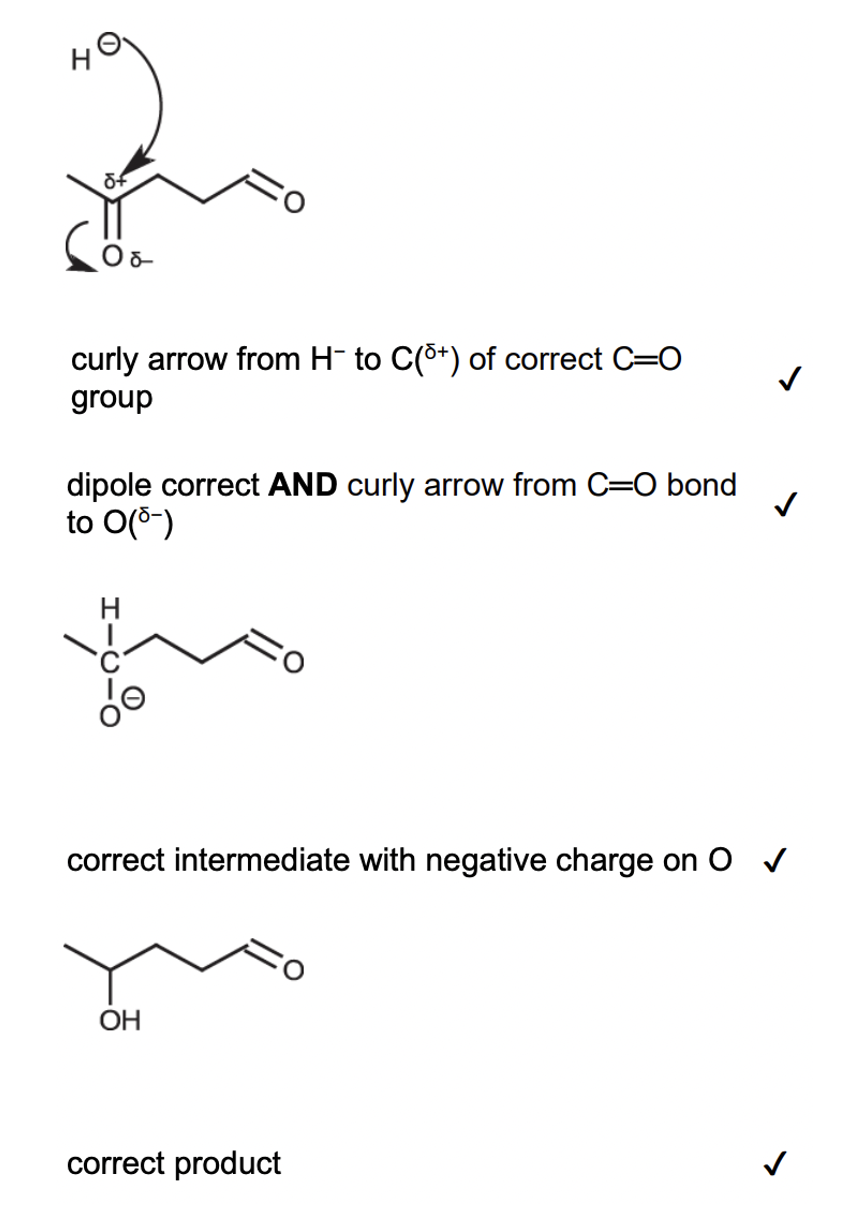
Alcohols are important in organic synthesis and can be formed by the reduction of carbonyl compounds. Complete the flowchart by filling in each box. [5]
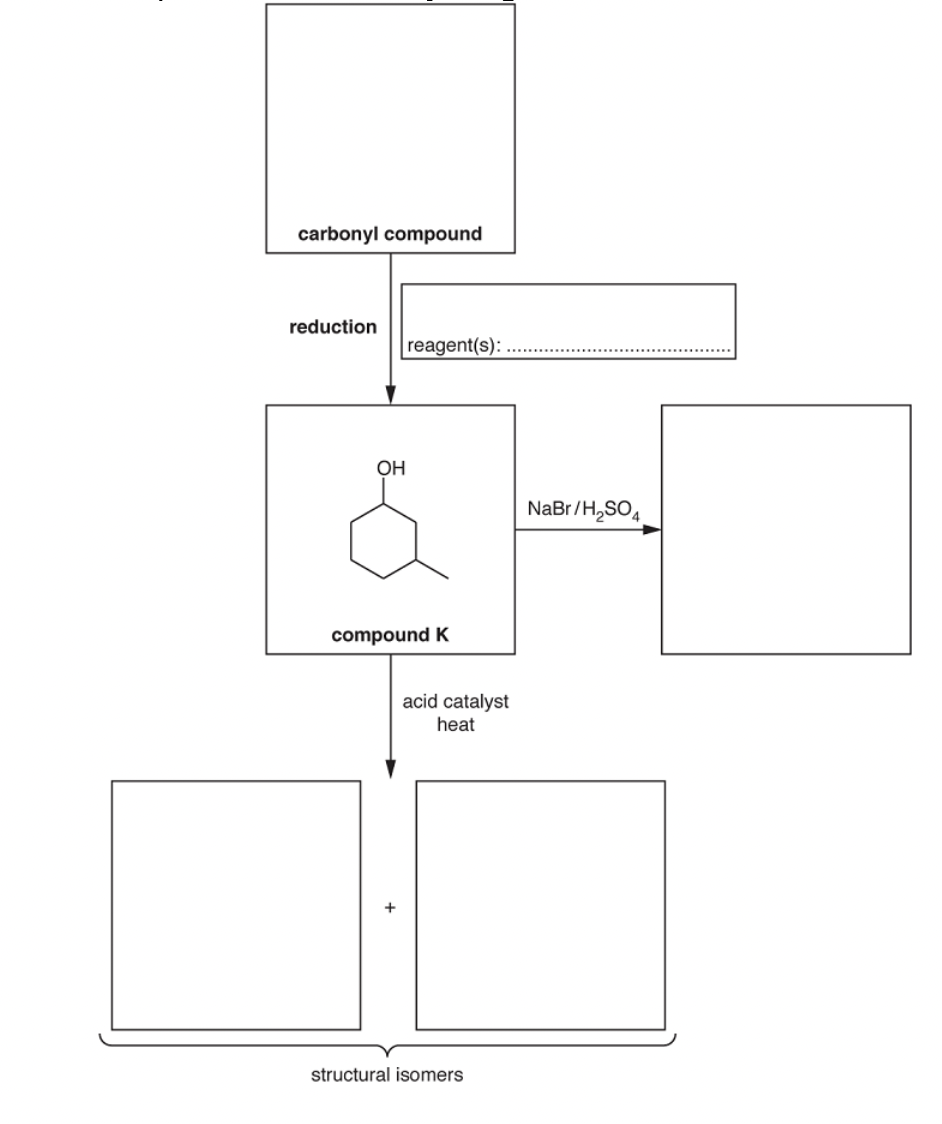
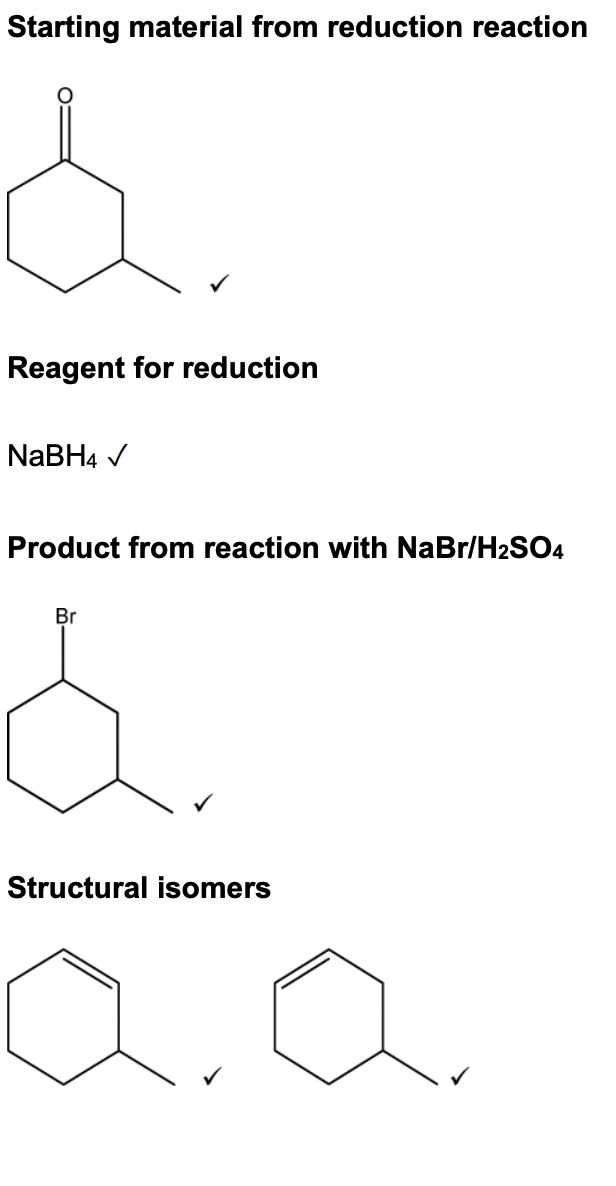
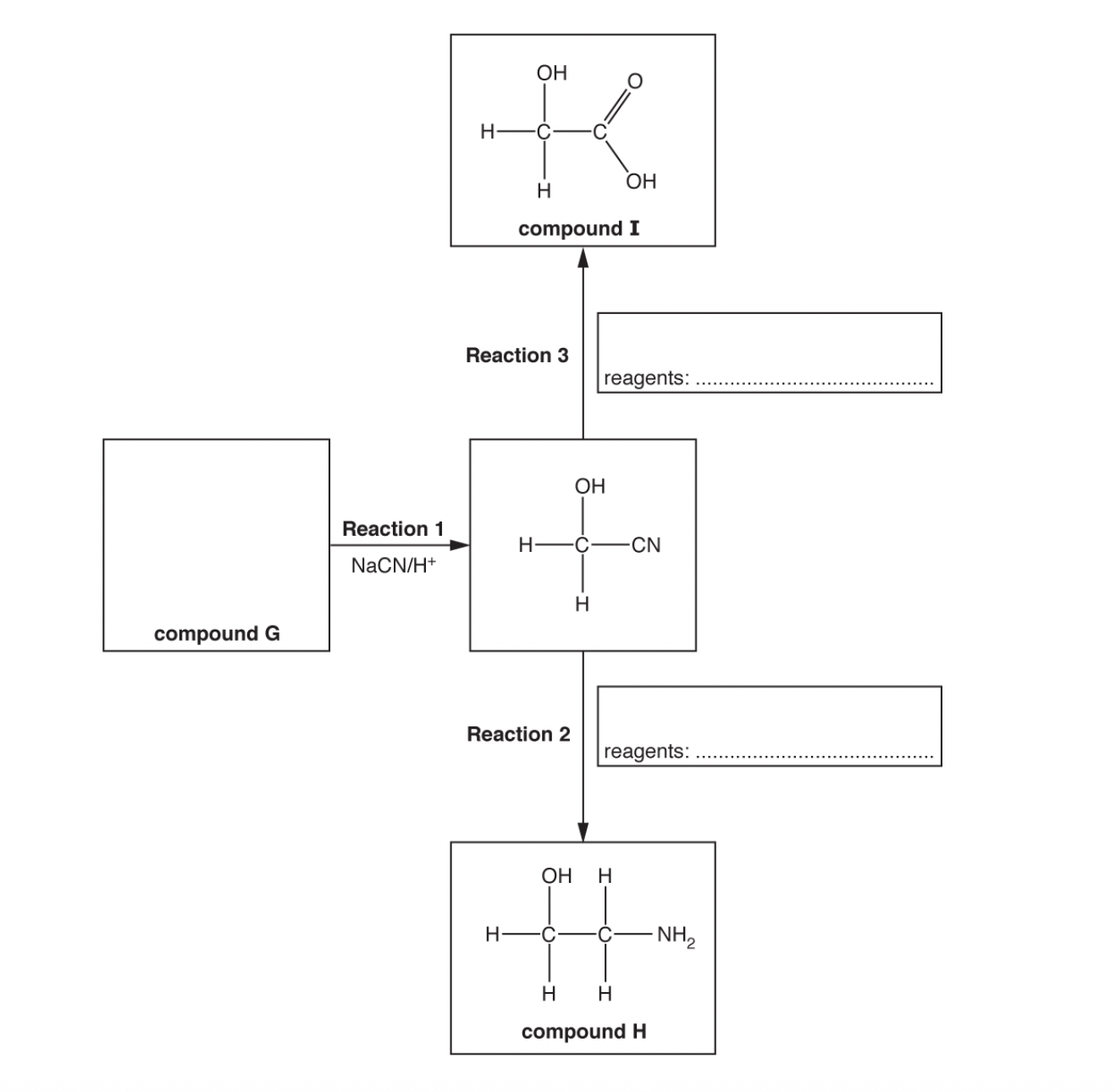
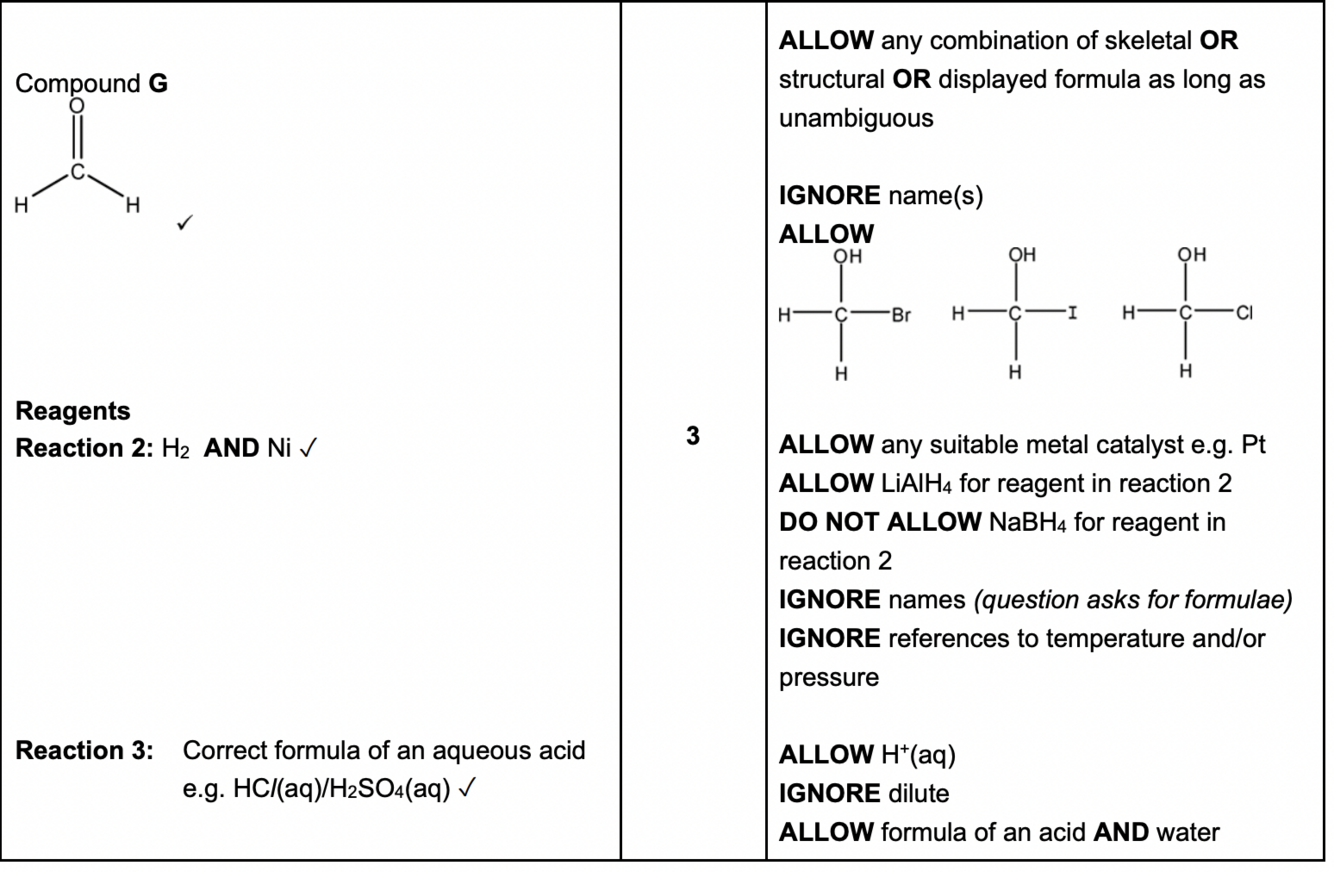
Compound G is used to synthesise compounds H and I as shown in the flowchart below. Complete the flowchart showing the structure of compound G and the formulae of the reagents for Reaction 2 and Reaction 3. [3]
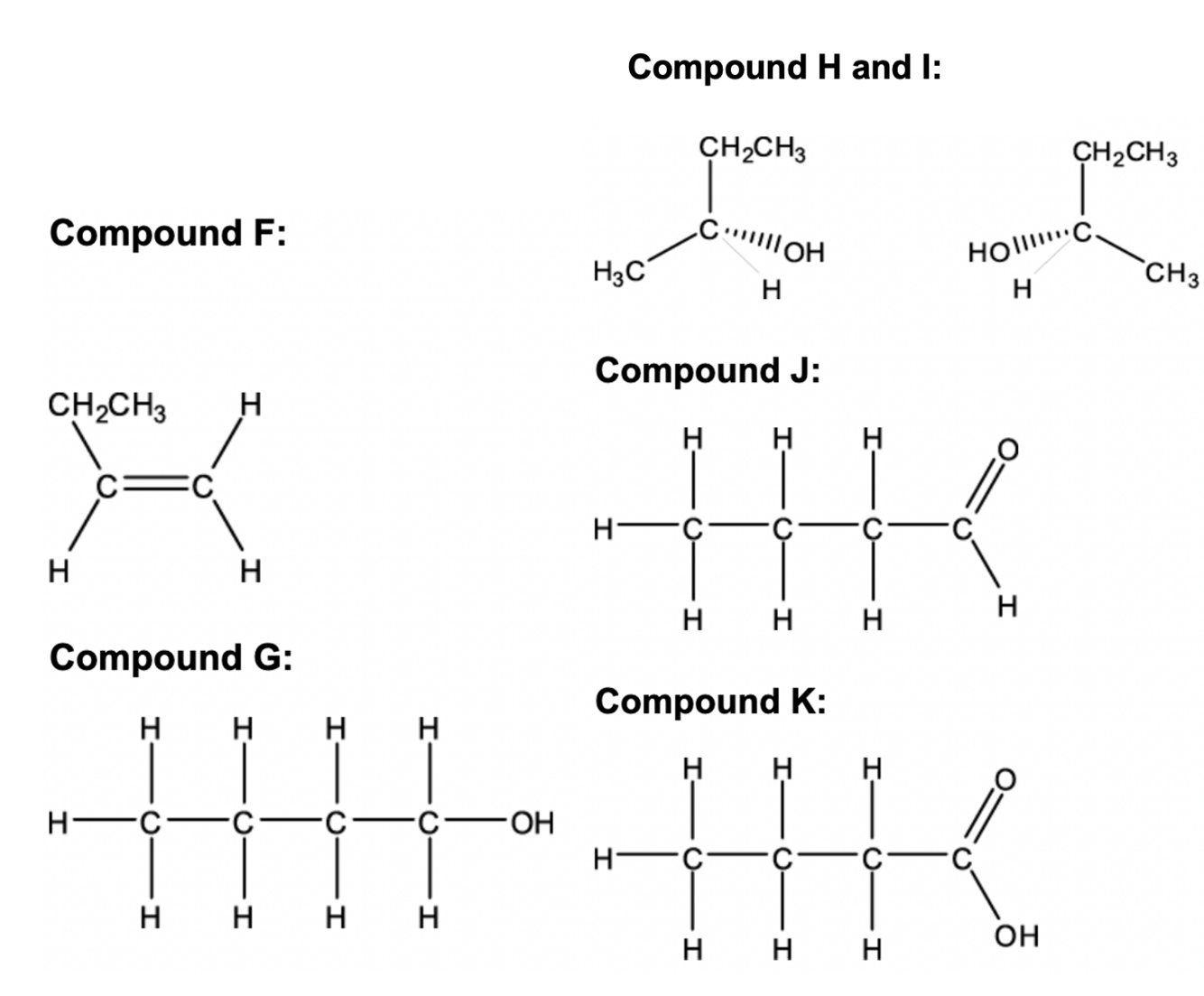
Compound F has the molecular formula C₄H₈. Compound F is reacted with steam in the presence of an acid catalyst, to form a mixture of three alcohols, G, H and I. Compound G is oxidised with acidified potassium dichromate(VI) to form compound J. Compound J reacts with Tollens’ reagent to form compound K. Compounds H and I are optical isomers. Draw the structures of the compounds F, G, H, I, J and K. [6]
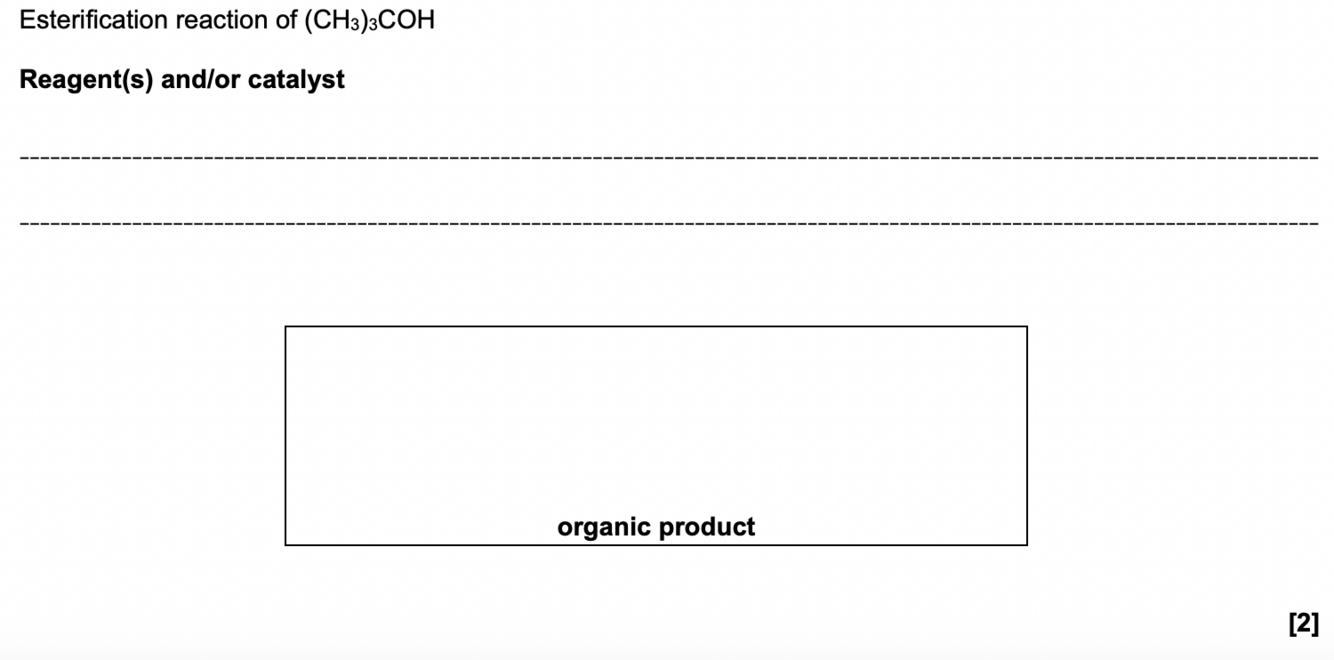
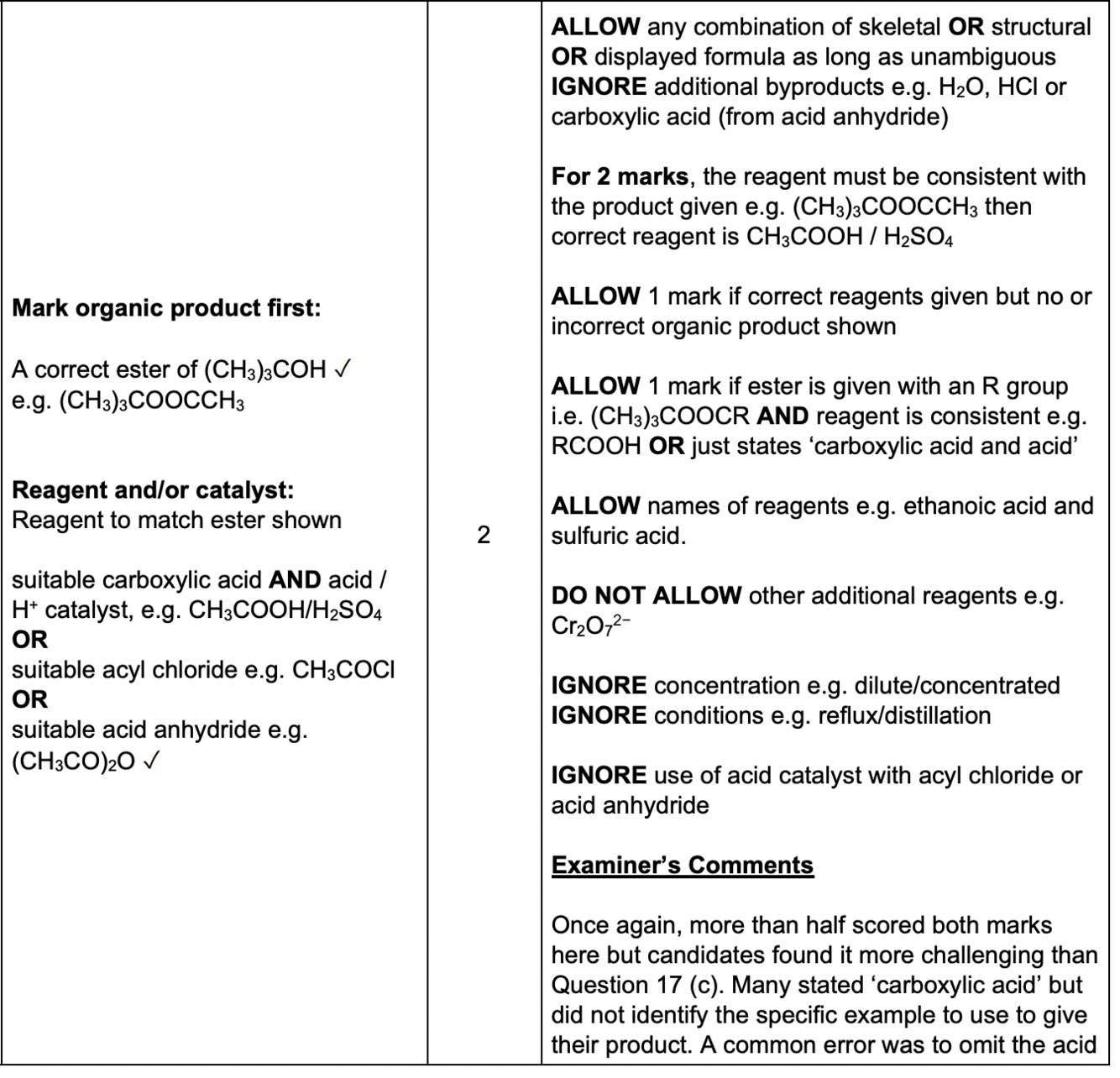
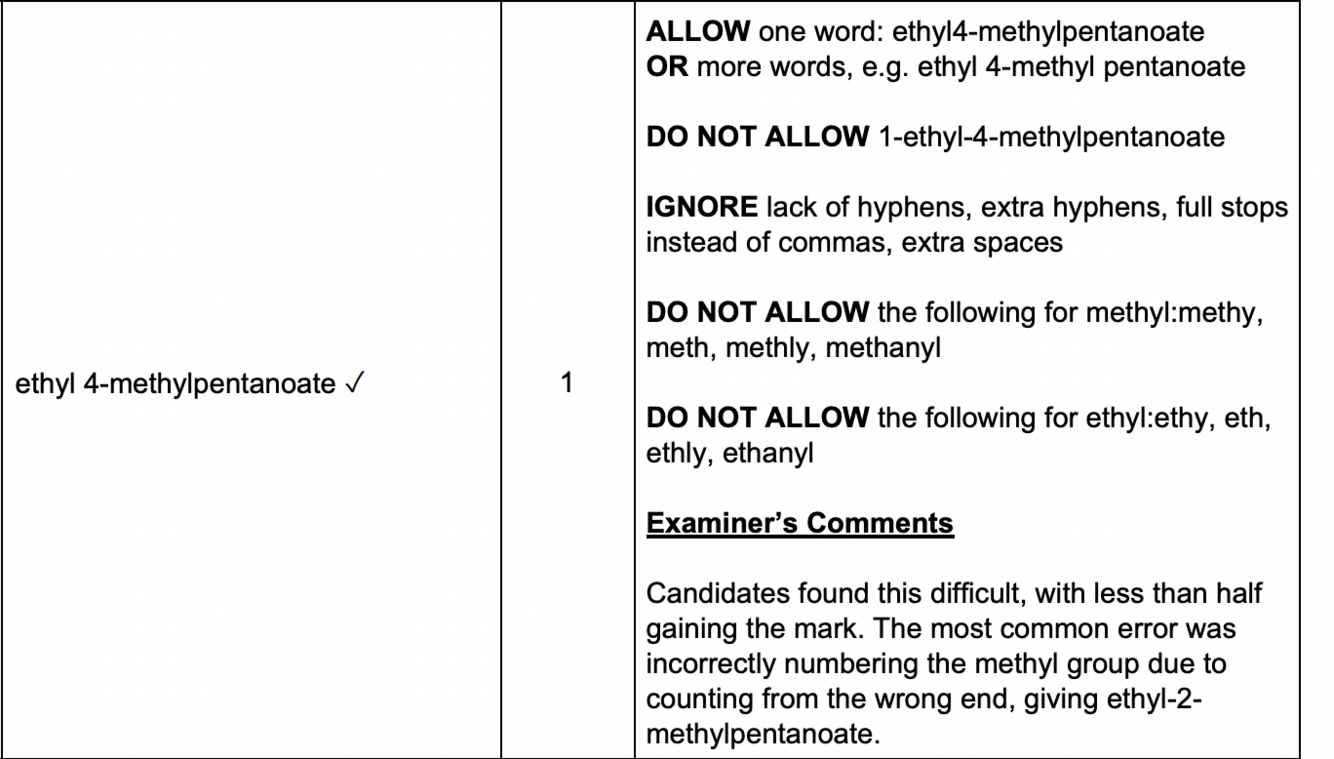
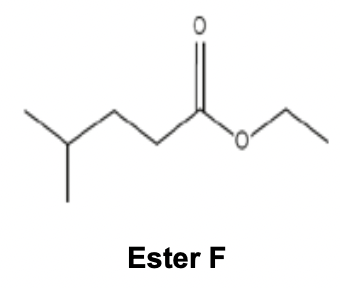
What is the systematic name for this ester? [1]
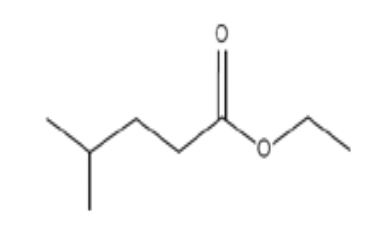
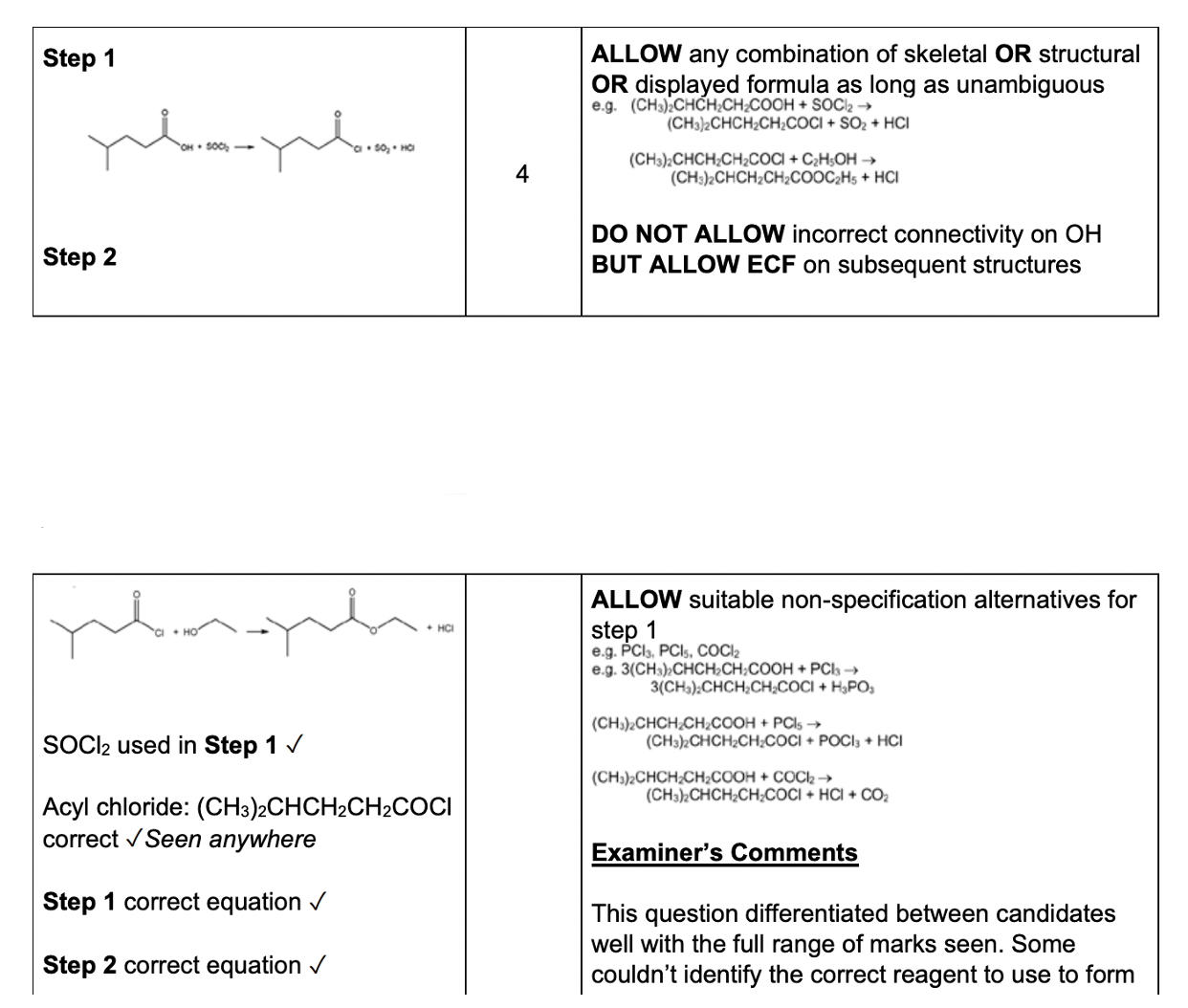
Ester F can be prepared from a carboxylic acid in two steps. Step 1: The carboxylic acid is converted into an acyl chloride. Step 2: The acyl chloride is converted into ester F. Write equations for Step 1 and Step 2. Show organic compounds as structures. [4]
Identify the structure of compound E and include the equation for this reaction. [2]
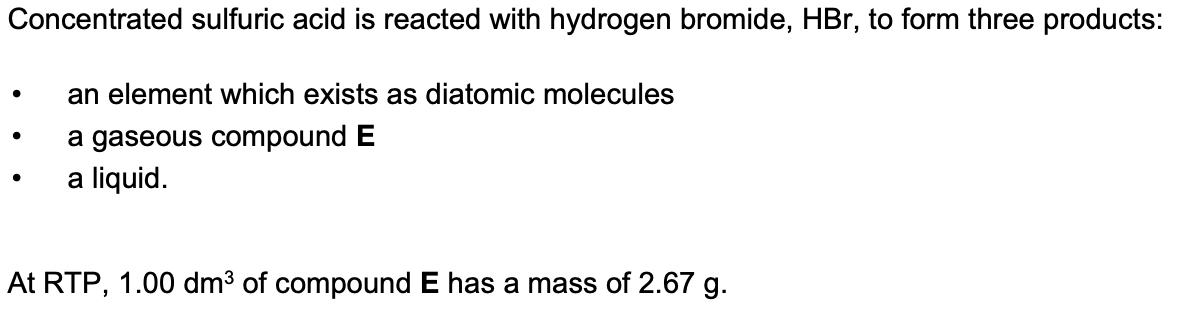
E: SO₂ ✓ H₂SO₄ + 2HBr → Br₂ + SO₂ + 2H₂O ✓ DO NOT ALLOW unbalaced equation for second mark
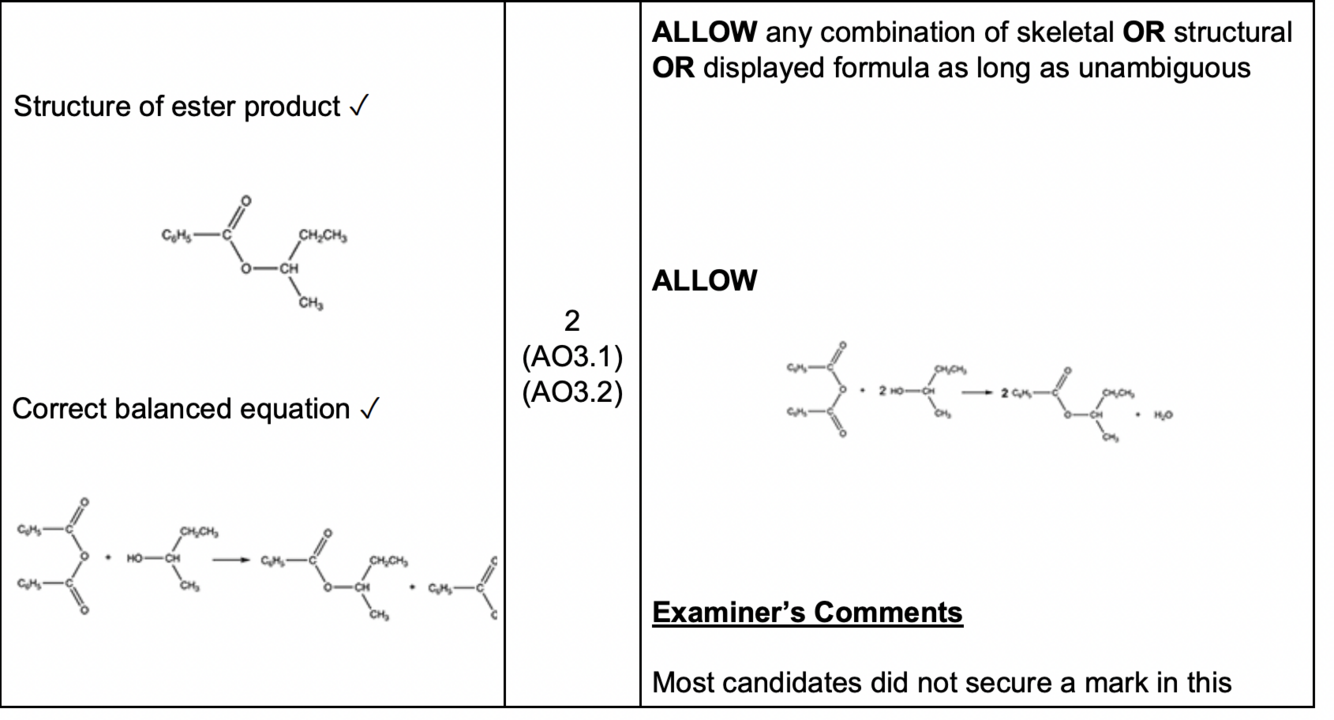
Application of Knowledge Acid anhydrides react in a similar way to acyl chlorides with phenols. Benzoic anhydride is the acid anhydride of benzoic acid, C₆H₅COOH. Benzoic anhydride reacts with butan-2-ol to form an ester. Suggest an equation for this reaction. Show structures for organic compounds. Use C₆H₅ for any phenyl groups. [2]
4