3.35 Thyroid Function
No description yet. This curated deck is ready for daily study.
Card preview (12)
Diseases
• Airway problems: all forms of thyroid disease may be associated with large goitres, which may extend retrosternally and cause airway problems. • Hyperthyroidism: the well known clinical features are predictable from knowledge of the actions of the hormone. Excess thyroid hormone hyper stimulates almost all metabolically active tissue. Severe cases may have cardiac arrhythmias and heart failure. The cardinal principle underlying the anaesthetic management of thyrotoxic patients is to render them euthyroid prior to surgery. • Hypothyroidism: in contrast, hypothyroid patients need much smaller doses of anaesthetic drugs. The BMR is greatly reduced, and with it cardiac reserve. Uncorrected myxoedema may be associated with amyloidosis, with consequent cardiac and renal impairment.
The thyroid gland
Produces thyroid hormone, which is an iodine-containing amino acid that is central to metabolism. In essence it maintains the metabolic rate that is optimal for normal cellular function.
Production
The production of thyroxine first involves iodide trapping within the gland by a process of active transport. Iodide is rapidly oxidized to iodine prior to the iodination of tyrosine with the formation of diiodotyrosine (DIT). Two molecules of DIT condense to form T4. Thyroxine is then stored in the colloid of the thyroid bound in a peptide linkage as part of the large thyroglobulin molecule. It then undergoes proteolysis and release into the circulation. Most of the hormone is released in the form of T4 with only about 5% secreted as T3. Once in the circulation about one-third of T4 is converted to T3.
Secretion:
controlled Thyroid-stimulating hormone (TSH) of the anterior pituitary, which in turn is regulated by thyrotropin-releasing hormone (TRH) from the hypothalamus. The process is subject to negative feedback control by thyroid hormones which act both at the pituitary and hypothalamus. The proteolysis of stored thyroid hormone is inhibited by iodide.
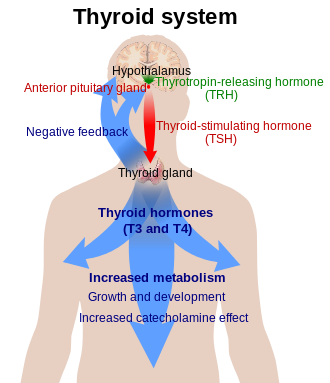
Binding:
Carriage in the circulation is via binding to albumin and thyroxine binding globulin (TBG). TBG has very high affinity and so most circulating T4 is bound. T3 is bound equally by TBG and by albumin. Free T3 and T4 concentrations in plasma are very low.
Functions
stimulate oxygen consumption, act as a regulator of carbohydrate and lipid metabolism, and have an important role in normal growth and maturation. Thyroxine is calorigenic, increasing the oxygen consumption of almost all metabolically active tissues. It increases the force and rate of myocardial contraction, increases the number and affinity of b-adrenergic receptors and enhances its response to circulating catecholamines Catabolic hormone it increase lipolysis and stimulates the formation of low-density lipoprotein receptors. It increases protein breakdown in muscle and enhances carbohydrate absorption from the gut.
How does Thyroid hormone exert its effect
Hormones enter cells and T3 binds to thyroid receptors in the nuclei. T3 acts more rapidly and is three to five times more potent than T4. The hormone–receptor complex then binds to DNA and changes the expression of a variety of different genes that code for enzymes that regulate cell function.
Hyperthyroidism
Should be rendered euthyroid before surgery. One approach is to achieve this over 2–3 months • Using propylthiouracil, which decreases thyroid synthesis and inhibits the peripheral conversion of T4 to T3. • Carbimazole can be used as an alternative. This also decreases synthesis of thyroid hormone, possibly by inhibiting iodination of tyrosine residues in thyroglobulin • For 10 days or so prior to surgery patients are also given potassium iodide to reduce the vascularity of the gland. An alternative and less time-consuming option is to control the manifestations of thyroid overstimulation using b-adrenoceptor blockers for 2–3 weeks preoperatively, together with potassium iodide as above
Emergency surgery in hyperthyroid patients carries
Risk of a thyrotoxic crisis, also known as ‘thyroid storm’, in which there is a sudden further extreme surge of metabolic stimulation, with hyperpyrexia, diaphoresis, tachycardia and arrhythmias. Intravenous b-blockade using propranolol
Hypothyroidism:
the opposite of thyroid storm is myxoedema coma, which is characterized by obtunded cerebration, marked hypothermia, alveolar hypoventilation and bradycardia. Correction of hypothyroidism is usually undertaken slowly, giving oral thyroxine, although intravenous T3 can be used in emergency situations. This risks provoking myocardial ischaemia and should be avoided if possible. T4 can be given, but its conversion to T3 under these circumstances is greatly depressed
Why hypothyroidism is known as myxoedema.
Skin contains various proteins combined with polysaccharides, hyaluronic acid and chondroitin sulphuric acid. In hypothyroidism these complexes accumulate, and so promote water retention along with a characteristic coarsening of the skin, which becomes puffy. When treated with thyroid hormone these complexes are metabolized with resolution of the ‘myx’-oedema
Why patients with thyrotoxicosis develop proptosis,
Exophthalmos is a characteristic of autoimmune Graves’ disease and is caused by swelling of the muscles and connective tissues of the orbit, which leads to proptosis. This effect is due not to thyroid hormone but to autoimmune attack on the tissues by cytotoxic antibodies. These are formed in response to antigens that are common to the eye muscles and to the thyroid.