Lecture 16 - Enols and Enolates
No description yet. This curated deck is ready for daily study.
Card preview (24)
Resonance=
electrons arranged differently
Tautomerisation=
the transfer of one proton (hydrogen) and shift of a double bond
Enols can be formed in keto-enol tautomerisation. What is a keto? What is an enol?
• Keto: carbonyl compounds with protons at the alpha position (bonded to alpha carbon- the carbon adjacent to C=O) that can enolize. • Enol: enols have a C=C double bond (alkENe) and an OH group (alcohOL) directly bonded to it.
Ketos and enols are NOT resonance forms. Instead they are…
structural/constitutional isomers - they have different physical and chemical properties. They are different compounds with different structures just with the same formula.
The Keto/Enol structural isomers can interconvert and are in ……………..
equilibrium
In a neutral solution keto/enol tautomerisation is a slow process. How can we speed it up?
acid/base catalyst.
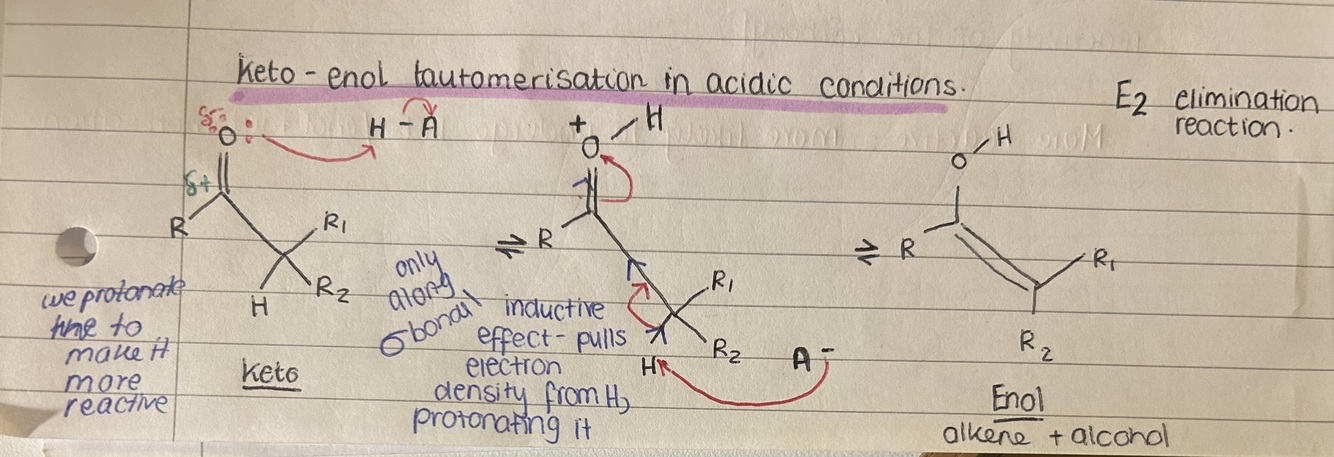
In the acid catalysed keto/enol tautomerisation reaction, what occurs?
• the oxygen in C=O is protonated first by the acid catalyst • the inductive effect pulls electron density from the protons at the alpha position towards the positively charged oxygen atom a proton is then lost from the alpha carbon- C-H bond breaks. So, a C=C bond forms. So, the C=O bond breaks
Draw the mechanism for the acid catalysed keto/enol tautomerisation reaction. Use a ketone as the example.
In the base catalysed elonization reaction, what occurs?
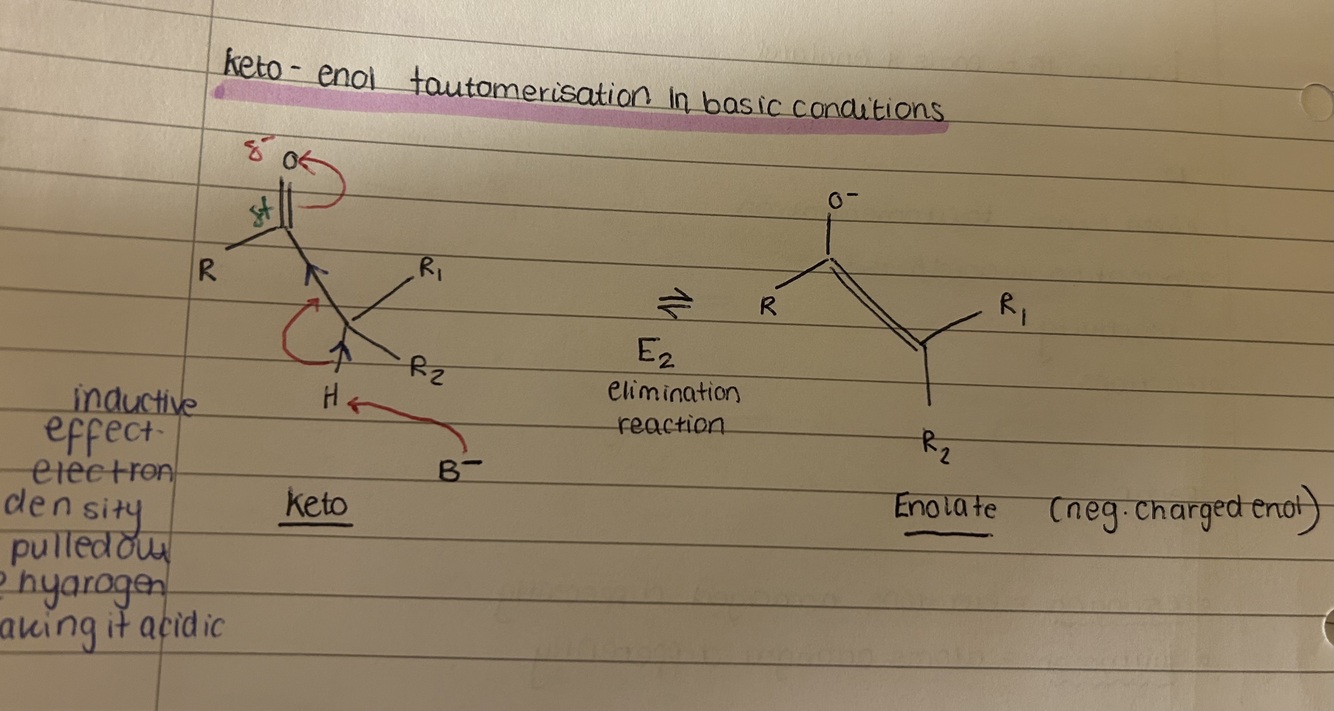
• inductive effect pulls electron density from the alpha protons towards the partially positive carbon atom in the C=O bond of the keto. This makes the alpha protons more acidic • an alpha proton is removed first by forming a bond with the base. A bond is broken between C-H • So, a double bond forms - C=C • But as a result, the C=O bond breaks • An enolate forms
What is an enolate?
negatively charged enol.
Draw a mechanism for the base catalysed enolization of a keto
What effects how likely it is for a keto to convert to an enol? For enolization to occur?
The acidity of the hydrogens at the alpha position
Rank ketone, ester, amides and acyl chloride in order of most likely to enolize to least likely
acyl chloride ketone ester amides
pKa of acyl chloride
~15
pKa of ketone
~20
pKa of ester
~25
pKa of amides
~30
What makes the hydrogens at the alpha position more acidic in a keto and therefore makes the compound more likely to undergo tautomerisation to form an enol?
If the partially positive carbon in the C=O bond is more positive, there is stronger inductive effect, pulling electron density from the hydrogen atoms at the alpha position, making them more acidic
The enolate ion- formed in the basic enolization reaction, has two resonance forms. Draw and name them. Give curly arrows to show how they interconvert.
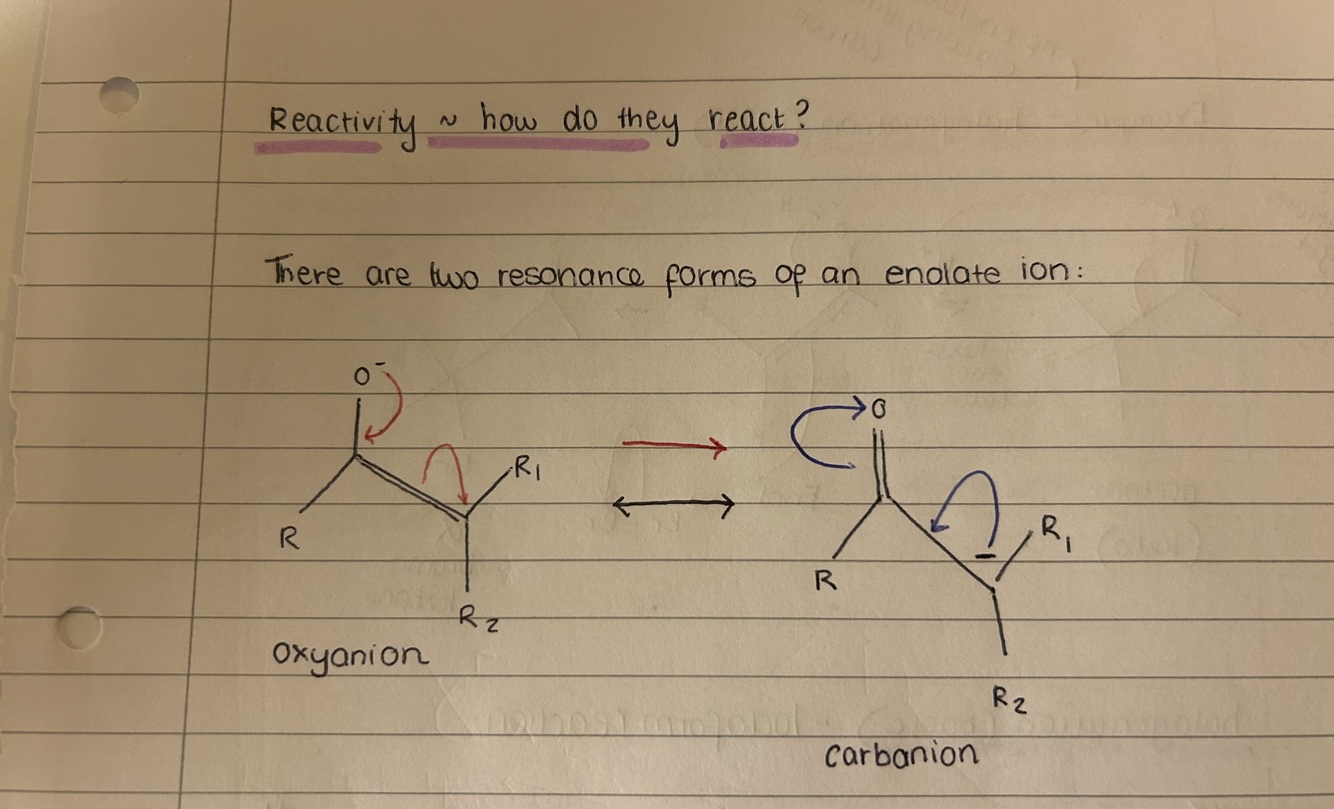
Why do we always draw enolate ions in their oxyanion resonance form?
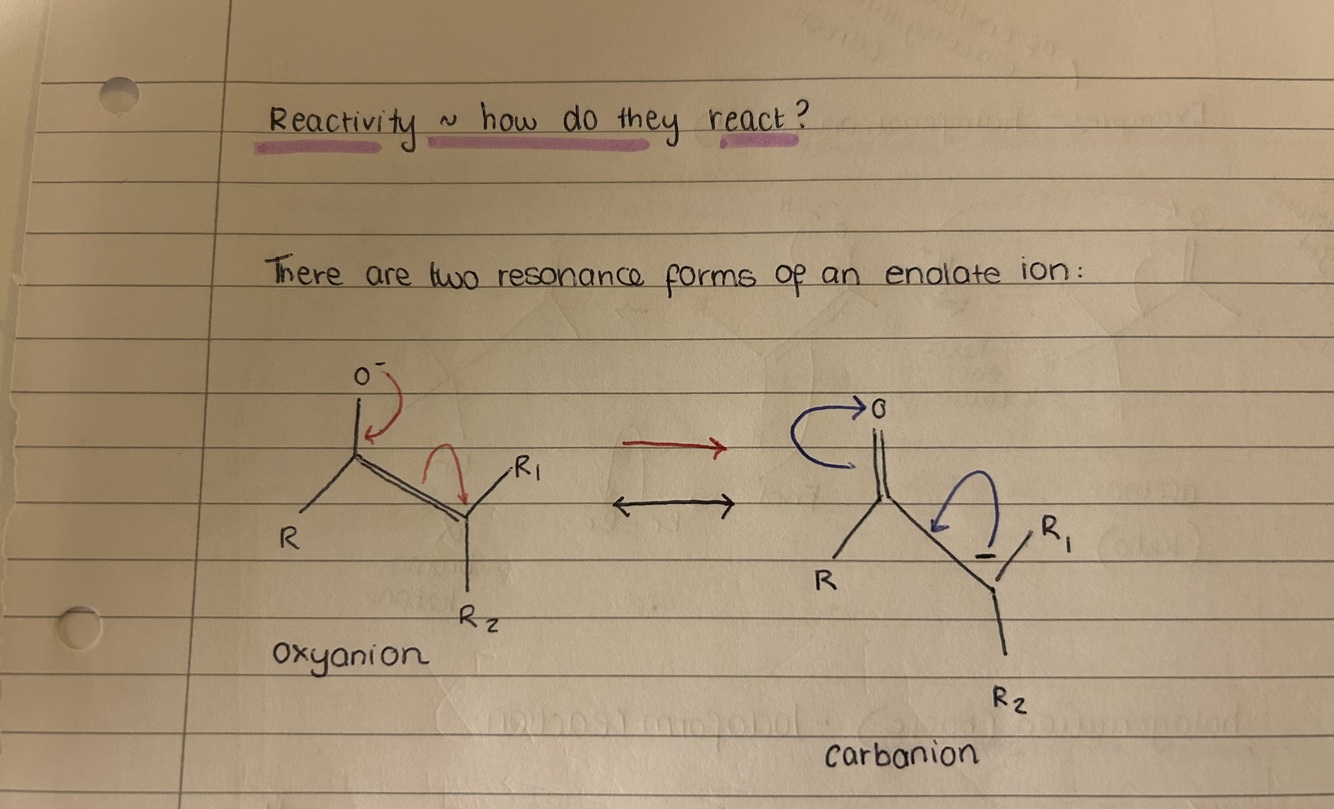
• oxygen is more electronegative than carbon • O- is more stabilised than C- • C- is therefore more reactive than O- Less stable= more reactive. The oxyanion contains the O- and is more stable than the carbanion, containing C- This is why we draw enolate as the oxyanion
Unlike Ketos which contain the electrophilic C=O, enols are…
nucleophilic
Because enols are nucleophiles, they usually react through…
the alpha carbon
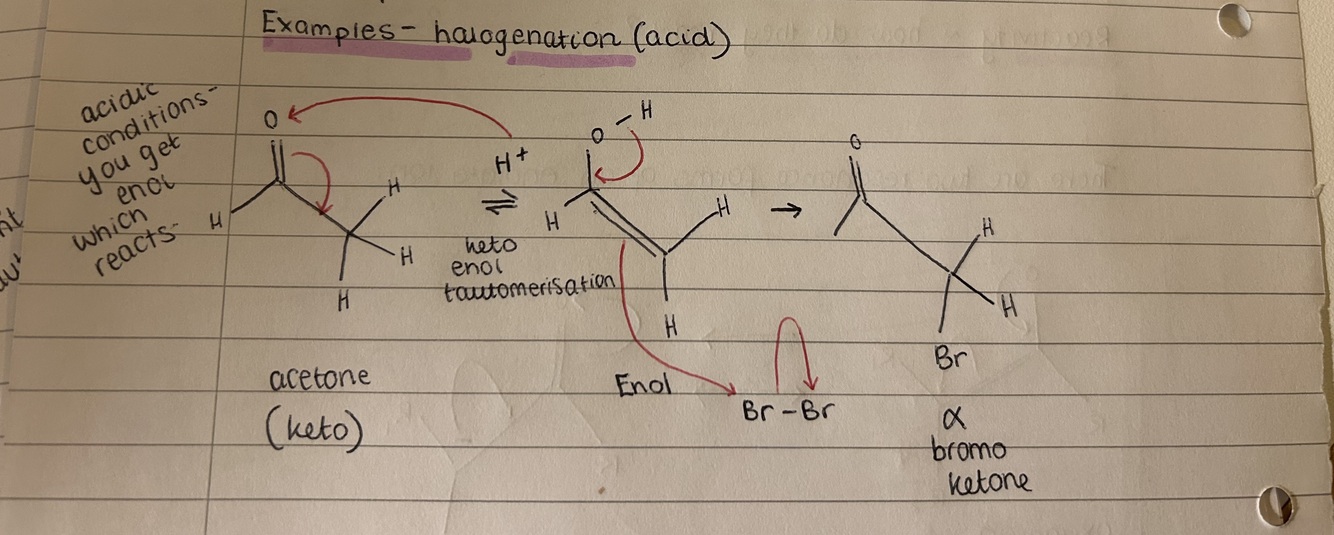
Give the acidic halogenation reaction of enols - start off using the keto propanone, produce an enol through tautomerisation with an acid catalyst and then react enol with a halogen- Br2. Name the product.
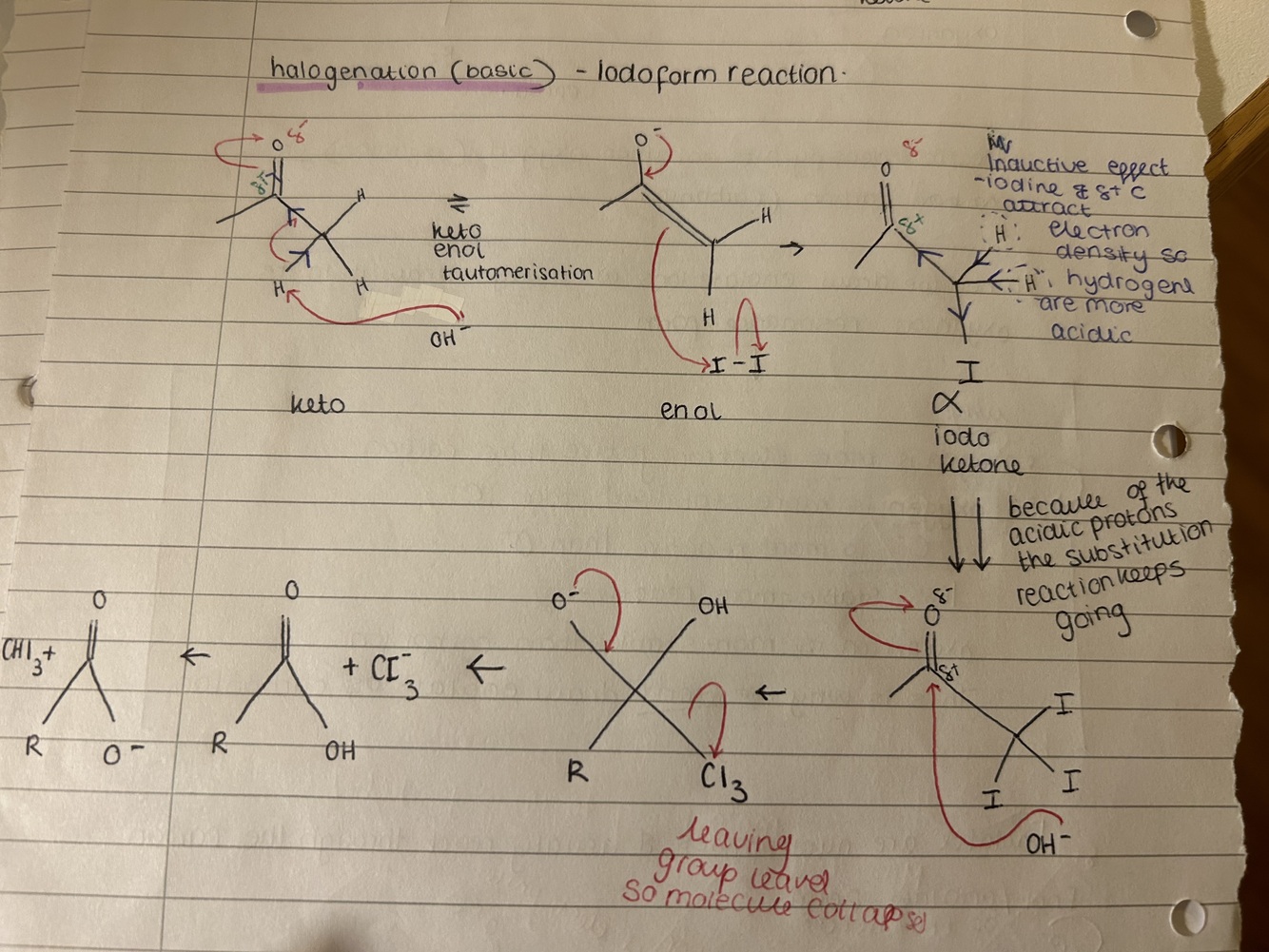
Give the basic halogenation reaction of enols - start off using keto propanone, produce an enolate with a base catalyst and then react enol with iodine. What is this reaction called?