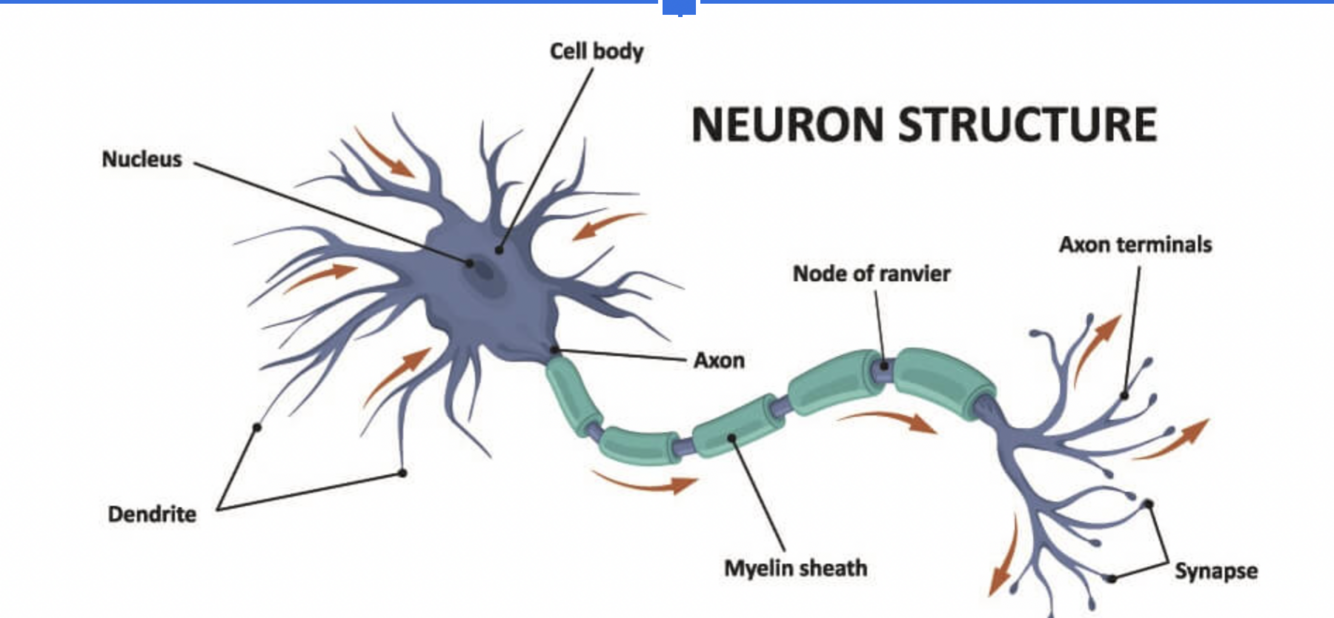
EOYE
No description yet. This curated deck is ready for daily study.
Card preview (24)
Axial skeleton → 80 bones
Bones along vertical axis, skull, vertebrae, ribcage
Appendicular Skeleton → 126 bones
Shoulder girdle, upper limbs, pelvic girdle, lower limbs
Function of skeleton BPASS
Blood cell production : RBC’s + WBC’s Protection of vital organs : Internal organs Skull protects brain Ribs + sternum protect heart Attachment point for muscles : Bones connected by ligaments Storage : Holds vitamins and minerals Support : Skeleton is structural framework for body
Anatomical Terminology of Locations of bones
Superior = towards head Inferior = further from head Anterior = closer to front of body Posterior = closer to the back of the body Medial = toward middle Lateral = toward the side Proximal = superior for appendicular limbs Distal = inferior for appendicular limbs
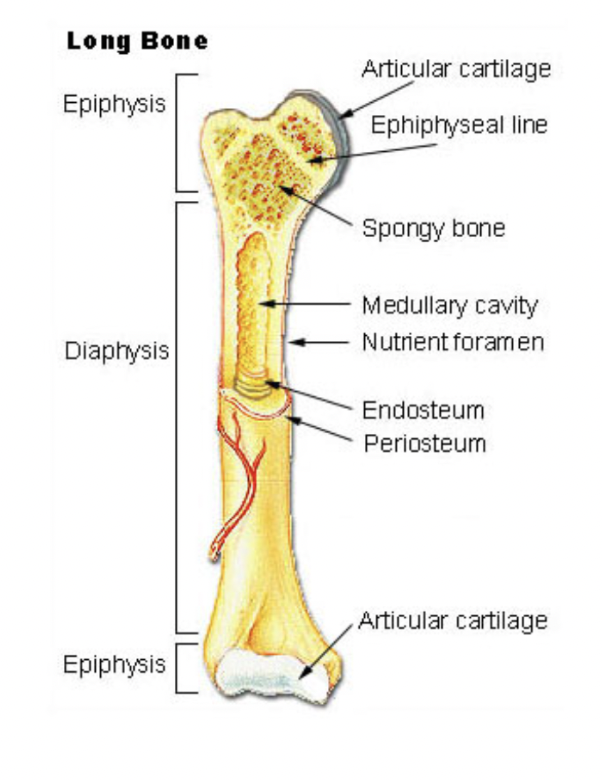
Long Bone Structure
Define Joints
When two or more bones come into contact or articulate with each other
Parts of joints
Tendons: Strips attaching the muscles to bone Ligaments: Bands connecting bones to bones at joints Cartilage: Soft cushioning that covers ends of bone (shock absorber)
Types of Joints
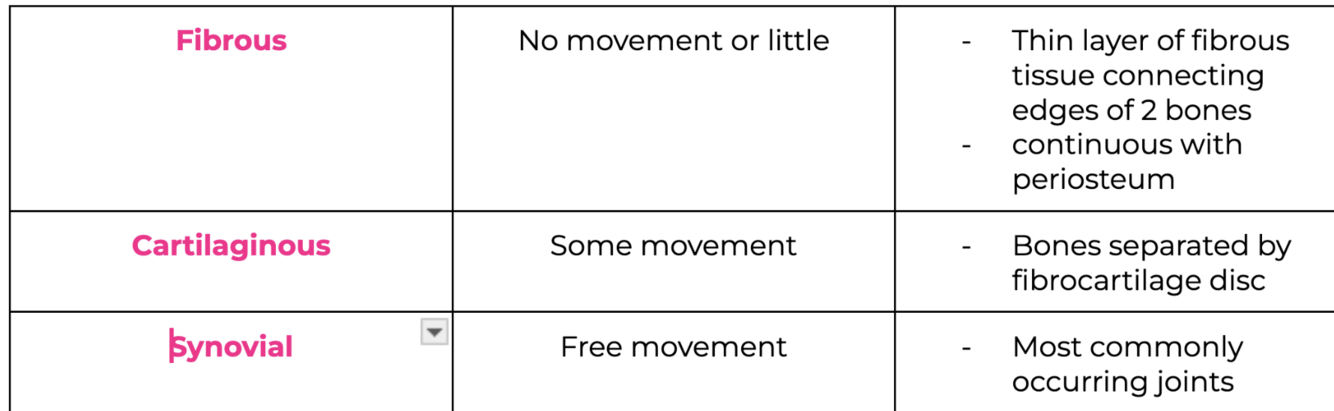
Synovial Joints
• Ball and socket Example: hip & shoulder • Pivot Example: the atlas, and axis at the top of the cervical vertebrae. • Saddle Joints. Example: The thumb is the only one in the entire body. • Hinge Joints Example: Elbow and knee • Condyloid Joints Examples: between the metacarpals and phalanges in the hand. • Gliding Joints Examples: between the carpals in the hand and tarsals in the ankle.
Types of Muscles:
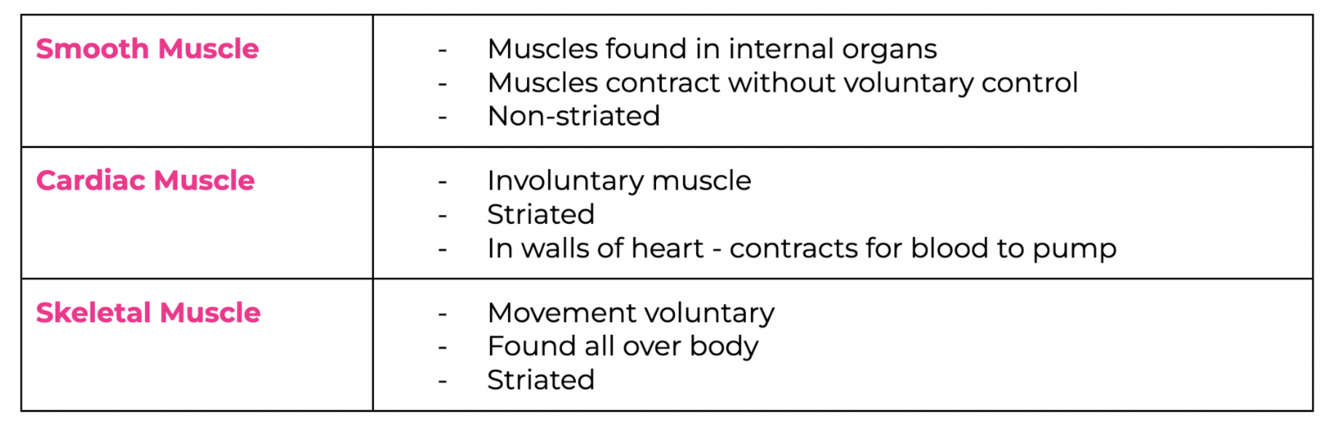
Characteristics of Muscle Tissue
Contractibility Ability to shorten Excitability Ability to receive and respond to stimuli Extensibility Ability to be stretched beyond normal length Elasticity Ability of a muscle fiber to recoil and resume resting length
Structure of skeletal muscle
Epimysium- Perimysium - Endomysium - Myofibril
Types of Muscle Contractions
Isometric Contraction: Tension but no movement NO change in length No external movement Static contraction Increases blood pressure Isotonic Contraction: Tension with movement Concentric Shortened → results in movement Force greater than resistance Eccentric Muscle contractility BUT lengthening of muscle Actin + Myosin are broken mechanically and it creates stronger bonds Isokinetic Contraction: Tension at a constant speed Rare in sporting Special equipment
Antagonist Pairs:
Muscles working in pairs The main muscle contracting is called agonist the opposite is called antagonist
What happens to muscles with use and no use:
Muscle Atrophy: “Use it or lose it” Decrease in mass of muscle tissue Hypertrophy: Increase in size of skeletal muscle Controlled by nerve stimuli and fed by capillaries
Origin and Insertion of Muscles
Origin Where the tendon of a muscle joins the stationary bone (usually proximal) Insertion Where the tendon of the muscle joins the moving bone (more distal)
Elbow Muscle movement
Flexion of the Elbow: Agonist: Biceps brachii Antagonist: Triceps brachii Example: Lifting a dumbbell towards the shoulder. Extension of the Elbow: Agonist: Triceps brachii Antagonist: Biceps brachii Example: Lowering a dumbbell back to the starting position.
Primary Glands in Endocrine system
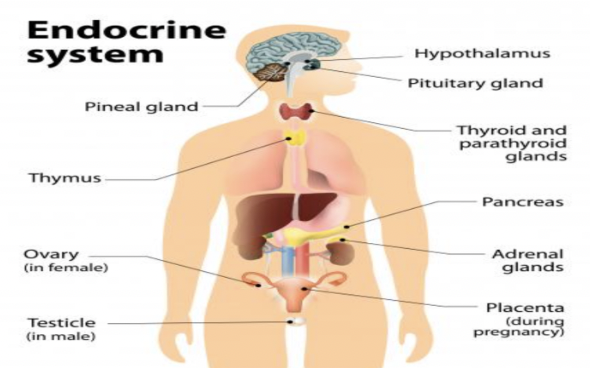
Hypothalamus + Pituitary Gland Relationship
Responsible for homeostasis The pituitary gland secretes hormones, such as Antidiuretic hormone (ADH) and growth hormone (GH), that help regulate a wide range of bodily functions including growth, and water and temperature regulation. Hypothalamus stimulates pituitary gland
Circulating and Local Hormones:
Hormones are secreted by glands for bodily functions Circulating hormones travel around the body through the blood (e.g testosterone) Local hormones act on neighboring cells (e.g serotonin) Circulating hormones regulate by complex feedback loops signaled by nervous system
Give an example of a negative feedback loop and contrast it to a positive feedback loop in the endocrine system. (4)
A negative feedback loop: blood glucose regulation to keep the body stable. - When blood glucose rises after eating, the pancreas releases insulin, which lowers glucose levels. When glucose is low, the pancreas releases glucagon, which raises glucose levels. A positive feedback loop: like during childbirth, - Pressure on the cervix causes the release of oxytocin, leading to stronger contractions and more pressure, continuing until the baby is born. Negative feedback maintains balance in the body, while positive feedback drives processes to completion.
Nervous systems … PNS, CNS etc
The Central Nervous System (CNS) Brain and spinal cord The Peripheral Nervous System (PNS) Nerves extending from the spinal cord to the body Autonomic Nervous System: Controls involuntary functions. Sympathetic (SNS): ‘Fight or flight,’ increases heart rate, dilates pupils, inhibits digestion, uses norepinephrine. Parasympathetic (PNS): ‘Rest and digest,’ decreases heart rate, constricts pupils, stimulates digestion, uses acetylcholine.
Two neurotransmitters involved in action potential synaptic cleft :
Acetylcholine and Acetylcholinesterase
Motor Unit: