Unit 1-Bonding
No description yet. This curated deck is ready for daily study.
Card preview (23)
Which substances contain metallic bonding?
Metals
Which substances contain covalent bonding?
Non metals
Which substances contain ionic bonding?
Metals and non metals
What is an ionic bond?
Electrostatic attraction between positive and negative ions
What is an ionic lattice?
A regular arrangement of alternating positive and negative ions
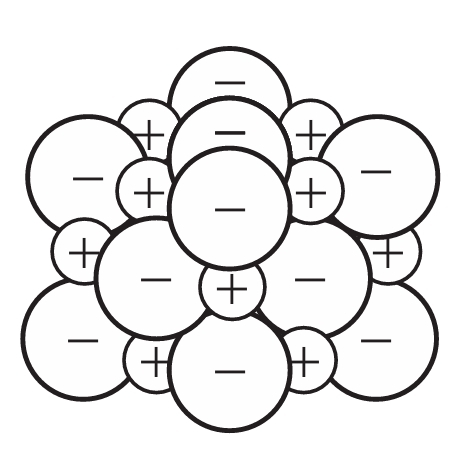
Why do ionic compounds have high melting and boiling points?
Strong ionic bonds must be broken to melt the lattice
Are ionic compounds soluble in water?
Ionic compounds are soluble in water.
When do ionic compounds conduct electricity? Explain your answer
When molten or in solution because ions are free to move
What is a covalent bond?
The attraction between two positive nuclei and their shared pair of electrons.
What are the two types of covalent structures?
Covalent molecular and covalent network
Which elements exist as diatomic molecules?
HINFOClBr Hydrogen, Iodine, Nitrogen, Fluorine, Oxygen, Chlorine and Bromine
Why do covalent molecular substances have low melting and boiling points?
Only weak forces between molecules are broken
Are covalent compounds soluble in water?
No, covalent compounds are insoluble in water.
Do covalent molecular substances conduct electricity?
No except carbon graphite
Why do covalent network substances have very high melting points?
Strong covalent bonds must be broken throughout the network
Describe metallic bonding.
The attraction between lattice of positively charged metal ions and a sea of delocalised electrons.
Name these shapes of molecules.
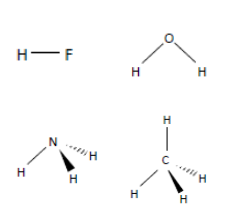
• linear • angular • trigonal pyramidal • tetrahedral
Explain the physical properties of covalent network compounds: • melting point and boiling point • solubility (water molecules surround ions) • electrical conductivity
• Giant covalent network structures have very high melting and boiling points because the network of strong covalent bonds must be broken. • Covalent molecules tend to be insoluble in water but soluble in covalent type solvents. • Covalent molecules never conduct except carbon graphite.
Describe the bonding in metals.
In metallic bonding, the outer electrons are delocalised (free to move). This produces an electrostatic force of attraction between the positively charged metal ions, and the negatively charged delocalised electrons.
Why do metals have high melting and boiling points?
Strong metallic bonds require lots of energy to break
Why do metals conduct electricity?
Delocalised electrons are free to move
Which type of bonding and structure is represented by each diagram?
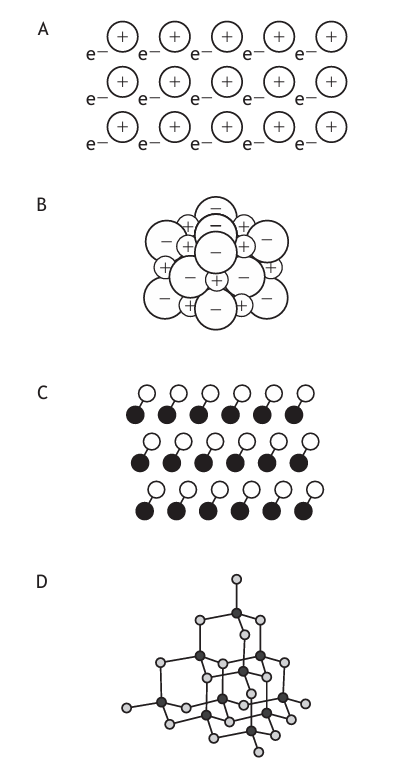
A = Metallic lattice B = Ionic lattice C = Covalent molecular D = Covalent network
Which type of bonding matches each line in the table?
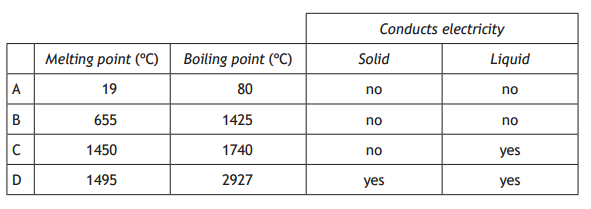
A= Covalent molecular B = Covalent network C = Ionic lattice D = Metallic lattice