energetics
No description yet. This curated deck is ready for daily study.
Card preview (24)
Enthalpy change
Enthalpy change is the amount of heat energy taken in or given out during any change in a system provided the pressure is constant.
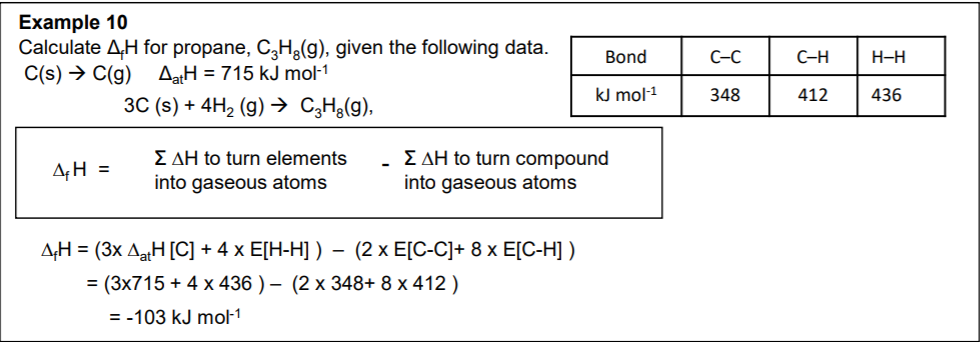
Standard Enthalpy Change of Formation
The standard enthalpy change of formation of a compound is the enthalpy change when 1 mole of the compound is formed from its elements under standard conditions (298K and 100kpa), all reactants and products being in their standard states.
Standard Enthalpy Change of Combustion
The standard enthalpy of combustion of a substance is defined as the enthalpy change that occurs when one mole of a substance is combusted completely in oxygen under standard conditions. (298K and 100kPa), all reactants and products being in their standard states
Incomplete combustion will lead to
soot (carbon), carbon monoxide and water. It will be less exothermic than complete combustion.
Standard conditions are:
• 100 kPa pressure • 298 K (room temperature or 25oC) • Solutions at 1mol dm-3 • all substances should have their normal state at 298K
Measuring the Enthalpy Change for a Reaction Experimentally equation

Calorimetric method
• washes the equipment (cup and pipettes etc) with the solutions to be used • dry the cup after washing • put polystyrene cup in a beaker for insulation and support • Measure out desired volumes of solutions with volumetric pipettes and transfer to an insulated cup • clamp thermometer into place making sure the thermometer bulb is immersed in a solution • measure the initial temperatures of the solution or both solutions if 2 are used. Do this every minute for 2-3 minutes • At minute 3 transfer second reagent to cup. If a solid reagent is used then add the solution to the cup first and then add the solid weighed out on a balance. • If using a solid reagent then use ‘before and after’ weighing method • stirs mixture (ensures that all of the solutions is at the same temperature) • Record temperature every minute after addition for several minutes
Errors in calorimetry method 5
• energy transfer from surroundings (usually loss) • approximation in specific heat capacity of the solution. The method assumes all solutions have the heat capacity of water. • neglecting the specific heat capacity of the calorimeter- we ignore any energy absorbed by the apparatus • reaction or dissolving may be incomplete or slow. • density of solution is taken to be the same as water
Calculating the enthalpy change of reaction, H from experimental data
• Using q = m x cp x T calculate energy change for quantities used • Work out the moles of the reactants used • Divide q by the number of moles of the reactant not in excess to give H • Add a sign and unit (divide by a thousand to convert Jmol-1 to kJmol-
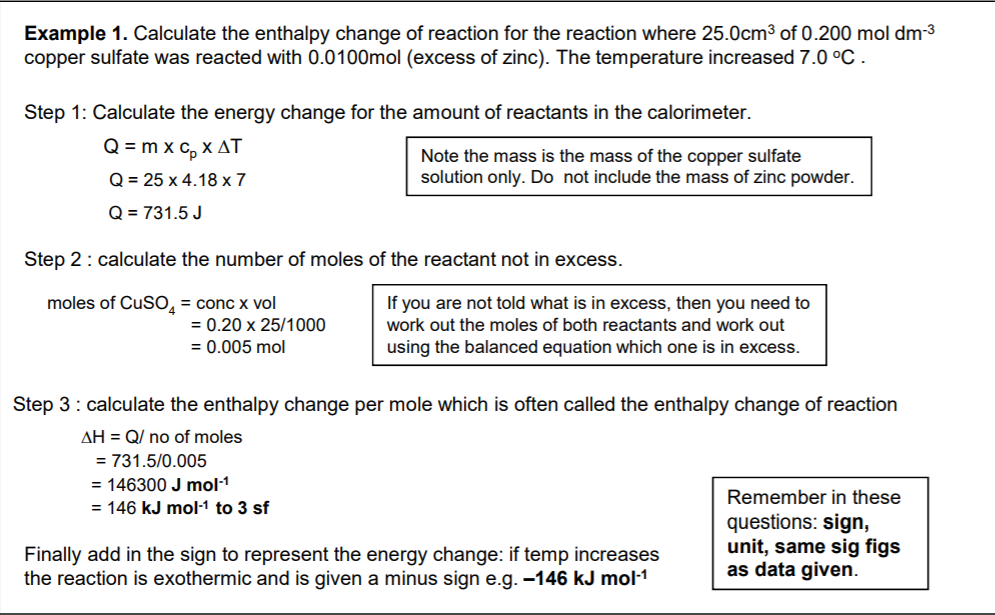
Example 1. Calculate the enthalpy change of reaction for the reaction where 25.0cm3 of 0.200 mol dm-3 copper sulfate was reacted with 0.0100mol (excess of zinc). The temperature increased 7.0 oC
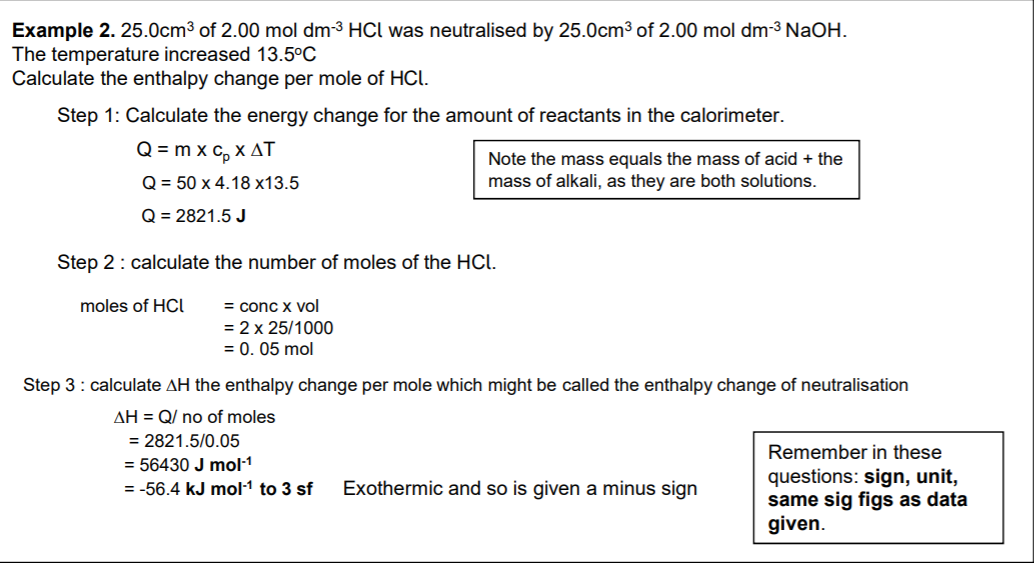
Example 2. 25.0cm3 of 2.00 mol dm-3 HCl was neutralised by 25.0cm3 of 2.00 mol dm-3 NaOH. The temperature increased 13.5oC Calculate the enthalpy change per mole of HCl.
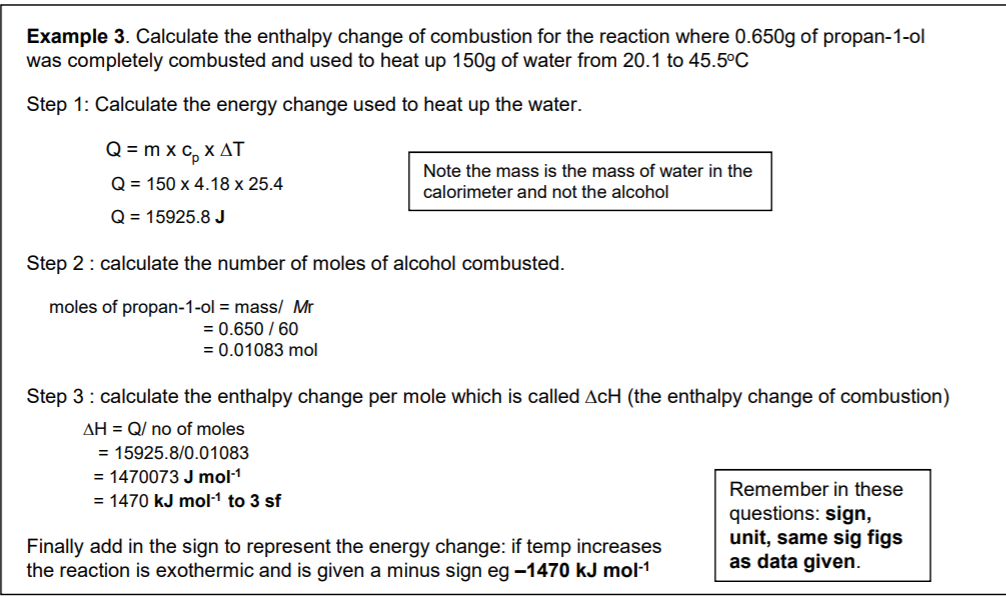
Example 3. Calculate the enthalpy change of combustion for the reaction where 0.650g of propan-1-ol was completely combusted and used to heat up 150g of water from 20.1 to 45.5oC
Errors in this method Measuring Enthalpies of Combustion Using Calorimetry
• Energy losses from the calorimeter • Incomplete combustion of fuel • Incomplete transfer of energy • Evaporation of fuel after weighing • Heat capacity of calorimeter not included • Measurements are not carried out under standard conditions as H2O is gas, not liquid, in this experiment
Hess’s Law
Hess’s law states that total enthalpy change for a reaction is independent of the route by which the chemical change takes place
Combustion calculation
reactants-products
Formation calculation
products-reactants
Mean Bond energies
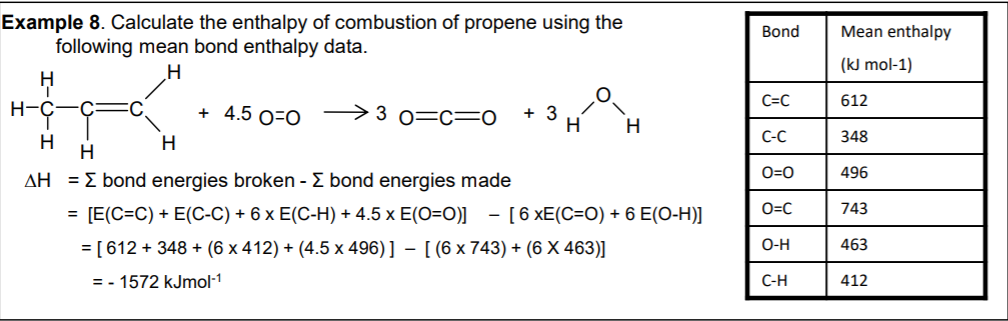
The mean bond energy is the enthalpy needed to break the covalent bond into gaseous atoms, averaged over different molecules. H = Σ bond energies broken - Σ bond energies made
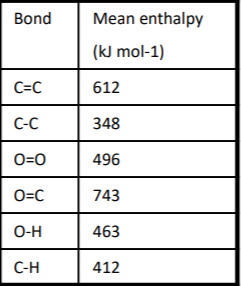
Example 8. Calculate the enthalpy of combustion of propene using the following mean bond enthalpy data
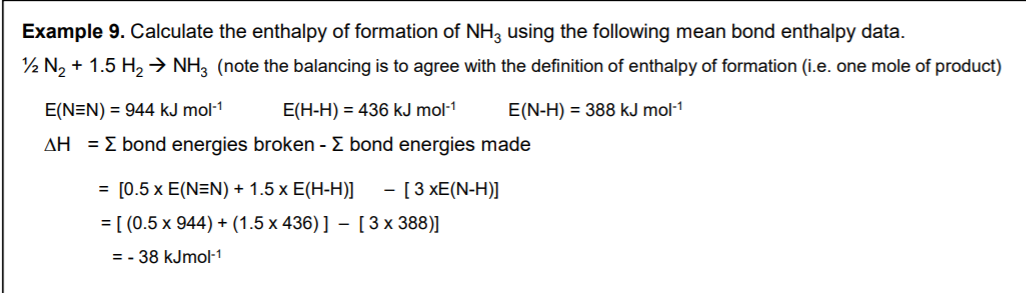
Example 9. Calculate the enthalpy of formation of NH3 using the following mean bond enthalpy data. ½ N2 + 1.5 H2 —– NH3 E(N≡N) = 944 kJ mol-1 E(H-H) = 436 kJ mol-1 E(N-H) = 388 kJ mol-1

Why experimental enthalpy values will vary from data
If the results are worked out experimentally using a calorimeter the experimental results will be much lower than the calculated ones because there will be significant heat loss. There will also be incomplete combustion which will lead to less energy being released. Remember that calculated values of enthalpy of combustions will be more accurate if calculated from enthalpy of formation data than if calculated from average bond enthalpies. This is because average bond enthalpy values are averaged values of the bond enthalpies from various compounds.
activation energy, E
The activation energy, EA, is defined as the minimum energy which particles need to collide to start a reaction
Maxwell Boltzmann Distribution
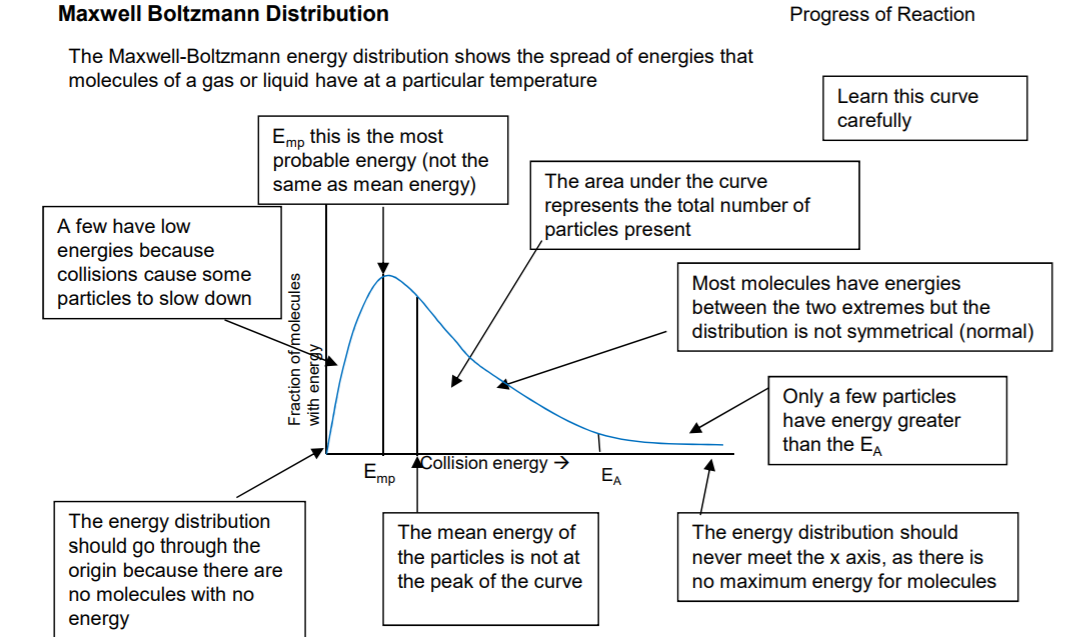
How can a reaction go to completion if few particles have energy greater than EA?
Particles can gain energy through collisions