9: Kinetics I
No description yet. This curated deck is ready for daily study.
Card preview (10)
Explain, in terms of collision theory, the effect of a change in concentration on the rate of a chemical reaction.
Increasing concentration of a solution: more particles per unit volume, frequency of collisions increases, frequency of successful collisions increases.
Explain, in terms of collision theory, the effect of a change in temperature on the rate of a chemical reaction.
Increasing temperature: average kinetic energy of particles increases, a higher proportion of collisions have energy greater than the activation energy, frequency of successful collisions increases.
Explain, in terms of collision theory, the effect of a change in pressure on the rate of a chemical reaction.
Increasing pressure of a gas: more particles per unit volume, frequency of collisions increases, frequency of successful collisions increases.
Explain, in terms of collision theory, the effect of a change in surface area on the rate of a chemical reaction.
Increasing surface area: more of the solid is exposed to collisions with other reactant particles, frequency of collisions increases, frequency of successful collisions increases.
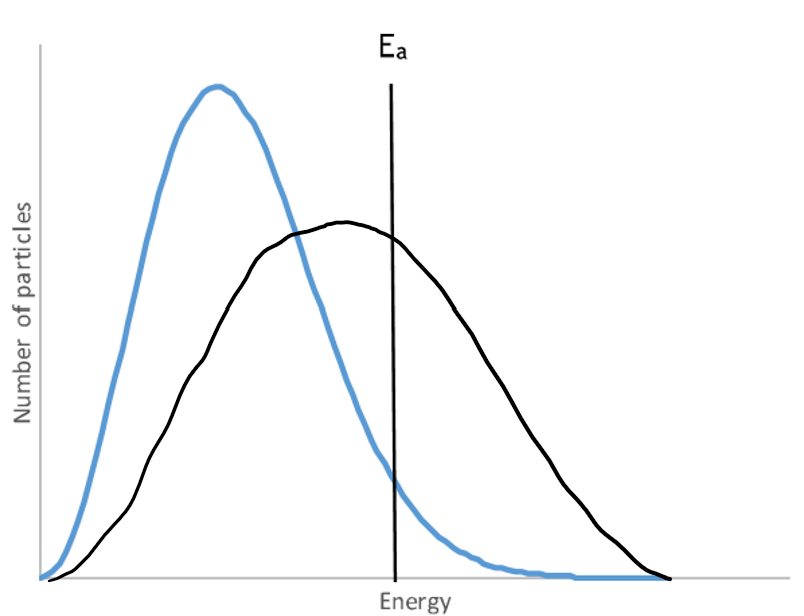
In terms of the Maxwell-Boltzmann distribution of molecular energies, how do changes in temperature affect the rate of a reaction?
Increased temperature: Stretches curve to the right, lower peak.
Describe the role of catalysts.
Providing alternative reaction routes of lower activation energy.
Describe the difference in the reaction profiles of catalysed and uncatalysed reactions for heterogeneous and homogeneous catalysis.
Catalysed reactions have a lower activation energy, so a smaller reaction profile curve. Homogeneous catalysis has an intermediate between the reactants and products.
Interpret the action of a catalyst in terms of the Maxwell-Boltzmann distribution of molecular energies.
Moves activation energy to the left, so more molecules have sufficient energy to react.
Describe the processes that occur on the surface of a heterogeneous catalyst.
• Molecule adsorbs onto catalyst surface • Bonds in molecules weaken • Reaction occurs at a lower activation energy • Product comes away from the surface
State the economic benefit of the use of catalysts in industrial reactions.
Reduces temperature needed for the reaction, so reduces energy cost.