Aldehydes and Ketones
No description yet. This curated deck is ready for daily study.
Card preview (24)
What is a carbonyl group
C=O group
In terms of the position of the carbonyl group, what is the difference between aldehydes and ketones
Aldehydes: Carbonyl group on an end of carbon of the chain chain Ketones: Carbonyl group on an inner carbon of the chain
What is the suffix for ketones
-one
What is the suffix for aldehydes
-al
What are aldehydes oxidised into and what are the conditions and reagent for this reaction
Carboxylic acids Reagent: potassium dichromate (VI) solution and dilute sulphuric acid. Conditions: Heat under reflux
What are ketones oxidised into
Ketones cant be oxidised easily
Write an equation showing the oxidation of propanal using [O] as oxidising agent

How do we make tollens
Add a few drops of NaOH to a solution of silver nitrate (forms a pale brown precipitate) Add a few drops of dilute ammonia until the precipitate dissolves This is tollens reagent
What are the practical steps in using tollens to distinguish between an aldehyde and ketone
• Add aldehyde/ketone to tollens in a test tube • Place in a hot water bath If an aldehyde is present, silver mirror appears If ketone is present no silver mirror appears
Why do we not heat the test tube with a Bunsen burner when testing for aldehydes and ketones
Aldehydes and ketones are flammable
Write an equation for the reaction between aqeuous tollens and ethanal State what occurs
CH3CHO + 2Ag+ + H2O —> CH3COOH + 2Ag + 2H+ Aldehydes only are oxidised by Tollen’s reagent into a carboxylic acid and the silver(I) ions are reduced to silver atoms
What is the observation when aldehydes are oxidised into a carboxylic acid using dichromate
Orange dichromate ion (Cr2O72-) is reduced to the green Cr3+ ion
Write the full equation for the oxidation of ethanal (using dichromate) into ethanoic acid
3CH3CHO + Cr2O72- + 8H+ —> 3 CH3COOH + 4H2O + 2Cr3+
What are the conditions and positive test result for distinguishing between aldehydes and ketones using Fehling’s
Conditions: heat gently Observation: Aldehydes :Blue Cu 2+ ions in solution change to a red precipitate of Cu2O. Ketones do not react.
Write an equation for the reaction between Fehling’s solution and ethanal State what occurs
CH3CHO + 2Cu2+ + 2H2O —> CH3COOH + Cu2O + 4H+ Aldehydes :Blue Cu 2+ ions in solution change to a red precipitate of Cu2O. Ketones do not react.
What do we use as a reducing agent when reducing aldehydes and ketones
NaBH4 Represented as [H] Source of hydride (H-) ions
What are aldehydes reduced to
Primary alcohols
How many [H]’s are required for the reduction aldehydes and ketones and where do these [H]’s come from
2 are required H- from reducing agent H+ from water
What are ketones reduced to
Secondary alcohols
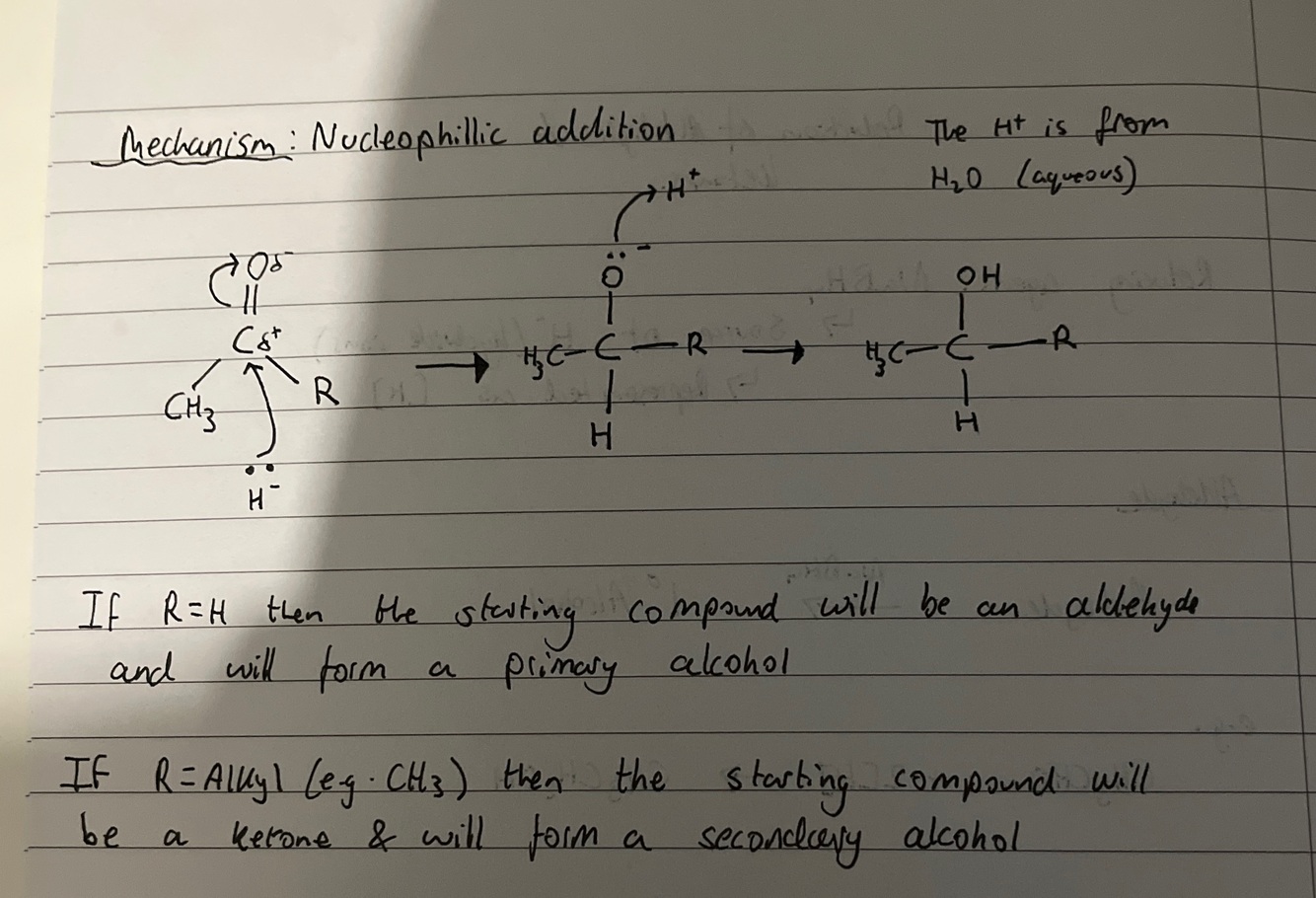
What is the name of the mechanism by which aldehydes and ketones are reduced using NaBH4
Nucleophilic addition
Outline the general mechanism for the reduction of aldehydes and ketones, by representing R as either H for an aldehyde or an alkyl group for a ketone State the name of this mechanism
Nucleophilic addition Partial charges on first C&O
What is an alkyl group
e.g. CH3
What are carbonyl compounds reduced to by CN- ions
Hydroxynitriles
What is the name of the mechanism by which carbonyl compounds are reduced to hydroxynitriles
Nucleophilic addition