ChemPath: Potassium
No description yet. This curated deck is ready for daily study.
Card preview (15)
What is the normal range for serum potassium?
3.5-5.0 mmol/L
What are the two main hormones involved in the regulation of potassium?
• Angiotensin II • Aldosterone
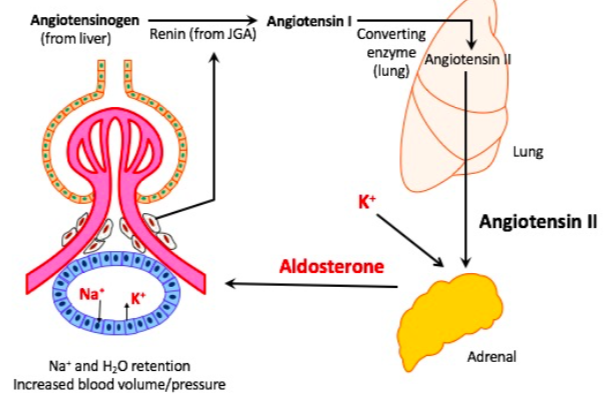
Outline how the renin-angiotensin-aldosterone system works.
• Reduced perfusion or low sodium will stimulate the production of renin from the juxta-glomerular cells • This cleaves angiotensinogen to angiotensin I • This is then converted by ACE in the lungs to angiotensin II → stimulates aldosterone release from the adrenals • Aldosterone stimulates sodium reabsorption and potassium excretion in the principal cells of the cortical collecting tubule NOTE: water will also be drawn in with the sodium so aldosterone should not greatly affect sodium concentration
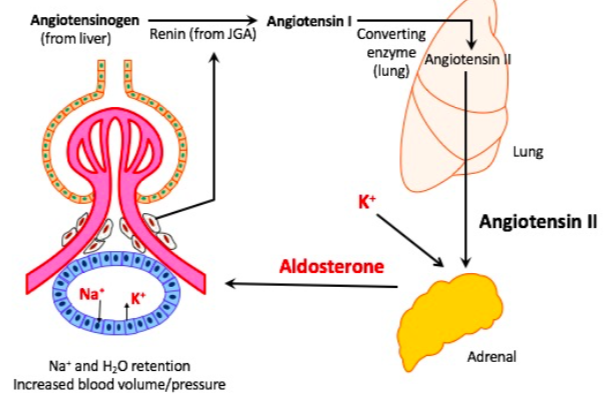
Outline the mechanisms of action of aldosterone.
• Aldosterone binds to MR and stimulates the transcription of ENaC channels • Aldosterone binding to MR also leads to increased Sgk1 which inhibits Nedd4 • Nedd4 usually ubiquitinates sodium channels and degrades them • Inhibition of Nedd4 leads to preservation of sodium channels thereby increasing sodium reabsorption • As you reabsorb more sodium, the lumen becomes more negative and K+ will move down the electrochemical gradient into the lumen via ROMK channels
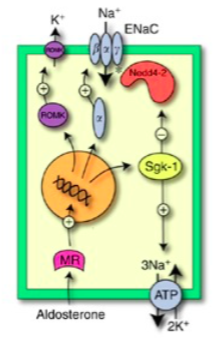
What are the main stimuli for aldosterone release?
• Angiotensin II • High potassium
List some causes of hyperkalaemia.
• Reduced GFR (renal failure) • Reduced renin activity (renal tubular acidosis type 4, NSAIDs) • ACE inhibitors/ARBs • Addison’s disease • Aldosterone antagonists • Potassium release from cells (rhabdomyolysis, acidosis)
Explain how acidosis leads to hyperkalaemia.
• When plasma H+ concentration is high, the cells try to take in more H+ from the plasma • To maintain electrochemical neutrality, K+ must leave the cell when H+ enters • This leads to hyperkalaemia
Outline the management of hyperkalaemia.
• 10 ml 10% calcium gluconate • 50 ml 50% dextrose + 10 U insulin • Nebulised salbutamol • Treat the cause
List some causes of hypokalaemia.
• GI loss • Renal loss • Hyperaldosteronism, Cushing’s syndrome • Increased sodium delivery to distal nephron • Osmotic diuresis • Redistribution into cells • Insulins • Beta-agonists • Alkalosis • Rare causes • Renal tubular acidosis (type 1 and 2) • Hypomagnesaemia
Name two conditions that can block the triple transporter.
• Loop diuretics • Bartter syndrome (mutation in triple transporter)
Name two conditions that can block the Na+/Cl- cotransporter.
• Thiazide diuretics • Gitelman syndrome (mutation in Na+/Cl- cotransporter)
Explain how increased delivery of sodium to the distal nephron can cause hypokalaemia.
• Increased delivery of Na+ to the distal nephron (e.g. because of blocking/ineffective triple transporter or Na+/Cl- cotransporter) leadas to increased reabsorption of Na+ in the distal nephron • This leads to the lumen of the distal nephron becoming more negative • This results in the movement of K+ down the electrochemical gradient through ROMK channels into the lumen
What are the clinical features of hypokalaemia?
• Muscle weakness • Arrythmia • Polyuria and polydipsia (hypokalaemia leads to nephrogenic DI)
What screening test should be done in a patient with hypokalaemia and hypertension?
Aldosterone: renin ratio (primary hyperaldosteronism will show high aldosterone and low renin)
Outline the management of hypokalaemia: • 3-3.5 mmol/L • <3 mmol/L
• 3-3.5 mmol/L • Oral potassium chloride (2x SandoK TDS for 48 hours) • Re-check serum K+ concentration • < 3 mmol/L • IV potassium chloride infusion • Maximum rate: 10 mmol/hr • NOTE: rates > 20 mmol/hr irritate the superficial veins • TREAT THE CAUSE