Rate of equations
No description yet. This curated deck is ready for daily study.
Card preview (24)
Rate Equations Calculation
r = k[A]m[B]n m, n are called reaction orders Orders are usually integers 0,1,2 0 means the reaction is zero order with respect to that reactant 1 means first order 2 means second-order NOTE: the orders are not the same as the stoichiometric coefficients in the balanced equation. They are worked out experimentally.
The total order
The total order for a reaction is worked out by adding all the individual orders together (m+n)
draw orders graph describe
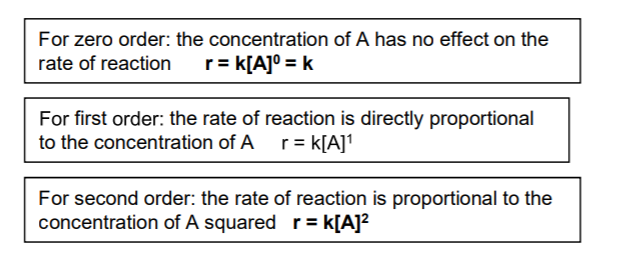
The rate constant (k)
• The units of k depend on the overall order of the reaction. It must be worked out from the rate equation • The value of k is independent of concentration and time. It is constant at a fixed temperature • The value of k refers to a specific temperature and it increases if we increase temperature
Continuous Monitoring
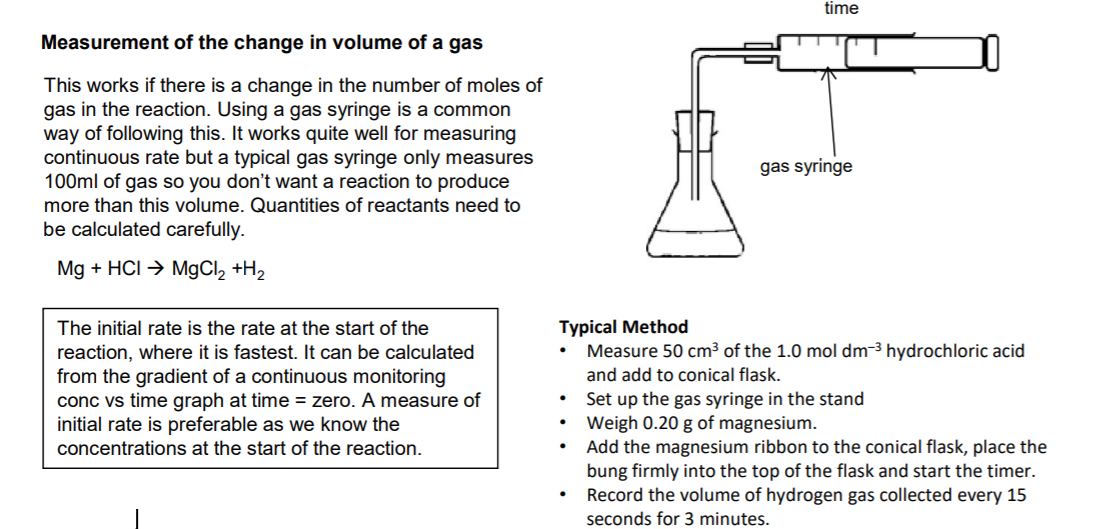
When we follow one experiment over time recording the change in concentration we call it a continuous rate method. The gradient represents the rate of reaction. The reaction is fastest at the start where the gradient is steepest. The rate drops as the reactants start to get used up and their concentration drops. The graph will eventually become horizontal and the gradient becomes zero which represents the reaction having stopped.
Measurement of the change in volume of a gas
A large excess of reactants effect on order
In reactions where there are several reactants, if the concentration of one of the reactant is kept in a large excess then that reactant will appear not to affect rate and will be pseudo-zero order . This is because its concentration stays virtually constant and does not affect rate.
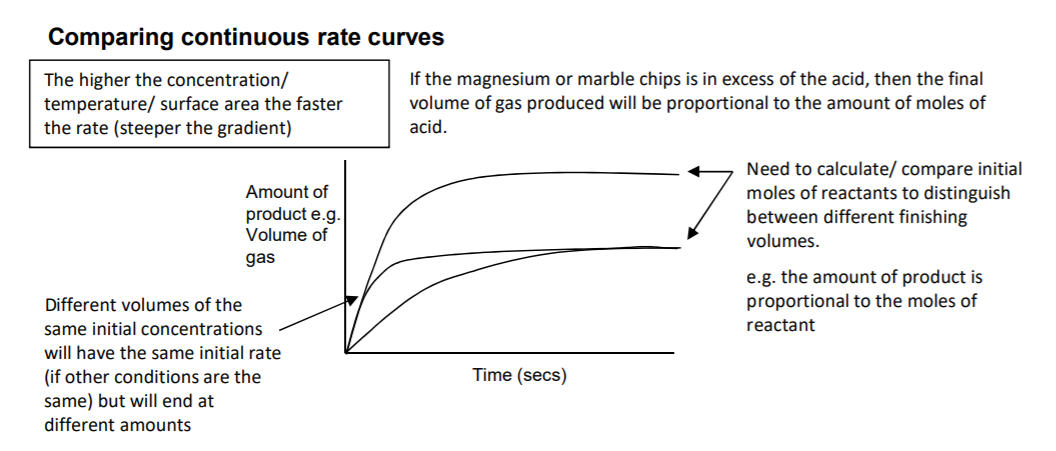
Comparing continuous rate curves
Initial rate method
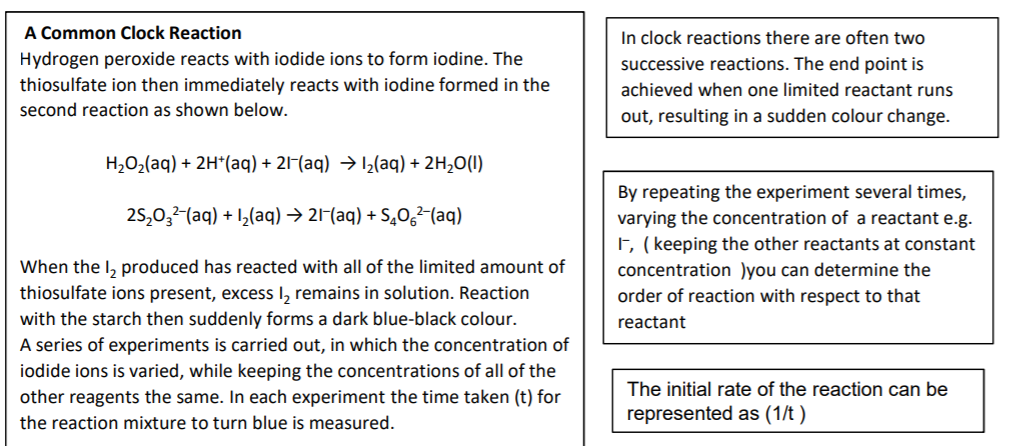
The initial rate can be calculated from taking the gradient of a continuous monitoring conc vs time graph at time = zero Initial rate can also be calculated from clock reactions where the time taken to reach a fixed concentration is measured.
A Common Clock Reaction
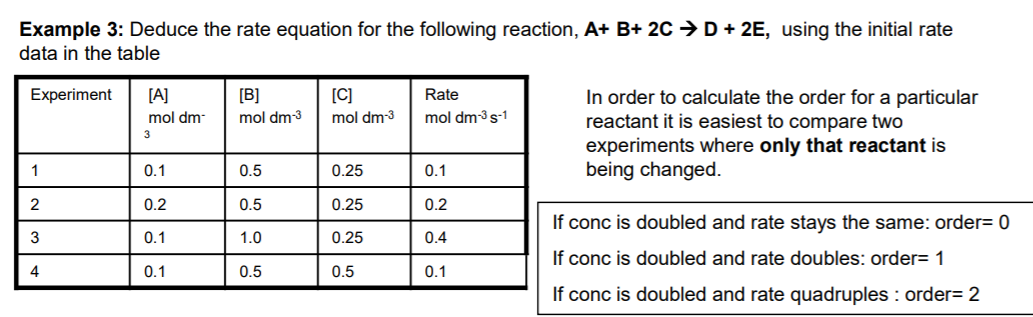
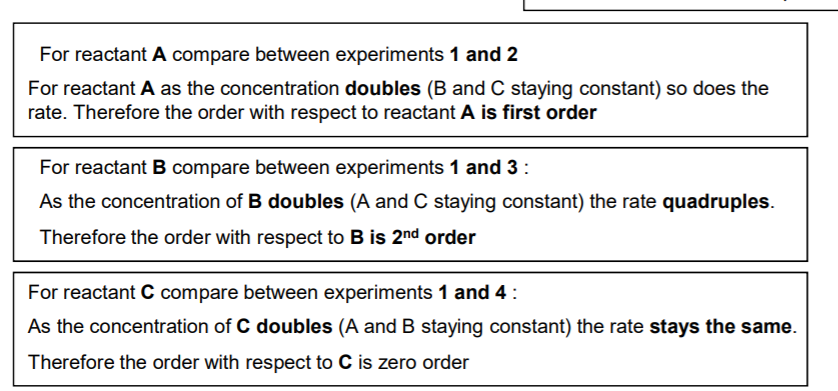
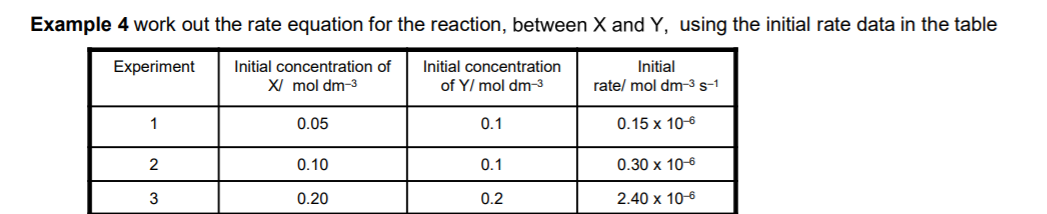
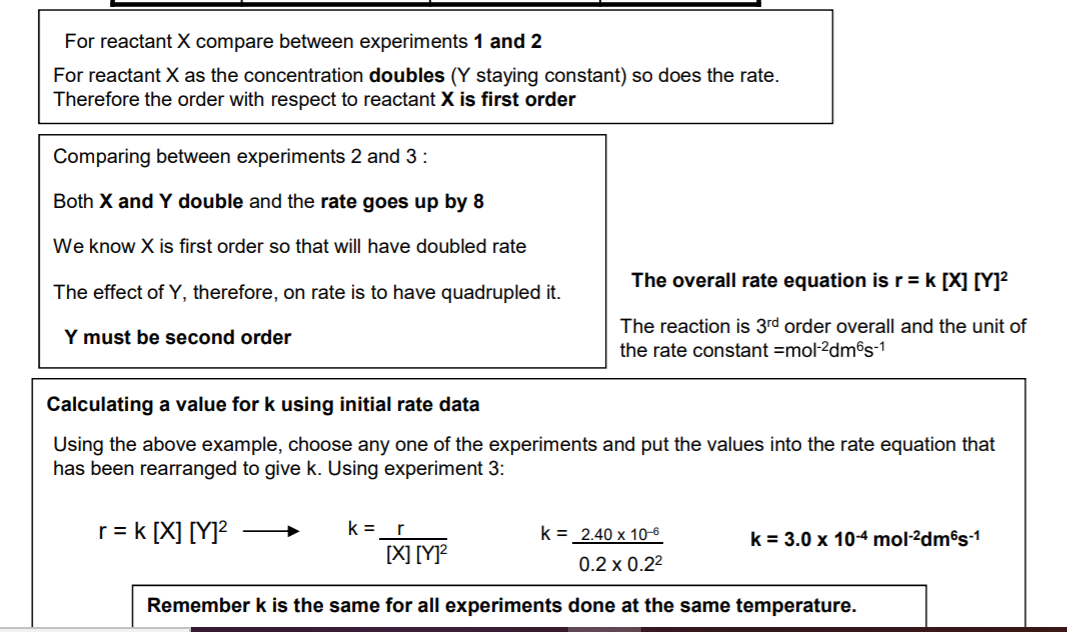
zero order: Calculating k from Concentration-time graphs
For zero order reactants, the rate stays constant as the reactant is used up. This means the concentration of that reactant has no effect on rate. Rate = k [A]0 so rate = k As the rate is the gradient of the graph on the right, the gradient is also the value of the rate constant
Effect of Temperature on Rate Constant: The Arrhenius Equation
Increasing the temperature increases the value of the rate constant k . The relationship is given by the Arrhenius equation k = Ae-EA/RT where A is the Arrhenius constant, R is the gas constant, and EA is the activation energy. ln k = ln A – EA/(RT)
Rate determining step
To calculate the initial rate, some assumptions are made:
• The concentration of the reactant does not change significantly over the timescale • The temperature is constant • The endpoint has not been over-estimated by observing the colour change or precipitate formed too late
By monitoring certain properties of a clock reaction, the rate can be determined. These properties might include:
• Precipitate formation — if the solution is clear and the reaction produces a precipitate which makes it opaque, then the time taken for us to no longer be able to see through the solution is measured • Colour change — colorimetry is a useful technique if there is a colour change, although if the colour change is very distinct, colorimetry is not needed
Iodine Clock Reaction
• H+ ions and hydrogen peroxide oxidise I– ions to form I 2 H2O2 (aq) + 2I– (aq) + 2H+ (aq) I2 (aq) + 2H2O (l) • A small amount of sodium thiosulphate with a starch indicator is added to give an orange solution 2S2O3 2– (aq) + I2 (aq) 2I– (aq) + S4O6 2– (aq) Any iodine produced by the first reaction immediately reacts with thiosulphate ions, converting them back to I - ions Eventually, sodium thiosulphate will be used up and I 2 will accumulate, causing the starch to change colour from orange to dark blue at the endpoint By repeating this reaction with different concentrations of one of the reagents and plotting a graph of rate against concentration, the order of reaction with respect to this reagent can be determined
Partial Pressure
The partial pressure of a gas in a mixture is the pressure that the gas would have if it alone occupied the volume occupied by the whole mixture. If a mixture of gases contains 3 different gases then the total pressure will equal the 3 partial pressure added together P =p1 + p2 + p3
Calculate Partial pressure
partial pressure = mole fraction x total pressure
mole fraction
mole fraction = number of moles of a gas total number of moles of all gases
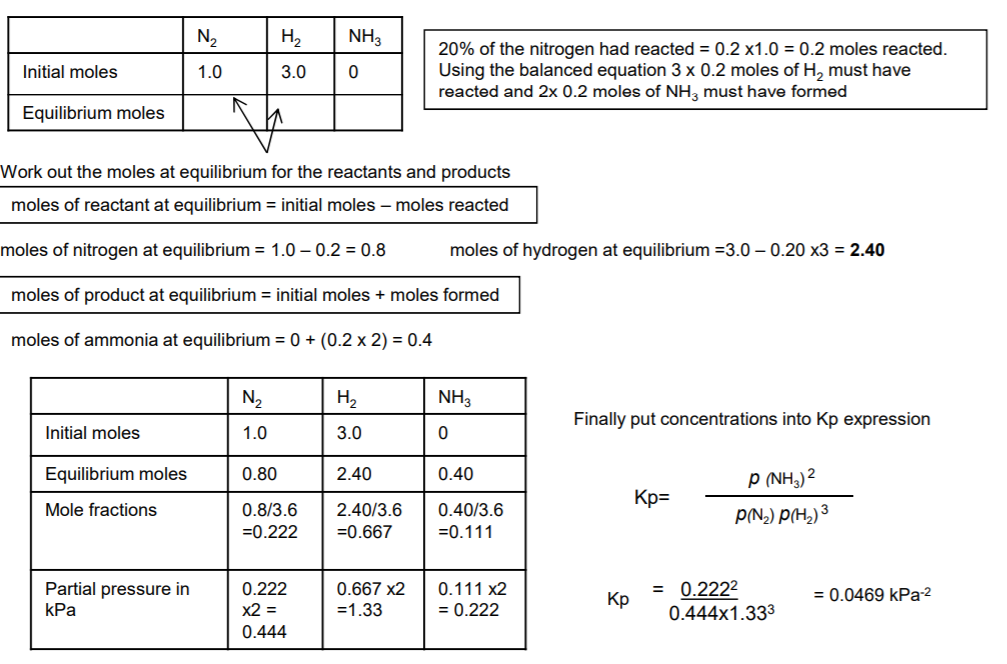
Example For the following equilibrium N2 (g) + 3H2 (g ) 2 NH3 (g) 1 mole of N2 and 3 moles of H2 are added together and the mixture is allowed to reach equilibrium. At equilibrium 20% of the N2 has reacted. If the total pressure is 2kPa what is the value of Kp?
Effect of changing conditions on the value of Kc or Kp
The larger the Kp the greater the number of products. If Kp is small we say the equilibrium favors the reactants Kc and Kp only change with temperature. It does not change if pressure or concentration is altered. A catalyst also has no effect on Kc or Kp
Effect of temperature on position of equilibrium and Kc
Both the position of equilibrium and the value of Kc or Kp will change it temperature is altered In this equilibrium which is exothermic in the forward direction If temperature is increased the reaction will shift to oppose the change and move in the backwards endothermic direction. The position of equilibrium shifts left. The value of Kp gets smaller as there are fewer products