Topic 12: Experimental Techniques
No description yet. This curated deck is ready for daily study.
Card preview (24)
How do you read the volume of a liquid?
Read the volume from the bottom of the meniscus when it is at eye level.
Name the three methods to measure the volume of a liquid.
Using; Volumetric pipettes Burettes Measuring cylinders
Identify this apparatus.

Volumetric pipette
How do you control the amount of liquid drawn up?
A pipette filler attached to the end of the pipette is used to safely control the amount of liquid you are drawing up
State the benefit of volumetric pipettes.
Volumetric pipettes are often calibrated to allow for the fact that the last drop of liquid stays in the pipette when the liquid is ejected. This reduces transfer errors.
Identify this apparatus.

Burette
How do you use a burette?
Take an initial reading. Once you have released as much liquid as you want, take a final reading. The difference between the readings tells you the amount of liquid used.
Identify this apparatus.
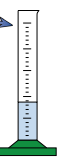
Measuring Cylinder
What are the disadvantages of a measuring cylinder?
They are less accurate than burettes and volumetric pipettes.
When do you use a dropping pipette?
If you only want a couple of drops of liquid and don’t need it to be accurately measured.
What do you use to measure solids.
A balance.
Why do we collect gases.
To investigate the rate of the reaction
How do you measure the volume of a gas?
Using a gas syringe By displacing water from a measuring cylinder
How do you find the volume of a gas using the displacement method?
• Fill a measuring cylinder with water, and carefully place it upside down in a container of water. • Record the initial level of the water in the measuring cylinder. • Position a delivery tube coming from the reaction vessel so that it’s inside the measuring cylinder, pointing upwards. Any gas that’s produced will pass through the delivery tube and into the measuring cylinder. As the gas enters the measuring cylinder, the water is pushed out. • Record the level of water in the measuring cylinder and use this value, along with your initial value, to calculate the volume of gas produced.
What apparatus do you use to measure temperature?
A thermometer
How do you use the thermometer?
1) Make sure the bulb of the thermometer is completely submerged in any mixture you’re measuring, but not touching the inside of the container. 2) If you’re taking an initial reading, you should wait for the temperature to stabilise first. 3) Read your measurement off the scale on a thermometer at eye level to make sure it’s correct.
What do you use to measure the time taken?
A stopwatch
Describe the method you would use to do a titration.
1) Using a pipette, measure out a set volume of the alkali into a flask. Add a few drops of an indicator — usually thymolphthalein or methyl orange 2) Fill a burette with a standard solution (a known concentration) of acid. 3) Use the burette to add the acid to the alkali a bit at a time. Swirl the flask regularly. Go slowly (a drop at a time) when you think the alkali’s almost neutralised. 4) The indicator changes colour when all the alkali has been neutralised (the exact point when the indicator changes colour is called the end-point) — thymolphthalein is blue in alkalis but colourless in acids, and methyl orange is yellow in alkalis but red in acids. 5) Record the volume of acid used to neutralise the alkali (called the titre). 6) Repeat this process a few times, making sure you get very similar results each time (i.e. within 0.1 cm3 of each other). You can then take the mean of your results.
State the apparatus used in a titration.
Volumetric pipette Burette Conical flask
Define pure substance
A substance completely made up of a single element or compound
Define mixture
Elements and compounds that are not chemically combined
A pure substance has ______________________
a specific, sharp melting and boiling point
Do mixtures have a sharp melting point?
No, they melt gradually over a range of temperatures. Impurities decrease the melting point and increase the boiling point.
Define solution
A mixture of a solute and a solvent that does not separate out