3. Cellular Specialization
No description yet. This curated deck is ready for daily study.
Card preview (24)
Define Tissue
A group of identical or different cells that function together as a unit to accomplish specific functions.
True or False All cells of a tissue must be identical.
False A tissue is a group of cells, whether identical or not, contributing to the same function in the body. Therefore, it is not necessary for all cells to be identical to constitute a tissue.
True or False: To be considered a tissue, the cells must adhere to each other. The adhesion is the result of either a substance covering the cells or from an intertwining of fibres between the cells.
True! Adhesion is an important characteristic of tissue cells
Name: 4 types of tissues
Connective tissue Epithelial tissue Muscle tissue Nervous tissue
Where is the epithelial tissue found?
It covers and protects organs on the inside and outside of the body 1. skin 2. salivary gland 3. small intestine 4. kidney
Describe Role of the epithelial tissue
The epithelial tissue secrets, absorbs and filters substances.
Identify: The most common type of tissue found throughout the body.
The connective tissue
Give 5 exemples Connective tissue
ex1: tendons ex2: cartilage ex3: fatty tissue ex4: bone tissue ex5:blood tissue
Describe What is the role of the connective tissue
The connective tissue binds (connects) and supports tissues and organs in the body.
Identify: 2 characteristics of the muscle tissue
• It can contract and regain it’s shape so body can move. • The contraction can be volontary or involontary.
Identify Tissue made up of neurons
Nervous tissue
Identify Type of tissue found outside of the body (ex: skin)
The epithelial tissue
Identify Tissue that line the respiratory tract
The endothelial tissue
True or false Blood is a type of connective tissue
True!
Name Muscle tissue whose contractions are involontary
Cardiac muscle tissue (ie, the heart)
Identify: 3 types of muscle tissue
• Skeletal muscle tissue (attached to bones) • Smooth muscle tissue • Cardia muscle tissue
identify 3 organs where smooth muscle tissue plays a role
It the lining of organs that contact like 1. stomack 2. bladder 3. uterus 4. some blood vessels
Describe: The fonction of nerve tissue
Control and guide the activities of the body so message can go from the brain to other parts of the body.
FIll the blank The functions of the ____ tissue consist in receiving external stimuli, analyzing them, and transmitting a response
Nervous tissue
What kind of tissue is this:
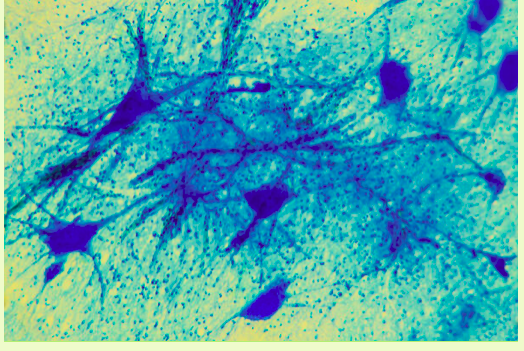
Nervous tissue
Fill the blank: ____ tissue is made up of elongated cells that have the ability to contract.
Muscle tissue
Identify 3 locations where nerve tissue can be found
• brain • nerves • spinal cord
Define Organs
A group of two or more different tissue types that perform one or more specific functions.
GIve exemples Organs
• stomach • heart • lungs