Unit 1 - Key Area 2
No description yet. This curated deck is ready for daily study.
Card preview (24)
Competition between individuals belonging to two or more different species who have very similar resource requirements which are in short supply.
Interspecific competition
A stable plant community which is maintained by persistent human interference, such as burning and grazing
Plagioclimax
An animal that must meet its energy requirements by ingesting other organisms or organic matter derived originally from plants. Also known as a consumer
Heterotroph
Interactions between organisms which reduce the population when numbers are high and allow the population to increase when numbers are low. (factors include disease, predation, competition)
Density dependent
Succession that occurs on a pre-existing soil after primary succession has been disrupted or destroyed and the ecological community has been disturbed
Secondary succession
Population overshoot
A temporary situation that occurs when a population exceeds its carrying capacity, before lack of resources causes a population crash.
An animal that relies on external environments for temperature control instead of generating their own body heat.
Ectotherm
Net primary productivity (NPP)
The rate at which an ecosystem accumulates energy or biomass, excluding the energy used for the process of respiration. NPP = GPP – respiration
The series of changes in an ecosystem when one community is replaced by another community as a result of changes in biotic and abiotic factors.
Succession
Predator–prey cycle
As a population of one species increases, its predator populations will increase in response. As the prey numbers fall due to predation, the predator numbers will also fall due to reducing resource availability.
What does this graph show?
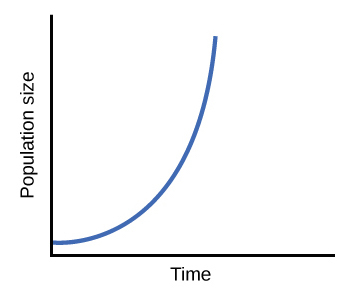
A J-curve population • lag phase • exponential growth e. g. human population growth
A sudden decline in the numbers of individual members in a population, species or group of organisms, usually in response to scarcity of resources, intra-specific competition and/or other biotic factors
Population crash
The assimilation of food into new biomass through the transfer of organic material between trophic levels.
Secondary productivity
An animal that obtains its energy by consuming both plant and animal material
Omnivore
Any organism that gains its energy from other organisms. Also known as a heterotroph
Consumer
A relationship between species that helps to prevent overpopulation of a particular species to ensure the survival of the species as a whole
Interdependence
A level or position in a food chain, occupied by a group of organisms that have a similar feeding mode, ie autotrophs and heterotrophs (herbivores, carnivores, omnivores).
Trophic level
The stages of succession in an ecosystem advancing towards its climax community.
Seral stage Examples of seres include xerosere, hydrosere, psammosere
What does this show?
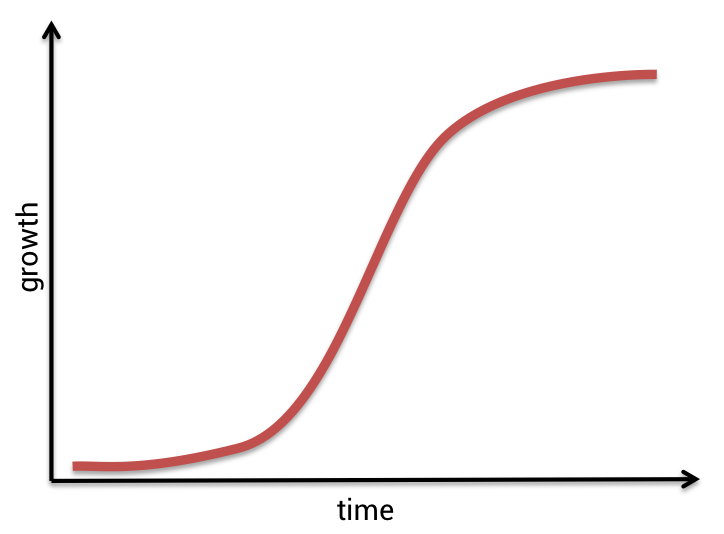
S-curve population growth • lag time • exponential growth • carrying capacity reached
The rate at which autotrophs (producers) produce a total biomass in a given area and time period.
Gross primary productivity (GPP)
Endotherm
An animal that uses internally generated heat to maintain body temperature independent of external temperature change.
The maximum population size of a species that the environment can sustain indefinitely.
Carrying Capacity
Density independent factor
Factors, usually natural disasters, which reduce the reproduction rate or increase the death rate of organisms independently of population density. (wild fires / droughts)
The percentage of biomass produced by one trophic level that is transferred and incorporated into biomass at the next trophic level.
Ecological efficiency