Organic Test 2
No description yet. This curated deck is ready for daily study.
Card preview (24)
Activation energy (Ea)
the minimum kinetic energy the molecules must have to overcome the repulsions between their electron clouds when they collide. Represents the energy difference between the reactands and the transition state
Transition State
The highest-energy state in a molecular collision that leads to reaction. This configuration is the transition between the reactants and products, and the molecules can either go on to products or return to reactants. A transition state is unstable and cannot be isolated
Intermediate
A species that exists for some finite length of time, even if it is very short. An intermediate has at least some stability.
Catalyst
Creates a transition state of lower energy, thereby lowering the activation energy and increasing the reaction rate.
Rate-Limiting Step (Rate-determining step)
Controls the overall reaction rate. The highest energy step of a multistep reaction is the “bottleneck,” and it determines the overall reaction rate. If we have the reaction-energy diagram, the highest point in the energy diagram is the transition state with the highest energy– generally the transition state for the rate-limiting step.
Halogenation reaction with methane: Cl vs. Br vs. F vs I
fluorine reacts explosively with methane, and chlorine reacts at a moderate rate. A mixture of bromine and methane must be heated to react, and iodine does not react at all.
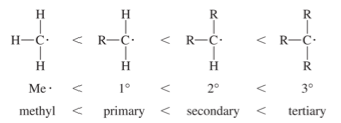
Order of stability of Radicals
Hammond postulate

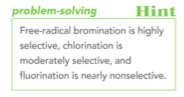
Selectivity of Cl, Br, and F in free-radical halogenation
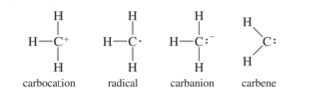
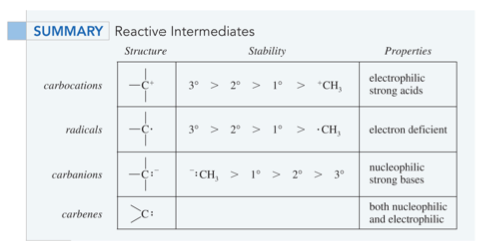
Different types of reactive intermediates
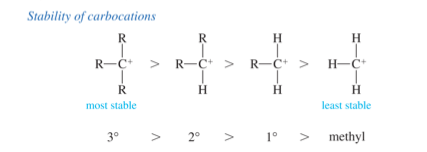
What is the order of stability of carbocations?
What is the order of stability of carbanions?
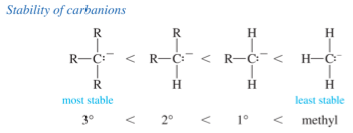
What are carbenes? What is the stability of carbenes?
Carbenes are uncharged reactive intermediates containing a divalent carbon atom. The simplest carbene has the formula :CH2 and is called methylene, just as a - CH2 - group in a molecule is called a methylene group.
What are the properties and order of stabilities of the reactive intermediates?
Constitutional Isomers
(structural isomers) differ in their bonding sequence, their atoms are connected differently.
Stereoisomers
have the same bonding sequence, but they differ in the orientation of their atoms in space
Chiral
Non superimposable mirror image (“handed”) different from mirror image, having an enantiomer
Achiral
(not chiral) superimposable mirror image (“not handed”) identical with its mirror image; not chiral
enantiomers
mirror-image isomers; pairs of compounds that are nonsuperimposable mirror images
The Cahn-Ingold-Prelog convention
• Assign a “priority” to each group bonded to the asymmetric carbon. Atoms with higher atomic numbers receive higher priorities a) Atoms with higher atomic numbers receive higher priorities b) In case of ties, use the next atoms along the chain of each group as tiebreakers c) Treat double and triple bonds as if each were a bond to a separate atom. • Put the fourth-priority group away from you. Draw an arrow from the first-priority group to the 2nd. Clockwise= R, counter-clockwise=S.
Optical Activity
Rotation of the plane of polarized light
The difference between two enantiomers

Using IUPAC notation, what denotes the direction of rotation of plane-polarized light

Racemic mixture
Optically inactive, a solution of equal amounts of two enantiomers