17.4 - Arenes Benzene
暂无描述。系统推荐的高质量记忆内容,适合每天坚持背诵学习。
卡片预览 (24 张)
What are aromatic compounds?
aromatic compounds are compounds with pleasant smells.
What does Aliphatic mean?
Aliphatic compounds are those that are not aromatic
What is Benzene?
The compound benzene is the centre of every aromatic compound. It is describe as an arene. ene indicating presence of C=C double bon in a molecule suggesting that an arene also contains C=C double bonds
What are the physical properties of Benzene?
Benzene is a colourless liquid with a boiling temperature of 80oc and it is insoluble in water. It is present in crude oil and the fuels obtained from it. So petrol tank of a car contains some benzene. It is toxic it is a carcinogen causing cancer. Its molecular formula is CH6 suggesting it is highly unsaturated.
What is the Kekule structure
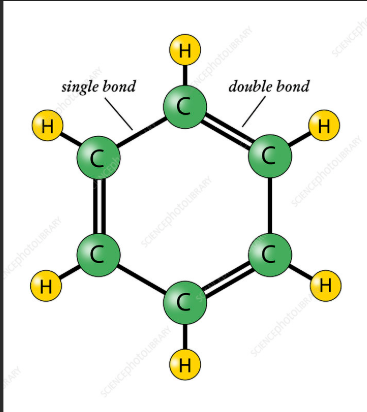
What are the problems with the Kekule structure?
If Benzene contains 3 C=C double bonds it should readily decolourise bromine water in an addition reaction. However, it does not. When bromine reacts with benzene a substitution reaction occurs evidence that there are no C=C double bonds. When dibromobenzene was discovered if the Kekule structure was correct there should be 4 isomers with this molecular formula. There is only 3 though. so 2 isomers with bromine on adjacent carbon atoms are identical. Adjacent carbon atom in one isomer are joined by C-C and in the other by C=C. Suggesting the bonds between carbon atoms in the benzene ring are the same not different Bond length data became available showed that the carbon-carbon bonds in benzene are all the same and also intermediate in character between the C-C and C=C bonds
What could the new model look like for Benzene?
In Benzene after all of the sigma bonds have formed each carbon atom will have one electron in a p orbital. instead of 3 individual pi bonds, formation of one large pi bond made up of all 6 electrons. Three in a circular have above the atoms and 3 below the atoms they form a delocalised pi bond.
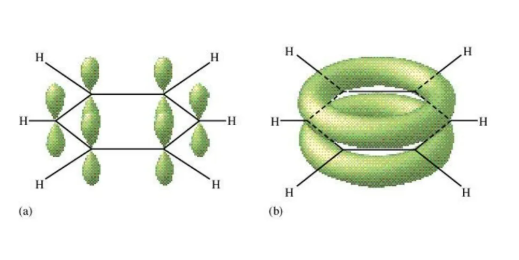
How does this new model solve our problems?
Problem 1 - There is no individual C=C double bonds no addition reaction with bromine Problem 2 - There are 3 not 4 isomers of C6H4Br2 because when the bromine atoms are on adjacent carbon atoms there is no difference in the arrangement of electrons between these atoms Problem 3 - The carbon-carbon bonds are all the same length because they are identical and not individual carbon single or double bonds Problem 4- When charge is spread around a species there is increased stability so higher boiling point. Substitution reaction to form C6H5Br rather than C6H4Br2 because this substitution preserves the stability of the delocalised electrons in the pi bond.
What is the new meaning of aromatic?
Referring to a hydrocarbon ring containing delocalised electrons.
How does Benzene undergo Hydrogenation?
Mixing Benzene with hydrogen and heating under pressure with a nickel catalyst. Forming cyclohexane
How does Benzene undergo combustion?
As with all hydrocarbon benzene burns in air with a smoky flame though. Typical for a compound with a high carbon to hydrogen ratio.
What reactions does Benzene undergo as an arene?
Benzene undergoes substitution reactions which the products are also aromatic.
How does Benzene undergo Bromination?
Benzene and bromine are heated under reflux in the presence of a catalyst called a halogen carrier. Halogen carrier are metal-halogen compound like AlCl3. For bromination enough to add iron fillings because they react with some of the bromine to form Iron(III) Bromide.
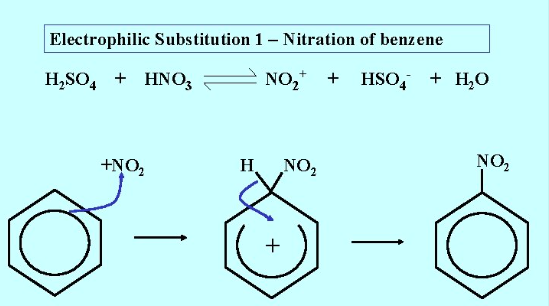
How does Benzene undergo Nitration?
Nitration refers to a substitution of a hydrogen atom by a nitro group. Nitro group has the formula NO2. Reaction is carried out by warming the Benzene with a mixture with concentrated nitric and sulfuric acid. Nitric acid considered as the source of the NO2 group and the sulfuric acid as a catalyst. Product is nitrobenzene and water
What are Friedel-Crafts reactions
Main 2 types of Friedel-Crafts reactions are alkylation and acylation they both have these common features: Use a reagent represented by XY, one of the hydrogen atoms in Benzene is substituted by Y, and the other product is HX A catalyst is needed like aluminium chloride although other halogen carrier like Iron(III) Chloride and bromide work Anhydrous conditions are needed because the water would react with the catalyst and sometimes the organic product.
What are Friedel crafts alkylation reactions?
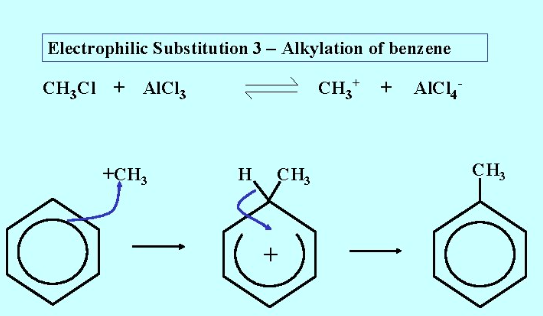
Alkylation means the substitution of one of the hydrogen atom of benzene by an alkyl group. The reagent is a halogenoalkane and the products are alkylbenzene and hydrogen chloride.
What are Friedel crafts acylation reactions?
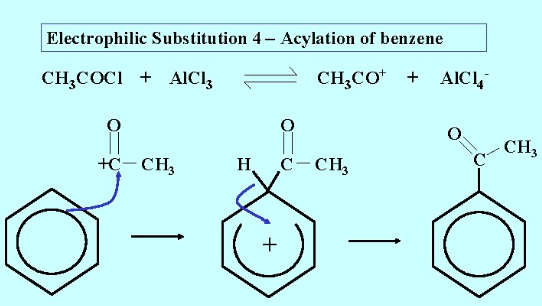
Acylation means the substitution of one of the hydrogen atom in benzene by an acyl group. The reagent is an acyl chloride and the products are a ketone and hydrogen chloride
What are the rules for naming aromatic compounds?
Phenyl to represent the benzene ring when it is attached to another functional group.
Why does Benzene undergo electrophilic substitution?
The Benzene ring is electron-rich. Although it is electrically neutral. the delocalised electron in the pi bond above and below the atoms means the molecule attracts electrophiles species are attracted to negative charge.
How does Benzene undergo electrophilic substitution?
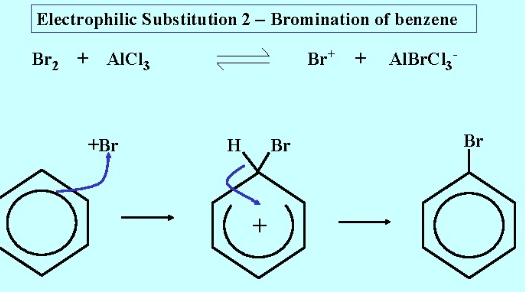
If Y+ represents the electrophile as it approaches the delocalised pi bond, it will attract 2 of the 6 electrons, which forms a covalent bond with it. This gives an intermediate species with a positive charge. In which one carbon atom is joined to both Y and H. There is now only 4 delocalised electrons these represent 2/3 of the circle The intermediate species lacks the stability of an aromatic compound because the circle is broken. The next step the H leaves as the H+ and the 2 electrons in the C-H bond join the remaining 4 to restore the delocalised pi bond
What does the electrophilic substitution look like for Bromination of Benzene?
Step 1: AlCl3 + Br2 > Br+ + AlCl3Br- bromine reacts with the catalyst to form Br+ Step 2: electrophilic attack the H atom shown in the product for second step is already present in Benzene it will be lost in step 3 Step 3: formation of aromatic product Step 4: Formation of inorganic products AlCl3Br- + H+ > AlCl3 + HBr
What does electrophilic substitution look like for the nitration of Benzene?
Inorganic products that are formed HSO4- + H+ > H2SO4
What does the electrophilic substitution look like for alkylation of benzene?
CH3+ formed Inorganic products formed: AlCl4- + H+ > AlCl3 + HCl
What does the electrophilic substitution look like for acylation of benzene?
Inorganic products formed: AlCl4- + H+ > AlCl3 + HCl