Ceramics and Glasses
No description yet. This curated deck is ready for daily study.
Card preview (24)
What are the applications of ceramics?
Facing materials: • Non-load bearing • Used for appearance Load bearing products (in compression only): • e.g. bricks • Low cost, good insulation, fireproof Paving units: • Abrasion resistant • Roofing tiles Chemically resistant products: • Sewers and piping • Industrial chimneys
What are the properties of ceramics?
• Brittle solids • No means for plastic deformation • Can be high strength • High stiffness • Low ductility and toughness
Why can’t ceramics plastically deform?
• The bonds in covalent ceramics are directional meaning dislocation motion is hard. • Alternating charges in ionic ceramics also prevent dislocation motion. • Therefore dislocations are unable to relieve stress.
What is the structure of glasses?
• Amorphous (non-crystalline) • No period packing • Complex structures • Most commonly silica based
Why are glasses amorphous?
• Impurities interfere with the formation of a crystalline structure making it amorphous. • They also reduce the melting point.
What are the properties of glasses?
• Rapid cooling • Brittle • Limited dislocation motion as there is no periodic structure • Compressive strength = 1000MPa • Modulus of rupture = 50MPa • Elastic modulus = 75MPa
What are the advantages of using glasses?
• Transparency for windows • Corrosion resistant • Electrical and thermal insulators • Ease of fabrication allowing you to manufacture objects easily and cheaply
How are glasses formed?
• Glasses do not crystallise and become extremely viscous on melting. • They are formed by heating raw materials above their melting point.
What affect do soda-limes have on glasses?
• Decreases the viscosity and number of impurities. • This allows you to work the molten glass at lower temperatures thus using less energy.
How can glass be fabricated?
Pressing: • Pressure is applied to the materials in a heated mould in order to produce the desired shape. Blowing: • A temporary shape is formed by pressing and blowing compressed air into a mould in order to get the glass to expand and conform to the desired shape. Drawing: • Used to produce glasses with a constant cross-section. Fibre-forming: • Glass is drawn through a small hope to form tiny fibres. Float glass: • Molten glass floats on the surface of molten tin producing a high quality, flat finish. The glass is then passed into an annealing lehr which controls cooling.
How can glass be strengthened?
• Tempering • Chemical strengthening • Reinforcement
What is tempering?
• Glass is heated above the state transition temperature before being cooled by jets of air. • This causes the surface to cool more rapidly and become rigid. • The interior continues to cool and contract, drawing in the rigid surface. • This produces surface compressive stresses which must be overcome to cause tensile failure.
What is chemical strengthening?
• Na+ ions on the glass surface are replaced with larger K+ ions which puts the surface into compression. • These compressive stresses must be overcome to cause tensile failure.
What is the heat treatment of glass?
Annealing Tempering
What is time dependent strength?
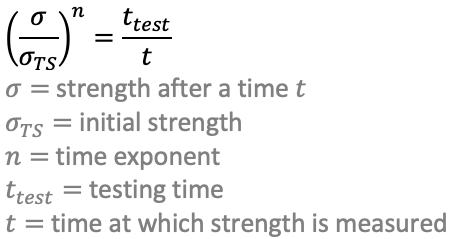
The strength of glass decreases over time, because from the moment of manufacture, slow crack growth occurs by: • Internal stresses • Chemical interaction • Mechanical interaction
What are the properties of ceramics?
Poor: • Ductility and toughness • Difficult to manufacture • High density Good: • Thermal stability • Chemical resistance • High compressive strength • High stiffness • Excellent wear properties
What are the different types of ceramics?
Natural: • Sandstone • Granite Traditional: • Generally formed from local clays which are cheap, abundant and easily formed. • Used in structural clay products such as bricks and tiles. • Whitewares such as crockery and plumbing fixtures.
What are the characteristics of clays?
• Water causes weak Van der Waals bonds to shear allowing the layers to slide over each other, becoming more plastic allowing effective shaping. • Complex crystal structures allowing hypoplastic formation. • Contains significant liquid and so have a low strength. • As you dry clay, water is removed and layer size and spacing decreases for the clay platelets.
What are the different fabrication techniques for clay?
Slip casting: • Slip is formed with a high water content and poured into a porous mould. • The water is then absorbed away into the mould leaving a solid layer. Complete casting: • Produces a solid cast. Incomplete drying: • Produces a drain cast. Firing: • Density and mechanical properties are increased as the green body is transformed into a fired solid. Vitrification: • Formation of liquid glass flows into pores to produce dense ceramics.
What is a common feature of forming techniques?
• They are normally ‘hydroplastic‘. • Water is mixed in to make a plastic and pliable solid. • This can then be moulded or extruded. • The component is then dried and fired.
What are the properties of advanced ceramics?
• Large stiffness due to ionic bonding. • Low density as generally made from light elements. • Wear resistant and hard as it is difficult to plastically deform. • Brittle. • Low toughness/ductility. • Poor strength in tension.
What are the applications of advanced ceramics?
• Used in engines to increase fuel efficiency. • Useful in bearing surfaces or abrasives. • Corrosion resistance. • Electrical or thermal insulators.
How are advanced ceramics processed?
• High purity powder • Controlling powder diameter • Adding polymer binders and plasticisers
How are powders formed into the desired shapes?
Uniaxial stress: • Ceramic powder and binder are placed into die. • Pressure is applied by a ram. • Simple cheap and fast. • Automated. • Limited to simple shapes. Isostatic press: • Ceramic powder and binder are placed into rubber preform. • Pressure is applied by a fluid to provide aqual pressure in all directions. • Time consuming and expensive. • Labour intensive. • Able to produce complex shapes. • Slip casts