Liver Function
No description yet. This curated deck is ready for daily study.
Card preview (20)
Which of the following enzymes would best aid in identifying hepatobiliary disease? a. Alkaline phosphatase (ALP) b. Aspartate aminotransferase (AST) c. Alanine aminotransferase (ALT) d. Ammonia
a. Alkaline phosphatase (ALP)
In which of the following types of cells does the conjugation of bilirubin take place? a. Hepatocytes b. Kupffer cells c. Macrophages d. Phagocytic cells
a. Hepatocytes
Which of the following enzymes is responsible for the conjugation of bilirubin? a. UDP-glucuronosyltransferase b. Alkaline phosphatase c. Glutamate dehydrogenase d. Leucine aminopeptidase
a. UDP-glucuronosyltransferase
Which of the following fractions of bilirubin is water soluble and reacts with a diazo reagent without the addition of an accelerator? a. Conjugated bilirubin b. Unconjugated bilirubin c. Total bilirubin d. Indirect bilirubin
a. Conjugated bilirubin
Which form of hepatitis is caused by a DNA virus? a. Hepatitis B b. Hepatitis A c. Hepatitis C d. Hepatitis D
a. Hepatitis B
Which of the following enzymes is most useful in establishing the hepatic origin of an elevated serum alkaline phosphatase? a. 5′-Nucleotidase b. Alanine aminotransferase (ALT) c. Aspartate aminotransferase (AST) d. Lactate dehydrogenase
a. 5′-Nucleotidase
Hepatitis E is likely to cause serious consequences in a. Pregnant women b. Children c. Travelers in Third World countries d. Older people
a. Pregnant women
• Worldwide, most primary malignant tumors of the liver are related to a. Alcoholism b. Gallstones c. Reye’s syndrome d. Malaria
a. Alcoholism
The reagent p-dimethylaminobenzaldehyde is used to measure which of the following? a. Urobilinogen b. Total bilirubin c. Ammonia d. Alkaline phosphatase
a. Urobilinogen
Which of the following conditions would result in elevations in primarily conjugated bilirubin? a. Dubin-Johnson syndrome b. Physiologic jaundice of the newborn c. Crigler-Najjar syndrome d. Gilbert’s syndrome
a. Dubin-Johnson syndrome
A urinalysis dipstick test indicated that urobilinogen was absent. Which condition does this support? a. Biliary obstruction. b. Hepatitis A acute infection. c. Defective liver cell function. d. Hepatocellular disease. e. This would support all of the above conditions.
a. Biliary obstruction.
Measuring serum ammonia levels has the potential to be fraught with preanalytical errors that may interfere with achieving an accurate result. Of the following preanalytical steps, which is incorrect? a. After phlebotomy, the patient’s blood should be immediately placed on ice. b. The blood should be collected in a red clot tube without anticoagulant. c. Hemolyzed samples should be rejected as this interferes by falsely increasing ammonia levels. d. Lipemia may also interfere with plasma ammonia measurements. e. All of the above are correct.
b. The blood should be collected in a red clot tube without anticoagulant.
. A patient presents with elevated levels of IgG anti-HAV, while levels of IgM anti-HAV are nondetectable. This patient is likely to a. Have an acute infection of HAV b. Have a chronic infection of HAV c. Have an immunity to HAV d. Be a carrier of HAV
c. Have an immunity to HAV
The product produced and measured when reacting bilirubin with a diazo reagent is a. NADPH b. NAD c. Azobilirubin d. Bilirubin diglucuronide
c. Azobilirubin
A healthy 28-year-old female sees her physician for a routine examination and has received a “relatively” clean bill of health except for the result below These results most likely indicate? a. Normal bilirubin metabolism b. Extrahepatic obstruction c. Dubin-Johnson syndrome d. Gilbert’s disease
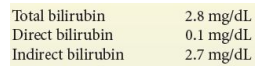
d. Gilbert’s disease
. Which of the following is measured using glutamate dehydrogenase and is a measure of advanced stages, poor prognosis, and coma in liver disease? a. Total bilirubin b. Ammonia c. Unconjugated bilirubin d. Urea
b. Ammonia
In which of the following disease states would you see an elevation in total bilirubin and conjugated bilirubin only? a. Biliary obstruction b. Hemolysis c. Neonatal jaundice d. Gilbert’s disease
a. Biliary obstruction
As a reduction product of bilirubin catabolism, this compound is partially reabsorbed from the intestines through the portal circulation for reexcretion by the liver. What is this compound? a. Urobilinogen b. Azobilirubin c. Biliverdin d. Urobilin e. Bilirubin
a. Urobilinogen
You are the technologist on duty and you are performing the following assay: Patient sample + Diazo reagent + Accelerator → Product Which fraction(s) of bilirubin will react in the above reaction? a. Conjugated b. Delta c. Unconjugated d. All of the above
d. All of the above
Choose the diagnosis most consistent with the following laboratory findings: a. Physiologic jaundice of the newborn b. Posthepatic bile obstruction c. Dubin-Johnson syndrome d. Rotor’s syndrome e. None of the above
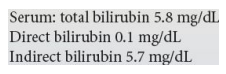
a. Physiologic jaundice of the newborn