Chemistry 6.3 Glucose, Hemoglobin, Iron, and Bilirubin
No description yet. This curated deck is ready for daily study.
Card preview (24)
Which of the following biochemical processes is promoted by insulin? A. Glycogenolysis B. Gluconeogenesis C. Lipolysis D. Uptake of glucose by cells
D. Uptake of glucose by cells
Which of the following hormones promotes hyperglycemia? A. Calcitonin B. Growth hormone C. Aldosterone D. Renin
B. Growth hormone
Which of the following is characteristic of type 1 diabetes mellitus? A. Requires an oral glucose tolerance test for diagnosis B. Is the most common form of diabetes mellitus C. Usually occurs after age 40 years D. Requires insulin replacement to prevent ketosis
D. Requires insulin replacement to prevent ketosis
Which of the following is characteristic of type 2 diabetes mellitus? A. Insulin levels are consistently low B. Most cases require a 3-hour oral glucose tolerance test for diagnosis C. Hyperglycemia is often controlled without insulin replacement D. The condition is associated with unexplained weight loss
C. Hyperglycemia is often controlled without insulin replacement
Which of the following results falls within the diagnostic criteria for diabetes mellitus? A. Fasting plasma glucose of 120 mg/dL B. Two-hour postprandial plasma glucose of 160 mg/dL C. Two-hour plasma glucose of 180 mg/dL following a 75 g oral glucose challenge D. Random plasma glucose of 250 mg/dL and presence of symptoms
D. Random plasma glucose of 250 mg/dL and presence of symptoms
Select the most appropriate adult reference range for fasting blood glucose. A. 40–105 mg/dL (2.22–5.82 mmol/L) B. 60–140 mg/dL (3.33–7.77 mmol/L) C. 65–99 mg/dL (3.61–5.50 mmol/L) D. 75–150 mg/dL (4.16–8.32 mmol/L)
C. 65–99 mg/dL (3.61–5.50 mmol/L)
When preparing a patient for an oral glucose tolerance test (OGTT), which of the following conditions will lead to erroneous results? A. The patient remains ambulatory for 3 days prior to the test B. Carbohydrate intake is restricted to below 150 g/day for 3 days prior to test C. No food, coffee, tea, or smoking is allowed 8 hours before and during the test D. Administration of 75 g of glucose is given to an adult patient after a 10- to 12-hour fast
B. Carbohydrate intake is restricted to below 150 g/day for 3 days prior to test
Which of the following 2-hour glucose challenge results would be classified as impaired glucose tolerance (IGT)? A. 130 mg/dL B. 135 mg/dL C. 150 mg/dL D. 204 mg/dL
C. 150 mg/dL
Which statement regarding gestational diabetes mellitus (GDM) is correct? A. Is diagnosed using the same oral glucose tolerance criteria as in nonpregnancy B. Converts to diabetes mellitus after pregnancy in 60% to 75% of cases C. Presents no increased health risk to the fetus D. Is defined as glucose intolerance originating during pregnancy
D. Is defined as glucose intolerance originating during pregnancy
Which of the following findings is characteristic of all forms of clinical hypoglycemia? A. A fasting blood glucose value less than 55 mg/dL B. High fasting insulin levels C. Neuroglycopenic symptoms at the time of low blood sugar D. Decreased serum C peptide
C. Neuroglycopenic symptoms at the time of low blood sugar
Which statement regarding glycated (glycosylated) Hgb (G-Hgb) is true? A. Has a sugar attached to the C-terminal end of the β chain B. Is a highly reversible aminoglycan C. Reflects the extent of glucose regulation in the 8- to 12-week interval prior to sampling D. Will be abnormal within 4 days following an episode of hyperglycemia
C. Reflects the extent of glucose regulation in the 8- to 12-week interval prior to sampling
Which HgbA1c value equates to an average blood glucose of less than 100 mg/dL? A. 5% B. 6.5% C. 9.5% D. 11%
A. 5%
Which statement regarding measurement of Hgb A1c is true? A. Levels do not need to be done fasting B. Both the labile and stable Hgb A1c fractions are measured C. Samples should be measured within 2 hours of collection D. The assay must be done by liquid chromatography
A. Levels do not need to be done fasting
Which stationary phase is used for the measurement of HgbA1c by HPLC? A. Octadecylsilane (C18) B. Cation exchanger C. Anion exchanger D. Polystyrene divinylbenzene
B. Cation exchanger
Evaluate the following chromatogram of a whole blood hemolysate, identify the cause, and choose the best course of action. (pg336) A. Result is not reportable because Hgb F is present and interferes B. The result is not reportable because Hgb C is present and interferes C. The result is not reportable because labile Hgb A1c is present D. The result is reportable; neither Hgb F nor C interferes
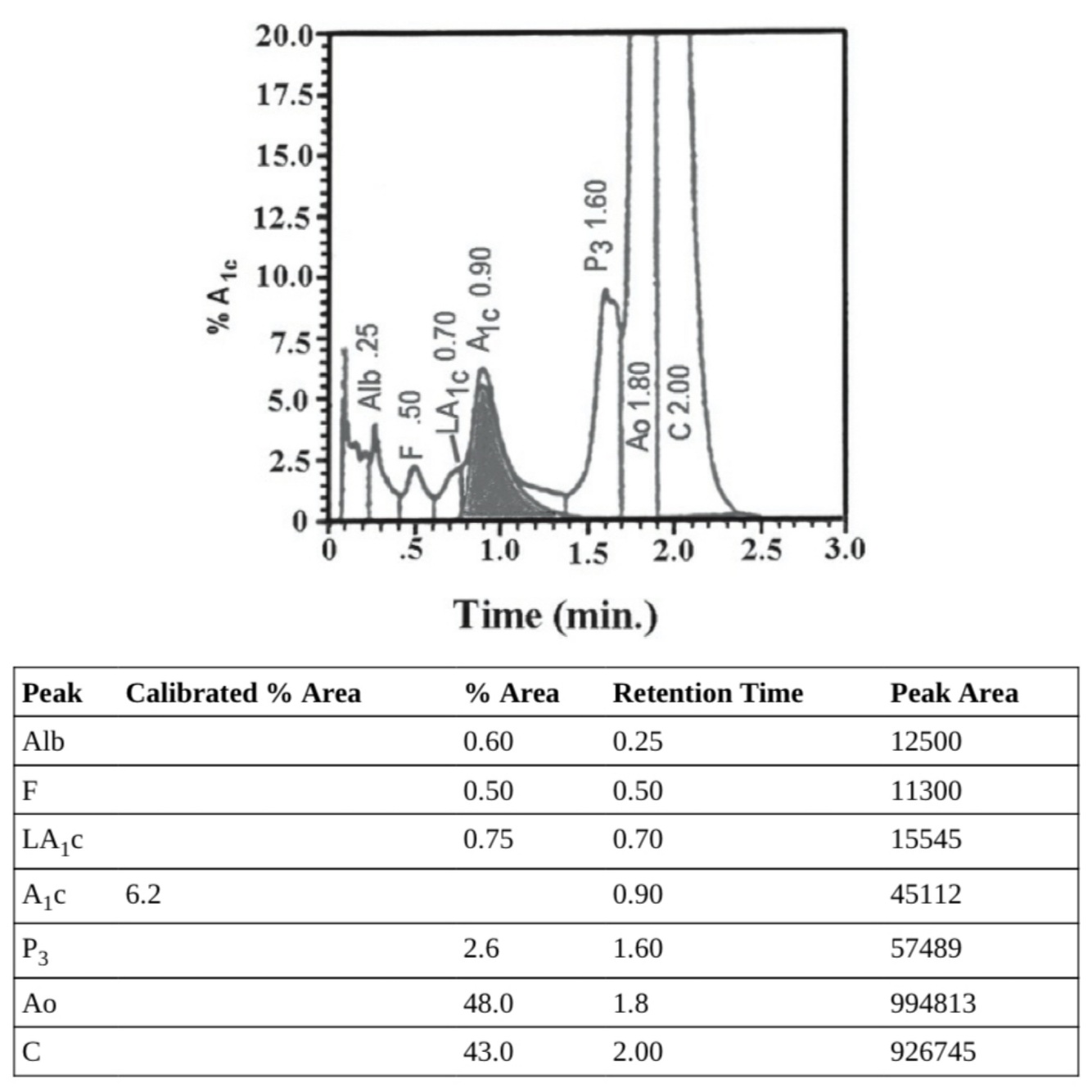
D. The result is reportable; neither Hgb F nor C interferes
Which statement best describes the use of the HgbA1c test? A. Should be used for monitoring glucose control only B. May be used for both diagnosis and monitoring C. Should be used only to monitor persons with type 1 diabetes D. May be used only to monitor persons with type 2 diabetes
B. May be used for both diagnosis and monitoring
According to the ADA criteria, which result is consistent with a diagnosis of impaired fasting glucose? A. 99 mg/dL B. 117 mg/dL C. 126 mg/dL D. 135 mg/dL
B. 117 mg/dL
What is the recommended cutoff for the early detection of chronic kidney disease in diabetics using the test for microalbuminuria? A. Greater than 30 mg/g creatinine B. Greater than 80 mg/g creatinine C. Greater than 200 mg/g creatinine D. Greater than 80 mg/L
A. Greater than 30 mg/g creatinine
In addition to measuring blood glucose, Hgb A1c, and microalbumin, which test should be done on persons with diabetes once per year? A. Urine glucose B. Urine ketone C. Plasma fructosamine D. Estimated glomerular filtration rate (eGFR)
D. Estimated glomerular filtration rate (eGFR)
Which testing situation is appropriate for the use of point-of-care whole blood glucosemethods? A. Screening for type 2 diabetes mellitus B. Diagnosis of diabetes mellitus C. Monitoring of blood glucose control in those with type 1 and type 2 diabetes D. Monitoring patients with diabetes for hyperglycemic episodes only
C. Monitoring of blood glucose control in those with type 1 and type 2 diabetes
Which of the following is the reference method for measuring serum glucose? A. Somogyi-Nelson B. Hexokinase C. Glucose oxidase D. Glucose dehydrogenase
B. Hexokinase
Polarographic methods for glucose analysis are based on which principle of measurement? A. Nonenzymatic oxidation of glucose B. The rate of O2 depletion C. Chemiluminescence caused by formation of adenosine triphosphate (ATP) D. The change in electrical potential as glucose is oxidized
B. The rate of O2 depletion
In addition to polarography, what other electrochemical method can be used to measure glucose in plasma? A. Conductivity B. Potentiometry C. Anodic stripping voltammetry D. Amperometry
D. Amperometry
Select the enzyme that is most specific for β-D-glucose. A. Hexokinase B. G-6-PD C. Phosphohexisomerase D. Glucose oxidase
D. Glucose oxidase