Vocabulary Words
No description yet. This curated deck is ready for daily study.
Card preview (24)
Kinetic Theory 4 Components
• All matter is composed of tiny particles • These particles are in constant random motion • The particles collide with each other and with the walls in which they are held. • The amount of energy that the particles lose from these collisions is negligible.
Melting Point
The temperature at which a solid becomes a liquid.
Heat of Fusion
The energy required to change a substance from solid to liquid at its melting point.
Boiling Point
The temperature at which the pressure of the vapor in the liquid is equal to the external pressure acting on the surface of the liquid.
Heat of Vaporization
The amount of energy required for the liquid at its boiling point to become a gas.
Sublimation
The process of a solid changing directly to a gas without forming a liquid.
Plasma
Matter that has enough energy to overcome not just the attractive forces between its particles but also the attractive forces within its atoms.
Thermal Expansion
An increase in the size of a substance when the temperature is increased.
Buoyancy
The ability of a fluid, a liquid, or a gas to exert an upward force on an object immersed in it.
Archimede’s principle
Buoyant force on an object is equal to the weight of the fluid displaced by the object.
Pascal’s Principle and Pressure (definition)
Pressure applied to a fluid is transmitted throughout the fluid.
Pressure
Force exerted per unit area.
Pascal’s Principle (equation)
pressure in = pressure out input force (N) output force (N) _______________ = _________________ input area (m^2) output area (m^2)
Bernoulli’s Principle
Fluid velocity increases when the flow of the fluid is restricted.
Viscosity
the resistance of a fluid to flowing
Boyle’s Law (definition)
If you decrease the volume of a container of gas and hold the temperature constant, the pressure from the gas will increase.
Boyle’s Law (equation)
initial pressure x initial volume = final pressure x final volume PixVi= PfVf
Charle’s Law (definition)
The volume of a gas increases with increasing temperature, as long as the pressure on the gas does not change.
Charle’s Law Equation
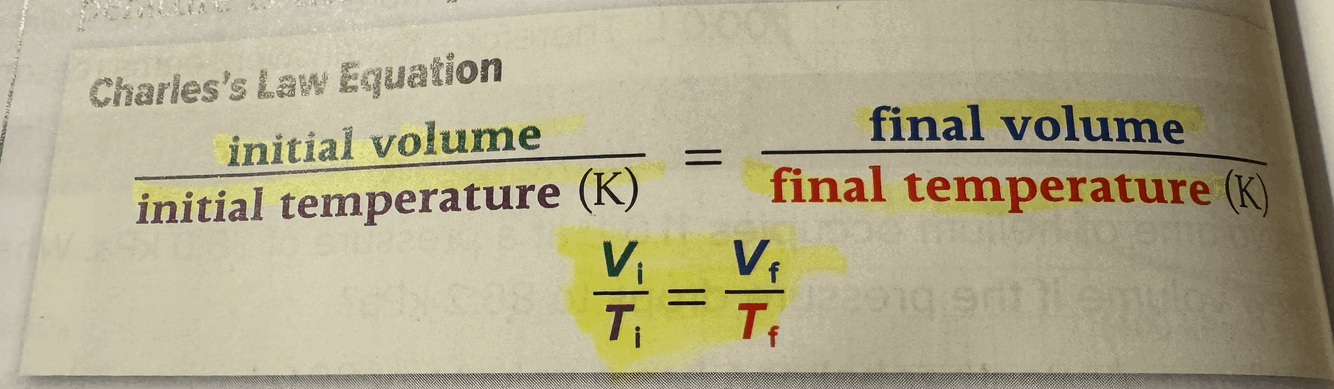
Substance
A type of matter with a fixed composition.
Element
A substance made up of atoms that are all alike.
Compound
A substance in which the atoms of two or more elements are chemically combined in a fixed proportion.
Heterogeneous
A mixture in which different materials remain distinct.
Suspension
A heterogeneous mixture made of a liquid and solid particles that settle.