Intro to Mammals
No description yet. This curated deck is ready for daily study.
Card preview (17)
Historical Context When did mammals first appear?
First appeared Triassic Period (220 Ma), coexisted with dinosaurs through to end of Mesozoic (225 to 135 Ma) Dominant terrestrial vetebrates since beginning of Cenozoic (63 to 0 Ma)
Number of Species
Comprised of 4.5K species (1.8K rodents) Make up around 1/6 of terrestrial vetebrates
The Vertebrate Skull
Composed of 3 main components: chrondocranium - the brain case visceral skeleton - the gill arches and jaws dermal elements - superficial framework (dermal bones)
Early Reptile Skull Structure Form, issues, and how they were resolved…
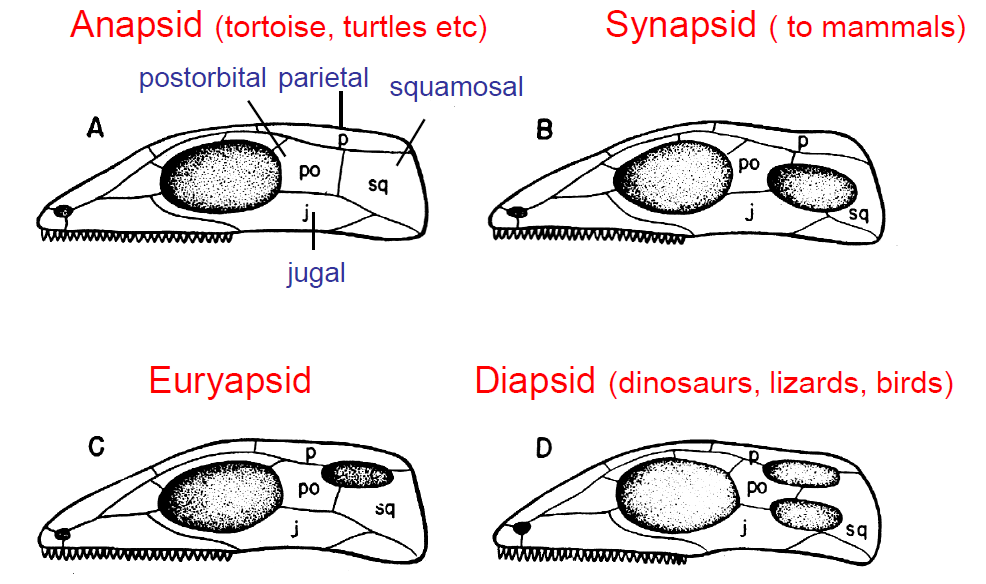
In the ancestral amniote and early reptiles the chrondocranium and dermal elements were solid & heavy, restricting jaw muscles - known as anapsid Problem solved by adding holes in side of dermal elements.
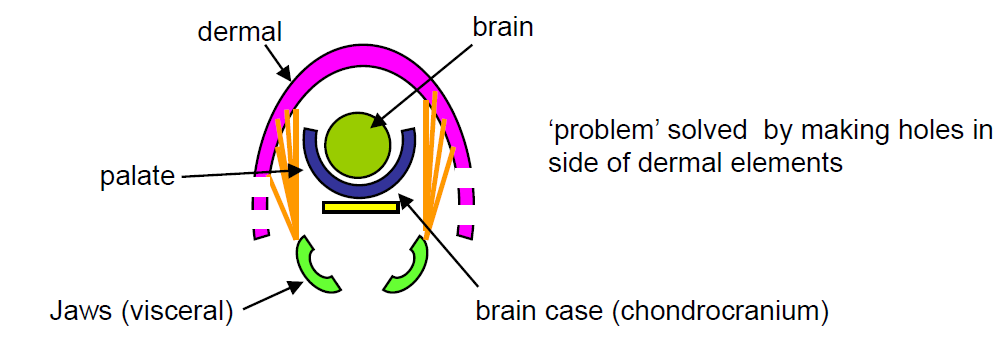
Various Skull Structures
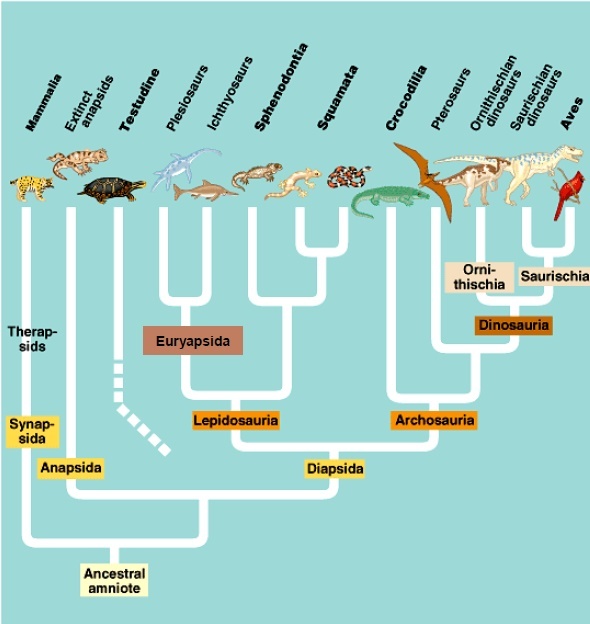
Mammal Lineages From what to what? And what on the way?
Split off from reptiles at the start of the Mesozoic - most recent CA was “the ancestral amniote” AA to mammals by way of: dimetrodons (large, reptilian synapsids) then therapsids (mammal-like reptiles) First “real” mammals appeared during Mesozoic - small and nocturnal, didn’t diversify until dinosaur extinction freed up niches
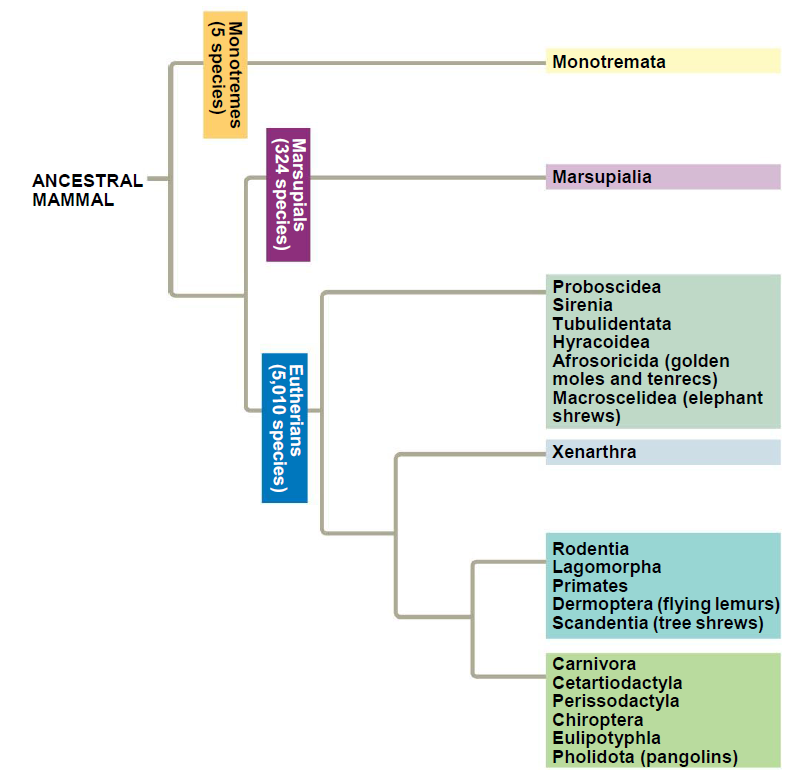
Mammal Subtaxa
Three (sort of): Monotremes (5 species) Marsupials (324) Eutherians (5010)
Monotremes Species? Defining Characteristics?
Only 5 species - 2 subgroups Echidnas (AUS & New Guinea) Platupuses (AUS) Lay eggs (reptilian) Have hair (mammalian) Endothermic (m), but at ~32 C Produce milk (m) but no nipples - secreted directly through skin
Marsupials Species? Defining Characteristics?
Found in AUS and Americas Includes Opossums, Bandicoots, Koalas, etc Young are born premature and crawl to pouch on mother to develop Show clear paralells to placental mammals, but outcompeted everywhere except AUS & NG
Eutherian Mammals
All other mammals Closely related to marsupials (probably diverged at least 125 Ma ago) 4 clades: Afrotheria Xenarthra Euarchontoglires Laurasiatheria
Afrotheria
Animals in or originally from Africa. Various orders: Proboscidea (elephants) Sirenia (manatees and dugongs) Hyracoidea (hyraxes or dassies) Macroscelidea (elephant shrews) Afrosoricida (tenrecs and golden moles) Tubulidentata (aardvark)
Xenarthra
Means “strange joints” - extra articulation in vertebral joints reduced/no teeth Sloths, anteaters, armadillos
Euarchontoglires
Not the most coherent of clades, but evidence against has yet to be uncovered: Glires: Rodentia (rodents) Lagomorpha (rabbits, hares, pikas) Euarchonta: Primates
Laurasiatheria
Mammals believed to have originated on the northern supercontient of Laurasia Carnivora (dogs, cats, bears, etc) Cetartiodactyla (sheep, pigs, cows, camels, etc) Cetacea (whales, dolphins, and porpoises) Perissodactyla (odd-toed ungulates including horses, tapirs and rhinoceroses) Chiroptera (bats) Eulipotyphla (hedgehogs, moles, shrews, etc) Pholidota (pangolins)
Mammalian Characteristics What makes a mammal?
Vertebrates - internal skeleton made of bone Skin: hair/fur; nails, hooves, horns; mammary glands facial muscles: more, and externally placed diaphragm: efficient breathing high metabolic rate (also in birds): endothermy heterodony: adapted, specialised teeth parasagittal gait: limbs paralell to vertebral column
Mammalian Bone What’s so special about it?
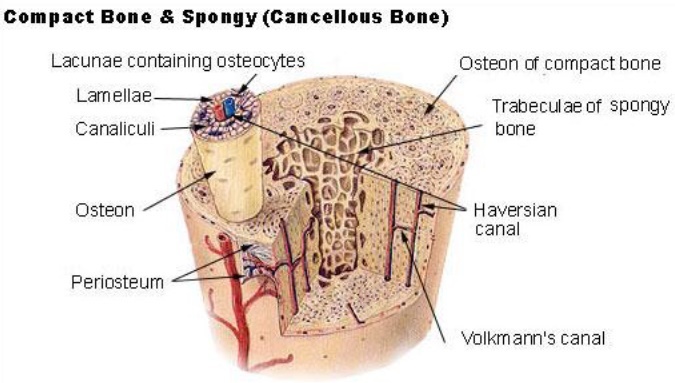
Bone: tissue w/ several cell types, innervated and w/ blood supply Regulator of Ca2+ and PO4 in mammals Formed and degraded much faster than in other vertebrates
Mammalian Skin
“Key to mammal-ness” Varies in thickness between rodents (<10 cells thick) to humans (20-40) to elephants and rhinos (200-400) Varies hugely in texture: hairy-furry, smooth-hairless, rough-dry, etc Hair (keratin): insulation, camoflage, display, defence/tools (horns, nails) Secretion: cooling/adhesion (eccrine glands), waterproofing/scent (sebaceous glands), volatile scent (apocrine glands), milk (mammary glands)