cellular respiration
No description yet. This curated deck is ready for daily study.
Card preview (24)
Define cellular respiration
Cellular respiration is the release of energy in cells, to form ATP, by breaking down glucose.
Define anaerobic cellular respiration.
Anaerobic cellular respiration is the release of energy in cells, to form ATP, by breaking down glucose without oxygen.
Define aerobic cellular respiration.
Aerobic cellular respiration is the release of energy in cells, to form ATP, by breaking down glucose with oxygen.
Where does anaerobic cellular respiration occur?
Cytosol
What occurs during glycolysis?
Glucose is broken down into two pyruvate molecules and loaded co-enzymes (2 NADH and 2 ATP)
Where does glycolysis occur?
Cytosol
What is the equation for anaerobic respiration in animals/bacteria?
Glucose –> lactate / lactic acid
How many ATP are produced in glycolysis?
2
How many ATP are produced in anaerobic cellular respiration?
2
What are the inputs of glycolysis?
Glucose, 2 NAD+, 2 ADP + Pi
What are the outputs of glycolysis?
2 Pyruvate, 2 NADH, 2 ATP
What is the equation for anaerobic respiration in yeast and plants?
Glucose –> ethanol + carbon dioxide
Outline the steps used to produce biofuel.
• Biomass is treated to help break it down and increase its surface area • Enzymes break down the starch and cellulose produced by a plant during photosynthesis. This produces monosaccharides like glucose. • Yeast use the glucose for anaerobic respiration/fermentation producing ethanol. • Ethanol produced is then purified and converted to a biofuel.
Name the three stages of aerobic respiration and state the location where they occur.
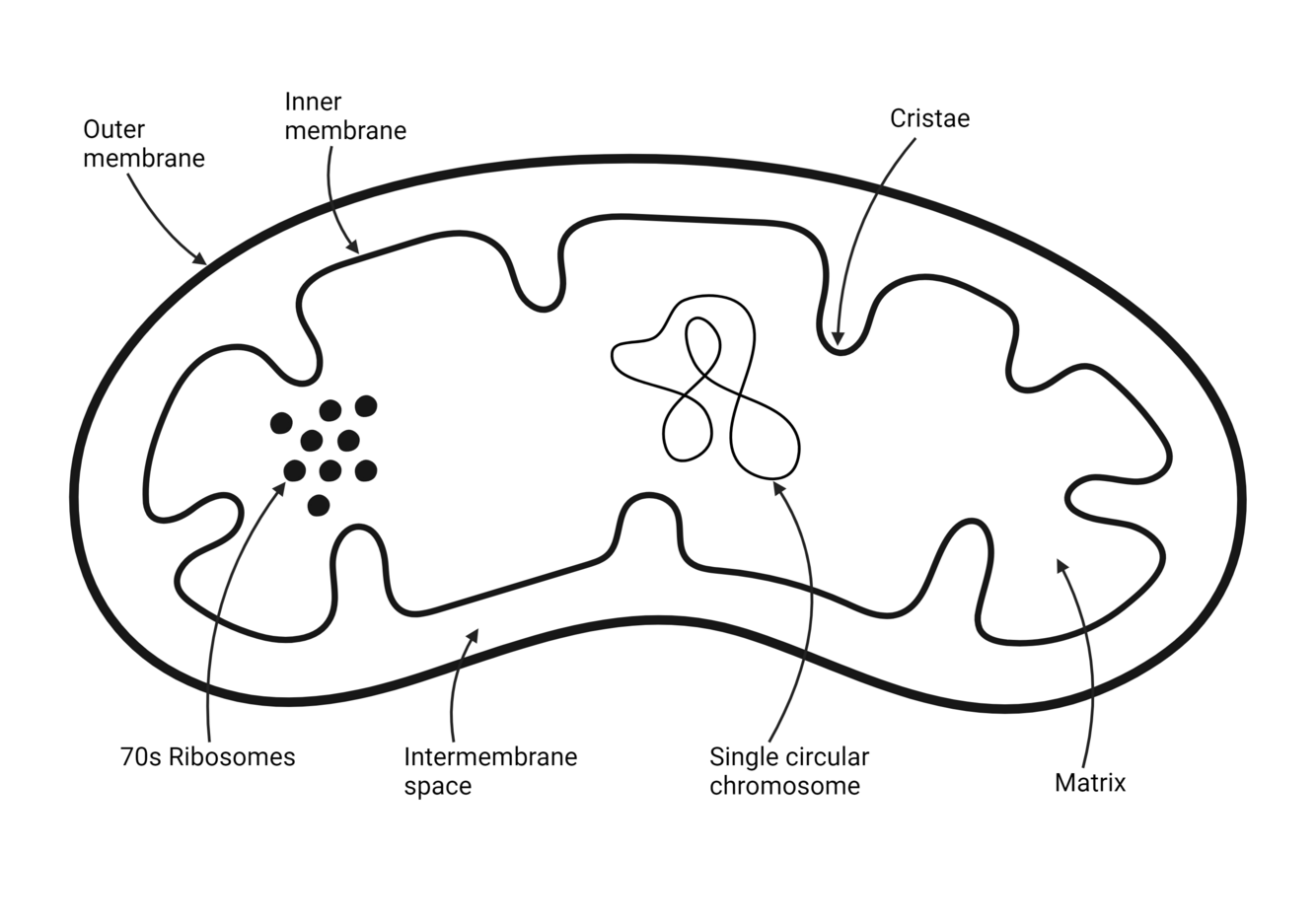
Glycolysis - cytosol Krebs cycle- mitochondrial matrix Electron transport chain- mitochondrial cristae
Draw and label a mitochondrion
What occurs in the Krebs cycle?
Removal of H+ ions from pyruvate creating, ATP, loaded co-enzymes and CO2
What are the inputs of the Krebs cycle?
2 pyruvate, 2 ADP + Pi, 8 NAD+, 2 FAD+
What are the outputs of the Krebs cycle?
6 carbon dioxide, 2 ATP, 8 NADH, 2 FADH2
What occurs during the electron transport chain?
H+ ions are used to create a concentration gradient to drive the synthesis of ATP. Oxygen is the final hydrogen ion and electron acceptor to form water.
What are the inputs of the electron transport chain?
6 oxygen, 26-28 ADP + Pi, 10 NADH, 2 FADH2
What are the outputs of the electron transport chain?
6 water, 26-28 ATP, 10 NAD+, 2 FAD+
How many ATP are produced in aerobic cellular respiration?
30-32
What is a co-enzyme?
In general these are molecules that assist enzymes that have loaded or unloaded forms which go between reactions in a cell in a cyclical manner.
What is the role of NADH in respiration?
Coenzymes assist enzymes, NAD+ carries hydrogen ions and electrons by forming NADH and moves from glycolysis and Krebs cycle to the electron transport chain in a cyclical manner.