21. Thermodynamics
No description yet. This curated deck is ready for daily study.
Card preview (20)
Enthalpy Change, ΔHf
change in heat energy at a constant pressure
Standard Enthalpy of Formation, ΔHf
ΔH when 1 mole of a compound is formed from its elements under standard conditions with all reactants and products being in their standard states
Standard Enthalpy of Combustion, ΔHc
ΔH when 1 mole of a compound is burned in oxygen under standard conditions with all reactants and products being in their standard states
Mean Bond Enthalpy, ΔHbe
ΔH when 1 mole of gaseous molecules each break a covalent bond to form 2 free radicals, averaged over a range of compounds
1st Ionisation Enthalpy, ΔHie
ΔH when 1 mole of e- is removed from 1 mole of gaseous atoms to give 1 mole of gaseous ions, each with a single +1 charge
2nd Ionisation Enthalpy, ΔHie
ΔH when 1 mole of e- is removed from 1 mole of gaseous 1+ ions to give 1 mole of gaseous ions each with a 2+ charge
Standard Enthalpy of Atomisation, ΔHat
ΔH when 1 mole of gaseous atoms are formed from an element in its standard state Example: Na(s) → Na(g), 1/2 Br2(l) → Br(g),
Relationship between ΔHbe and ΔHat
(only with diatomic molecules) ΔHbe = ΔHat x 2
1st Electron Affinity, ΔHea
ΔH when 1 mole of gaseous atoms is converted to 1 mole of gaseous ions, each with a single -1 charge, under standard conditions Example: O(g) + e- → O- (g)
2nd Electron Affinity, ΔHea
ΔH when 1 mole of e- are added to 1 mole of gaseous -1 ions, to form 1 mole of gaseous ions, each with a -2 charge Example: O-(g) + e- → O -2 (g)
Lattice Formation Enthalpy, ΔHlf (exothermic)
ΔH when 1 mole of a solid ionic compound is formed from its gaseous ions Example: Na+(g) + Cl- (g) → NaCl (s), Mg2+ (g) + 2Br- (g) → MgBr2 (s)
Lattice Dissociation Enthalpy, ΔHld (endothermic)
ΔH when 1 mole of solid ionic compound dissociates into its ions
Standard Enthalpy of Solution, ΔHsol
ΔH when 1 mole of a solid ionic substance dissolves * to form its aqueous ions * (in enough solvent to form a solution in which the ions are far enough apart to not interact with each other)
Standard Enthalpy of Hydration, ΔHhyd
ΔH when 1 mole of gaseous ions are converted to 1 mole of aqueous ions
In terms of bonding/attractions, describe what processes happen when NaCl dissolves in water, state whether these processes are exothermic or endothermic
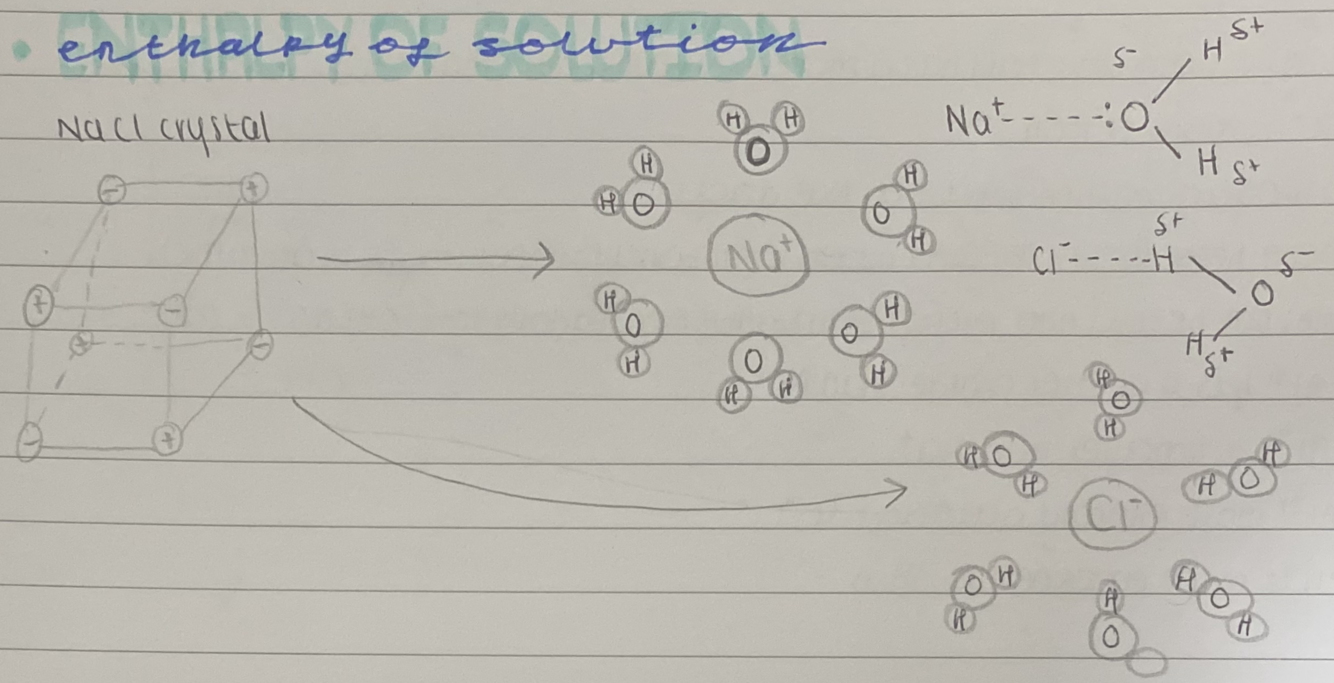
• ionic bonds between Na+ and Cl- are broken - endothermic • water forms attractions to Na+ and Cl- - exothermic • the δ+H is attracted to the Cl- • the δ-O is attracted to the Na+
Which structure do you use when comparing lattice enthalpies for different substances?
CRAM C- charge (not if -ve ion is of same charge) R- radius A- attractions between ions (strong/weak) M - more endo ΔHld / more exo ΔHlf
What does the +ve ion do to the negative ion when the molecules has covalent character?
+ve ion polarises (distorts) the -ve ion (by attracting some of its e- density, resulting in a partial sharing of e-)
Covalent character occurs in ionic compounds more strongly with which features?
+ve ion = small with high charge -ve ion = large with high charge
Assumptions that the Perfect Ionic Model makes about ionic substances
• ions are perfect spheres • ions can’t be polarised
Compare the Perfect Ionic model’s to the Born Haber
BH: - accounts for covalent character and ionic bonding - more ΔH -ve PI: - only accounts for ionic bonding (not covalent character) - less ΔH -ve (if a compound has similar lattice enthalpy values with both PI model and BH cycle the the compound has very little covalent character)