M5 Entropy and Electrochemistry Q&A
No description yet. This curated deck is ready for daily study.
Card preview (4)
When can the following reaction be feasible? How does temperature affect its feasibility?

• ΔS is positive so TΔS is positive • At high temperatures TΔS is more positive than ΔH so ΔG is negative • As temperature increases TΔS becomes more + • so ΔG becomes more – • so feasibility increases
When can the following reaction be feasible? How does temperature affect its feasibility?

• ΔS is negative so TΔS is negative • At low temperatures TΔS is less negative than ΔH so ΔG is negative • As temperature increases TΔS becomes more - • so ΔG becomes less - • so feasibility decreases
How can the standard cell potential value be used to predict the feasibility of a reaction? Describe the two limitations of this prediction.
• If the standard cell potential has a positive value, the reaction is predicted to be feasible.Limitations: • As the reaction occurs the concentrations may change (from 1 moldm-3) and therefore be non-standard • The reaction may have a very high activation energy, and therefore may not occur.
State and explain the effect of increasing the concentration of Cu2+ ions on the cell potential of the following reaction:
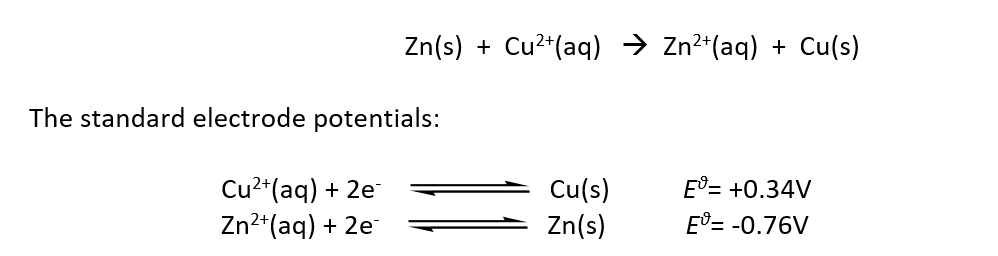
• An increase in concentration of copper (II) ions would cause the equilibrium position of the Cu2+/Cu half-cell to shift to the right. • Electrons are more readily gained by Cu2+ / reduction happens more readily • E value of Cu2+/Cu half-cell would become more positive • There would be a larger difference between the two electrode potentials • The cell potential, Ecell, value will be more positive
