COGS 101B Final
No description yet. This curated deck is ready for daily study.
Card preview (24)
Types of knowledge/LTM
Semantic Memory Episodic Memory Procedural and declarative memory Implicit and explicit memory
Semantic memory
memory for categorical, factual information
Three Primary Characteristics of semantic memory:
• organized by CONTENT. Similar concepts are more likely to cue one another through association [lexical decision task] 2. it allows us to make INFERENCES. There appears to be a logical, hierarchical order to the categories. 3. Information is not tied to a single instance. Semantic info GENERALIZES beyond a single episode
Semantic memory is organized by ________
content
Semantic memory allows us to make _________
inferences
Semantic information ______ tied to a single instance. It ______ beyond a single episode
is not generalizes
One way of testing semantic information is using _______
Lexical decision task
Lexical decision task (Meyer & Schvaneveldt, 1971) It is used to test ________
A string of letters is presented (e.g. PRINTER or PROGER) and you judge if it is a word or a non-word The letter string is PRECEDED by a related or unrelated word Related primes (e.g. nurse–> DOCTOR) were FASTER than unrelated primes (e.g. butter–> DOCTOR) This is one way of testing semantic info
What does the speed of retrieval (for related and unrelated primes) say about the internal structure of memory?
Suggests a possible structure to LTM
Collins & Quillian (1969) proposed a _______ model of LTM. This model contains nodes and ____
Hierarchical model nodes and links
Hierarchical model of LTM contains these two elements
nodes and links
Nodes (in the hierarchical model)
concepts or ideas (e.g. bird, animal)
Links (in the hierarchical model)
are labeled (“is-a” or “has-part”) and directed. subordinate categories point to superordinate categories
_____ help verify inferences in the hierarchical network
Activation Tags
Three problems with the hierarchical model
• typicality effect 2. violations of the hierarchical order 3. How do you respond with “false”?
typicality effect
A problem of the hierarchical model people verify typical instances of a category faster than atypical examples
How can we fix the problem of the typicality effect?
Some links need to be stronger than others
Violations of the hierarchical order
A problem of the hierarchical model some activation seem to go around the hierarchical order We need to add a link, but this violates the hierarchy “is a canary a bird?” is faster than “is a canary an animal?” “is a penguin a bird?” is slower than “is a penguin an animal?”
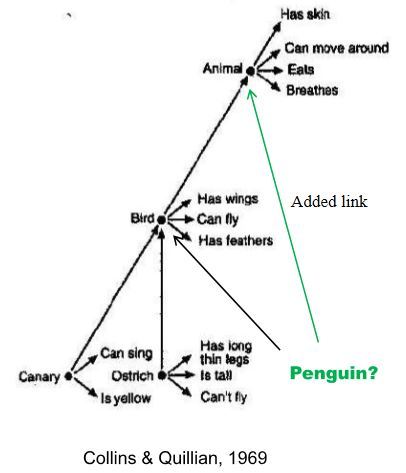
How do you respond with “false” (in the hierarchical model)
a problem of the hierarchical model speed to respond “false” should only depend on “is-a” and “has-part” links. However, people also seem to consider similarities. is a bat a bird? gets a slower false response is a bat a plant? gets a faster false response how related the nodes are determine how fast we can make the distinction
Relatedness effect
If two nodes are more related to each other, it takes longer to compare them is a bat a bird? they are similar so we compare them where as is a at a plant? they are not similar at all so theres nothing to consider. –fan effect
Episodic Memory
Detailed information for specific autobiographical events (things that happened to you)
Episodic memories are _______ organized
temporally “mental time travel”
In episodic memory there is an association between the memory and ______
its source
Amnesia
a loss of memory function