ACIDS, bases and salts
No description yet. This curated deck is ready for daily study.
Card preview (24)
Properties of acids
Acids have pH values of below 7, have a sour taste and are corrosive. In acidic conditions, blue litmus paper turns red and methyl orange indicator turns red. Acids are substances that can neutralise a base, forming a salt and water. When acids react, they will lose electrons to form positively charged hydrogen ions (H+). The presence of H+ ions is what makes a solution acidic.
Acids and metals
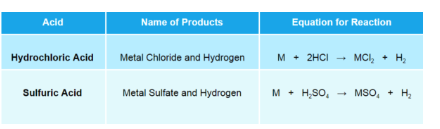
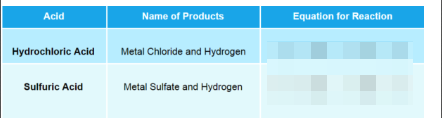
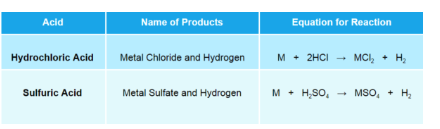
Only metals above hydrogen in the reactivity series will react with dilute acids. When acids react with metals they form a salt and hydrogen gas:
Acids with Bases (Alkalis)
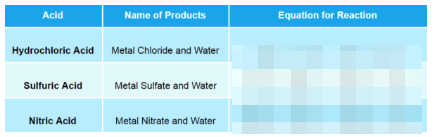
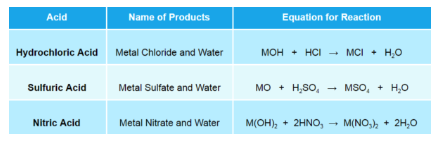
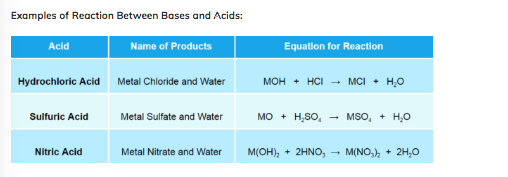
Metal oxides and metal hydroxides can act as bases. When they react with acid, a neutralisation reaction occurs. Acids and bases will react together in a neutralisation reaction and produce a salt and water:

Examples of Reaction Between Acids and Bases:
Acids with Metal Carbonates
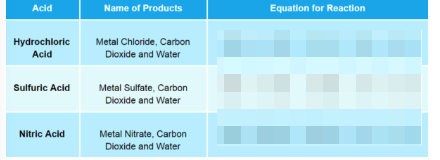
Acids will react with metal carbonates to form the corresponding metal salt, carbon dioxide and water: Acid + Metal Carbonate → Salt + Carbon Dioxide + Water
Examples of Reaction Between Acids and Bases:
Properties of bases
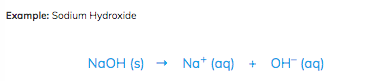
Bases have pH values of above 7. A base which is water soluble is referred to as an alkali. In basic (alkaline) conditions red litmus paper turns blue and methyl orange indicator turns yellow. Bases are substances which can neutralise an acid, forming a salt and water. Bases are usually oxides or hydroxides of metals. When alkalis react, they gain electrons to form negative hydroxide ions (OH–). The presence of the OH– ions is what makes the aqueous solution an alkali.
Bases and acids
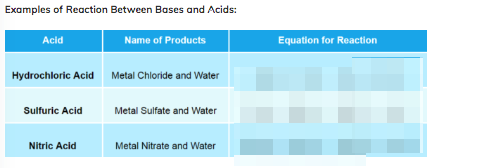
When they react with an acid, a neutralisation reaction occurs. Acids and bases react together in a neutralisation reaction and produce a salt and water:

Alkalis and ammonium salts
Ammonium salts undergo decomposition when warmed with an alkali. Even though ammonia is itself a weak base, it is very volatile and can easily by displaced from the salt by another alkali. A salt, water and ammonia are produced. Example: NH4Cl + NaOH → NaCl + H2O + NH3 This reaction is used as a chemical test to confirm the presence of the ammonium ion (NH4+). Alkali is added to the substance with gentle warming followed by the test for ammonia gas using damp red litmus paper. The litmus paper will turn from red to blue if ammonia is present.
The pH scale
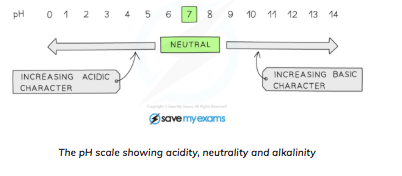
The pH scale is a numerical scale which is used to show how acidic or alkaline a solution is. It goes from 1 – 14 (extremely acidic substances can have values of below 1). All acids have pH values of below 7, all alkalis have pH values of above 7. The lower the pH then the more acidic the solution is. The higher the pH then the more alkaline the solution is. A solution of pH 7 is described as being neutral e.g. water.
Universal indicator
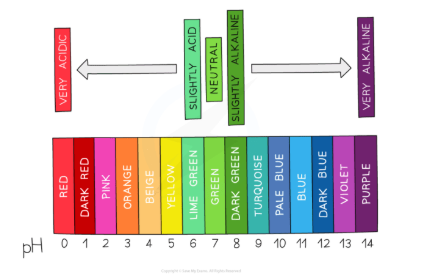
Universal indicator is a mixture of different indicators which is used to measure the pH. A drop is added to the solution and the colour is matched with a colour chart which indicates the pH which matches specific colours. The pH scale with the Universal Indicator colours which can be used to determine the pH of a solution
The importance of pH and soil acidity
Soil pH is analysed to indicate the acidity or alkalinity of soil. Most plants favour a pH value of between 5.5 and 8. Changes in soil which cause a pH to be outside this range adversely affect plant processes resulting in reduced growth and crop yield. Soils may become acid from acid rain, overuse of fertilisers which contain ammonium salts or by the excessive breakdown of organic matter by bacteria. Crushed or powdered limestone (calcium carbonate) or lime (calcium oxide) or slaked lime (calcium hydroxide) is added to neutralise the excess acidity in the soil. The addition process must be carefully monitored though, as if added in excess, further damage could be done if the pH goes too high. Extended Subject Content
Proton transfer
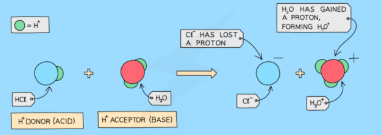
The earlier definition of an acid and a base can be extended. In terms of proton transfer, we can further define each substance in how they interact with protons.
Acids
Acids are proton donors as they ionize in solution producing protons, H+ ions. These H+ ions make the aqueous solution acidic.
Bases (Alkalis)
Bases (alkalis) are proton acceptors as they ionize in solution producing OH– ions which can accept protons. These OH– ions make the aqueous solution alkaline.
Strong acids and bases
Acids and alkalis can be either strong or weak, depending on how many ions they produce when dissolved in water. Strong acids and bases ionize completely in water, producing solutions of very low pH for an acid or very high pH for a base. Strong acids include HCl and H2SO4 and strong bases include the Group I hydroxides.
Weak acids and bases
Weak acids and bases partially ionize in water and produce pH values which are closer to the middle of the pH scale. Weak acids include organic acids such as ethanoic acid, CH3COOH and weak bases include aqueous ammonia. For both weak acids and bases, there is usually an equilibrium set-up between the molecules and their ions once they have been added to water. Example of a weak acid: propanoic acid

In both cases the equilibrium lies to the … indicating a / base molecules, with a concentration of ions in solution.
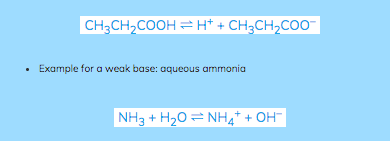
• left, • high concentration of intact acid • low
Effect of concentration on strong and weak acids and alkalis
A concentrated solution of either an acid or a base is one that contains a high number of acid or base molecules per dm3 of solution. It does not necessarily mean that the acid or base is strong though, as it may be made from a weak acid or base which does not dissociate For example a dilute solution of HCl will be more acidic than a concentrated solution of ethanoic acid, since most of the HCl molecules dissociate but very few of the CH3COOH do.
In acid-base chemistry, the terms strong and weak refer to the… If referring to concentration when answering a question, then the words … should be used.
• ability to dissociate and produce H+/OH– ions. • concentrated or dilute
Acid and basic oxides general
Acidic and basic oxides have different properties and values of pH. The difference in their pH stems from whether they are bonded to a metal or a nonmetal element. The metallic character of the element influences the acidic or alkaline behaviour of the molecule.
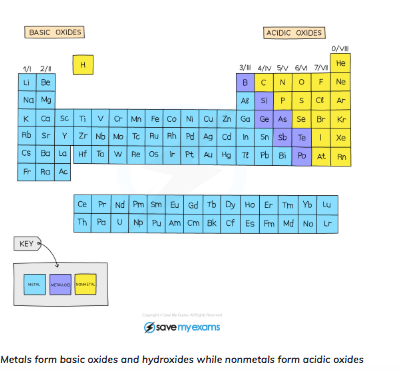
Acidic oxides
Acidic oxides are formed when a nonmetal element combines with oxygen. They react with bases to form a salt and water. When dissolved in water they produce an acidic solution with a low pH. Common examples include SO2 and SiO2.