3.1.6 Chemical Equilibria, Le Chatelier's Principle and Kc
No description yet. This curated deck is ready for daily study.
Card preview (24)
Reactants get used up = forward reaction ___ ___
slows down
Products is formed = reverse reaction ___ __
speeds up
Define dynamic equilibrium
When the rate of forward reaction equals the rate of backwards reaction in a closed system
At dynamic equilibrium, concentrations of reactants and products ___ ____
stay constant
What is Le Chatelier’s Principle?
In closed system, position of equilibrium moves to oppose any change
Le Chatelier’s Principle only applies to reactions where …
every species in same physical state
What happens if you increase the concentration of a reactant in a reaction at equilibrium?
• Equilibrium tries to remove increase in reactant • ∴ makes more product • Equilibrium shifts to right
What happens if you increase the concentration of a product in a reaction at equilibrium?
• Equilibrium tries to remove increase in product • Makes reverse reaction go faster • Equilibrium shifts to left
Decreasing concentration has the _____ effect
opposite
What happens if you increase the pressure of a reaction at equilibrium?
• Shifts equilibrium to side with fewer moles of gas • To reduce pressure/oppose the change
What happens if you decrease the pressure of a reaction at equilibrium?
• Equilibrium shifts to side with more moles of gas • Raises pressure/opposes the change
What happens if you increase the temperature of a reaction at equilibrium?
• ↑ temp = adding heat • Equilibrium shifts in endothermic (positive ΔH) direction to ↓ temp./oppose the change
What happens if you decrease the temperature of a reaction at equilibrium?
• ↓ temp = removing heat • Equilibrium shifts in exothermic (negative ΔH) direction to produce more heat, to ↑ temp/oppose the change
Why do you get a higher yield at lower temperatures?

• ∵ it’s exothermic reaction, lower temps = forward reaction • ∴ at lower temps = more ethene and steam is converted to ethanol
Why is the reaction carried out at temperatue of 300°C?

• It’s a compromise between reasonable yield and faster reaction • Lower temps = slower rate of reaction • No point in getting very high yield of ethanol if it takes you 10 years
Why is 60-70 atm used?

It’s a compromise - gives reasonable yield for lowest possible cost
Why is high pressure used?

• High pressure shifts equilibrium to side with fewer molecules = forward reaction, increases yield • High pressure increases rate of reaction too
Why is not very high pressure used? Name 2 reasons why

• Very expensive ∵ • Power or energy required to provide high pressure • Strong pressure vessel needed (to withstand high pressure)
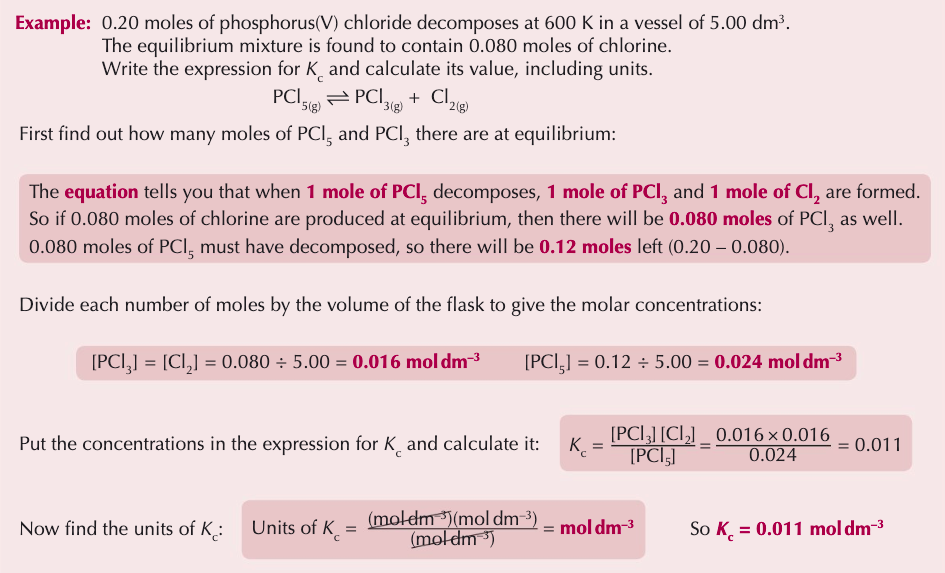
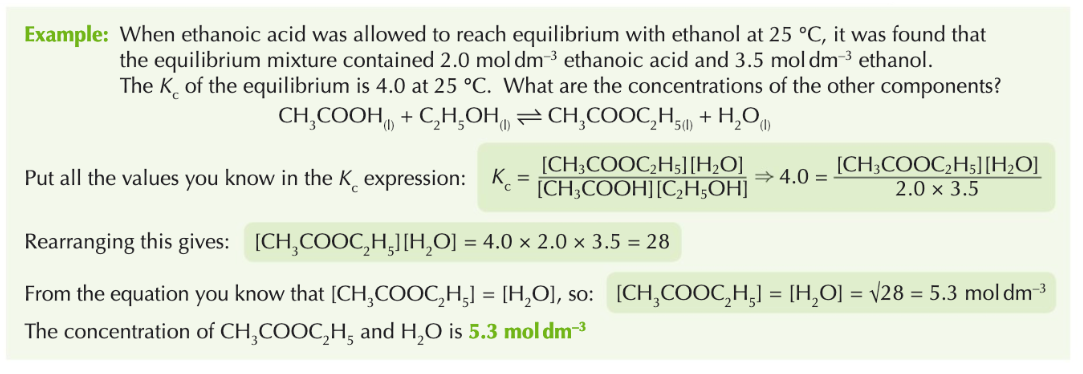
State the expression that Kc can be written as for the equation: aA + bB ⇌ dD + eE
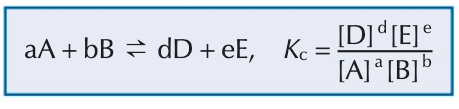
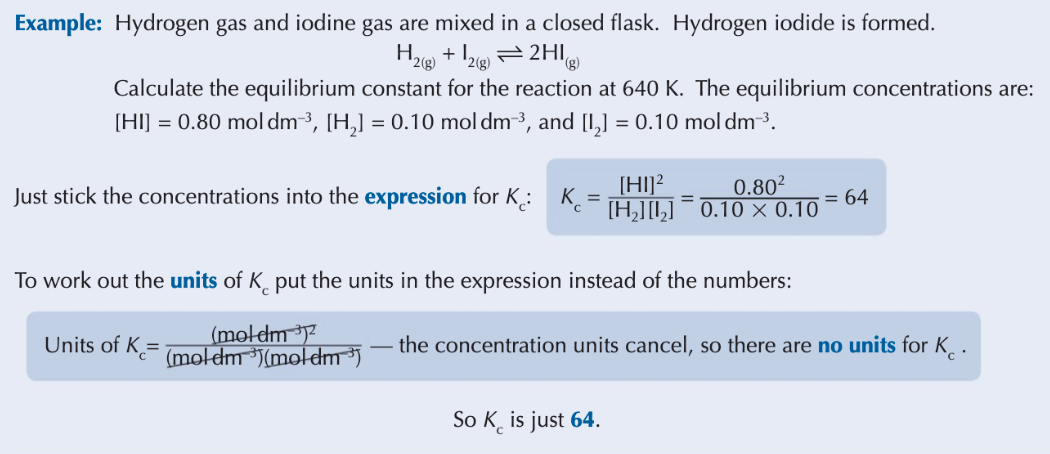
Kc Equal numbers of products and reactants = __ ____
no units



Value of Kc is only valid for one particular ____
temperature