dosage and prescription
No description yet. This curated deck is ready for daily study.
Card preview (7)
2 basic concepts
• strength training leads to functional improvements • failure should occur after 8th rep or patients should succeed < 80% of the time with neuromuscular tasks
framework for modifying parameters
• tempo - slow movements focused on prolonged eccentric or return phase • ROM - greater ROM • resistance - farther from joint, increased resistance • environment (cognitive load) - patient holds conversation or performs cognitive task • environment (surface) - stand on softer surface, narrower BOS • support - decrease use of UE support
why are therabands not ideal and what is preferred
• TB not ideal because not consistent load through ROM, difficult to standardize • ankle weights, DBs, weighted vests preferred - for lack of ability to hold weights, adds balance with new COM, vests enhance neuromuscular function of proximal muscles to improve stability and balance
where is failure
• at 7th-9th rep - still high intensity • lower boundary is 5 reps • for strength gains, need > 5 reps
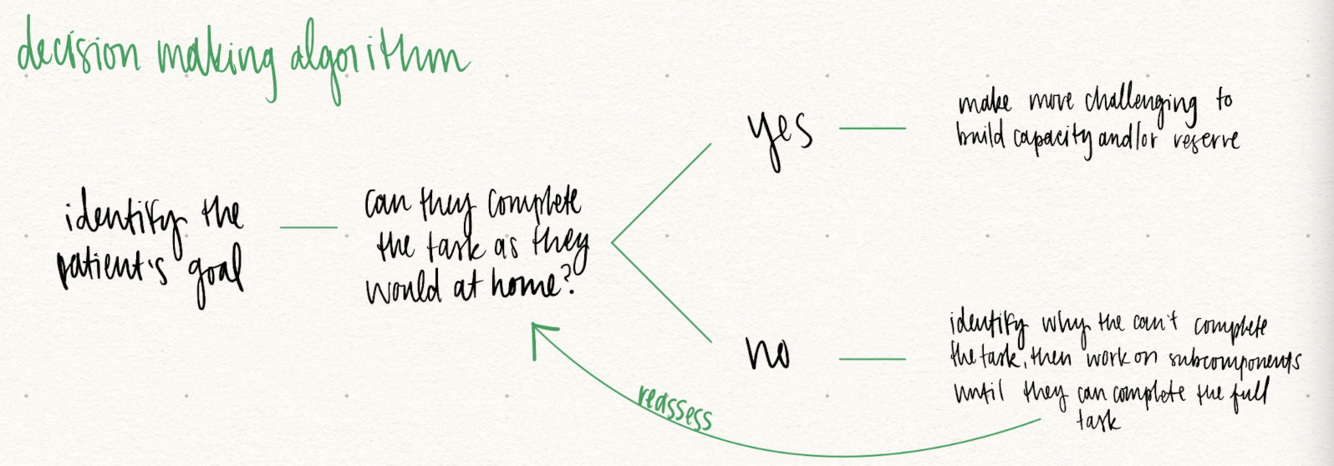
decision making algorithm
Borg
• original 6-20 • modified 1-10 • designed to monitor aerobic intensity • accurate in multiple populations
RPE
• can be less accurate when attempting to monitor intensity for strength training • can be more accurate for experienced lifters but varies widely among patients and novice lifters • can ask “how many more reps do you think you could have done”