Organic 8: Aldehydes and Ketones
No description yet. This curated deck is ready for daily study.
Card preview (20)
Why is the boiling point of an aldehyde/ketone higher than an alkane with comparable molecular mass?
Stronger intermolecular forces (permanent dipole-dipole) Takes more energy to break
Why are aldehydes and ketones so reactive?
Due to the presence of strongly polar C=O bond
Why is the boiling point of an aldehyde/ketone lower than an alcohol with comparable molecular mass?
Because alcohols have stronger intermolecular forces (hydrogen bonds) Takes more energy to break
Why are short-chain aldehydes/ketones soluble in water, but long-chains aren’t?
C=O bond is polar so can dissolve in water by forming hydrogen bonds In long chains, a larger portion of the molecule is non-polar, so cannot dissolve in water
Arrange the following compounds in order of melting point from highest to lowest: propanone, butane, propan-1-ol
Highest: Propan-1-ol Propanone Lowest: Butane
What state are short chain aldehydes/ketones at room temperature?
Liquids (Methanal is gas)
What state are long chain aldehydes/ketones at room temperature?
Solids
Why is the C=O bond strongly polar?
Large difference in electronegativity between carbon and oxygen
Describe the general mechanism for a nucleophilic addition reaction with an aldehyde or a ketone.
Reagent: Sodium or Potassium Cyanide followed by dilute hydrochloric acid 1) Nucleophile is added to the carbon on the C=O bond 2) Electrons in C=O bond move to O 3) Lone pair on O moves to H+ from dilute hydrochloric acid Forming hydroxynitrile
Why does nucleophilic addition lead to formation of a racemic mixture?
The cyanide ion can attack either side of the planar C=O bond So theoretically forms a 50/50 mixture of each enantiomer
How can aldehydes be oxidised to carboxylic acids?
Using acidified potassium dichromate (K2Cr2O7/H+)
Why can’t ketones be easily oxidised?
Because the C-C bond would have to be broken which would require more energy So only very strong oxidising agents can break the C-C bond and would form carbon dioxide and water
What are the two tests you would use to distinguish between aldehydes and ketones?
Tollen’s Fehling’s
Explain how the Tollen’s test works.
Tollen’s reagent contains the complex ion [Ag(NH3)2]+, which is formed when aqueous silver nitrate is reacted with aqueous ammonia When an aldehyde is warmed with Tollen’s reagent, Ag+ is reduced to metallic Ag(s) forming a silver mirror Ketones give no reaction as they don’t have a hydrogen atom attached to the carbonyl carbon
Explain how the Fehling’s test works.
Fehling’s reagent contains a solution containing Cu2+ ions (blue) When an aldehyde is warmed, it is oxidised by Fehling’s reagent, reducing the Cu2+ ions to Cu+ forming an insoluble red precipitate of copper(I) oxide Ketones give no reaction as they don’t have a hydrogen atom attached to the carbonyl carbon
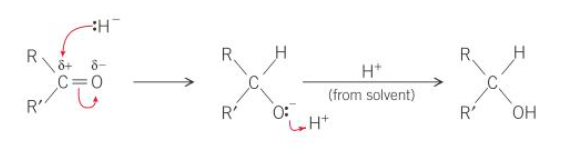
What reducing agent is used to reduce aldehydes and ketones?
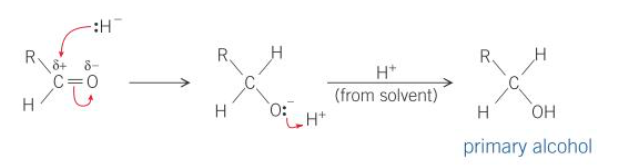
Aqueous NaBH4: sodium tetrahydridoborate (III) Generates the nucleophile :H- (hydride ion) It is attracted to the delta positive carbon on C=O bonds
What are aldehydes reduced to?
Primary alcohols
Give a general equation for the reduction of aldehydes using NaBH4.
RHCO + 2[H] –> RCH2OH Nucleophilic addition reaction
What are ketones reduced to?
Secondary alcohols
Give a general equation for the reduction of ketones using NaBH4.
RR’CO + 2[H] –> RR’CHOH Nucleophilic addition reaction